

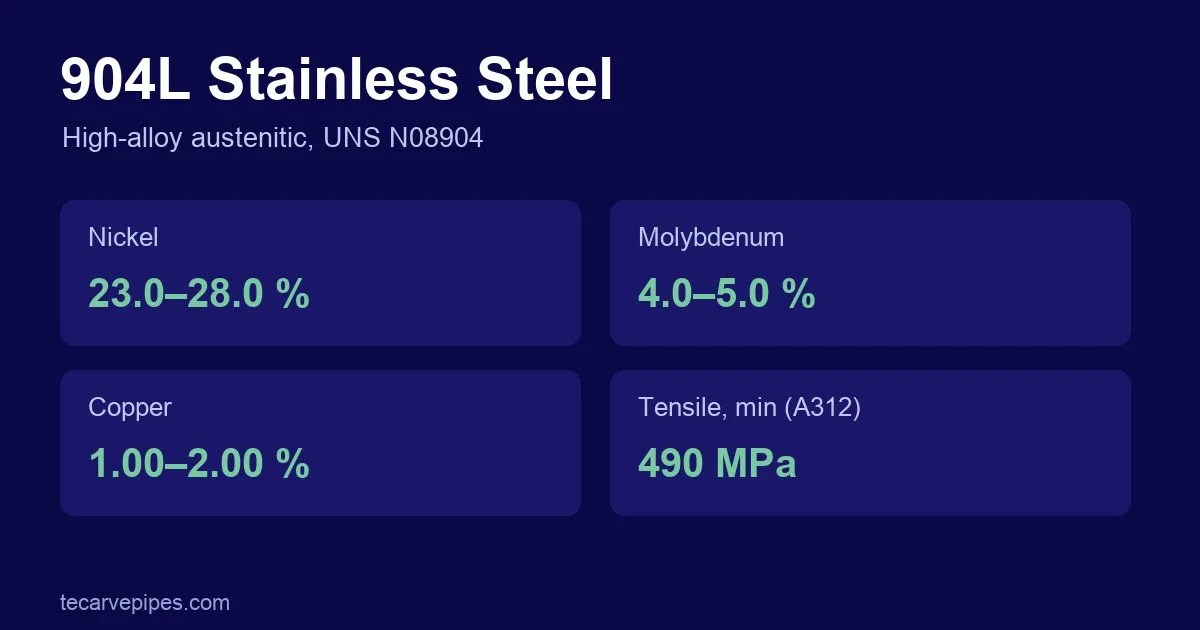

904L stainless steel (UNS N08904) is a high-alloy austenitic stainless steel with 23–28 % nickel, 4–5 % molybdenum and 1–2 % copper. The copper improves resistance to reducing acids such as sulfuric acid, and the high molybdenum raises resistance to chloride pitting well above 316L.
Chemical and tensile values below are from ASTM A312/A312M-24b Tables 1 and 4. ASTM A554-26 lists the same grade with phosphorus 0.045 % max and sulfur 0.035 % max.
904L chemical composition
| Element | 904L (N08904) | 316L (S31603) for comparison |
|---|---|---|
| Carbon, max | 0.020 | 0.030 |
| Manganese, max | 2.00 | 2.00 |
| Phosphorus, max | 0.040 | 0.045 |
| Sulfur, max | 0.030 | 0.030 |
| Silicon, max | 1.00 | 0.75 |
| Chromium | 19.0–23.0 | 16.0–18.0 |
| Nickel | 23.0–28.0 | 10.0–14.0 |
| Molybdenum | 4.0–5.0 | 2.00–3.00 |
| Nitrogen, max | 0.10 | 0.10 |
| Copper | 1.00–2.00 | — |
In A312 the grade is listed by UNS number N08904 without a “TP” grade name, so order it as “ASTM A312, UNS N08904 (904L)”.
Mechanical properties (A312)
| Grade | Tensile strength, min | Yield strength, min |
|---|---|---|
| N08904 (904L) | 71 ksi [490 MPa] | 31 ksi [215 MPa] |
| TP316L (S31603) | 70 ksi [485 MPa] | 25 ksi [170 MPa] |
Pitting resistance compared with 316L
The pitting resistance equivalent number, PREN = Cr + 3.3 Mo + 16 N, is a common way to rank grades for chloride pitting. Calculated from the minimum chromium and molybdenum above, 904L gives about 32 and 316L about 23. This is a ranking aid, not a design value; real performance depends on temperature, chloride level and surface condition.
Where 904L is used
- Sulfuric and phosphoric acid handling, where its copper and molybdenum help.
- Heat-exchanger and process tube in chloride-bearing cooling water where 316L pits.
- Chemical, pulp and pollution-control equipment.
Where even higher chloride resistance is needed, 6Mo grades such as N08926 or S31254, duplex 2507, or nickel alloys are the usual next step. See the duplex pipe guide and nickel alloy pipe and tube.
Which specifications cover 904L tube and pipe
N08904 is listed in ASTM A312 (pipe), A269 (general-service tubing), A249 (welded heat-exchanger tube) and A554 (welded mechanical tubing). Name the specification and UNS number on the order, and confirm the chemistry on the EN 10204 3.1 certificate.
TeCarve supplies 904L seamless and welded pipe and tube with heat chemistry confirmed against the ordered specification.
Between 316L and 904L sits 317L, with 3–4 % molybdenum.
Frequently asked questions
What is 904L stainless steel?
A high-alloy austenitic stainless steel, UNS N08904, with 19–23 % chromium, 23–28 % nickel, 4–5 % molybdenum and 1–2 % copper (ASTM A312).
Is 904L better than 316L?
For chloride pitting and sulfuric acid service, yes: it has about twice the molybdenum, much more nickel, and added copper. For mild service 316L is usually sufficient and costs less.
Is 904L magnetic?
No. 904L is fully austenitic and non-magnetic in the annealed condition.
Which ASTM specification covers 904L pipe?
ASTM A312 lists it as UNS N08904. It is also listed in A269, A249 and A554.