


A pressure relief valve opens automatically when the pressure in a vessel or line rises to its set pressure, discharges enough fluid to stop the pressure rising further, and closes again when the pressure falls. It is the last line of protection against overpressure in boilers, pressure vessels and process piping.
Ranges below describe the spring-loaded safety relief valves TeCarve supplies, sourced from a qualified specialist maker and inspected before export. Certificates are held by the valve maker.
Relief valve, safety valve and safety relief valve
The names are often used loosely. In common industry usage:
| Term | Typical meaning |
|---|---|
| Relief valve | Opens gradually in proportion to the overpressure; mainly for liquids |
| Safety valve | Opens rapidly with a “pop” action; mainly for steam, gas and vapour |
| Safety relief valve | Designed to work in either way, depending on the fluid |
| Pressure relief valve | The general term covering all of the above |
Main types
- Conventional spring-loaded: a spring holds the disc on the nozzle; set pressure is adjusted by spring compression. Back pressure on the outlet affects its behaviour.
- Balanced bellows: a bellows isolates the spring and the top of the disc from the outlet, reducing the effect of variable back pressure and protecting the spring from the process fluid.
- Pilot-operated: a small pilot valve controls the main valve, allowing operation closer to set pressure; often used for gas service.
API 526 flanged steel safety relief valves
API 526 standardises the inlet and outlet sizes, pressure classes, centre-to-face dimensions and orifice letter designations of flanged steel pressure relief valves, so valves can be specified and exchanged by orifice letter and size. The valves TeCarve supplies are built to API 526 dimensions:
| Item | Range |
|---|---|
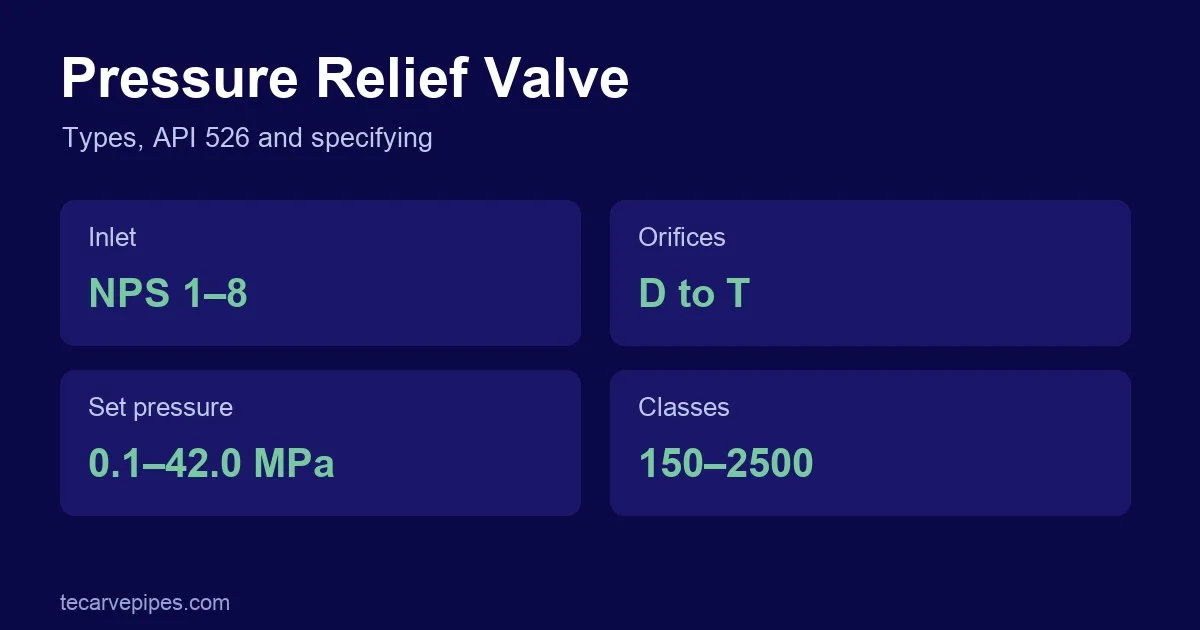
| Inlet / outlet | Inlet NPS 1–8 (DN 25–200), outlet NPS 2–10 |
| Orifices | D through T |
| Pressure class | Class 150–2500, flanged RF or RTJ |
| Set pressure | 0.1–42.0 MPa |
| Design | Spring-loaded closed bonnet, conventional or balanced bellows (Alloy 625 or 316L bellows) |
| Materials | Bodies WCB, CF8M, CF3M or CD3MN; Stellite-faced 316/316L nozzles and discs |
| Type-tested ranges | Spring valves for gas and liquid up to 42 MPa at DN 80 and 5 MPa at DN 300, −46 to 300 °C; cryogenic −196 to 80 °C; steam up to 540 °C; pilot-operated gas valves −29 to 200 °C up to DN 400 at 4 MPa |
| Maker certification | ASME UV Certificate of Authorization and National Board NB-501 (to August 2029); PED 2014/68/EU Module D for its listed spring safety valve type; CNAS ISO/IEC 17025 laboratory |
What to state on a relief valve enquiry
- Fluid and state (gas, steam, liquid, two-phase), and its temperature.
- Set pressure, allowable overpressure and the required relieving capacity or orifice letter.
- Back pressure at the outlet, constant or variable, which decides conventional vs balanced bellows.
- Inlet and outlet size, pressure class and facing (RF or RTJ).
- Body and trim materials; CF8M or CF3M for corrosive or hygienic service, CD3MN duplex for chlorides.
- Code stamp or certificate required (for example ASME UV and NB capacity certification, or PED).
Sizing and set pressure must follow the code that governs the protected equipment and should be checked by the responsible engineer. See the valves, pumps and instrumentation page for the full valve range.
Frequently asked questions
What is the difference between a safety valve and a relief valve?
In common usage, a safety valve opens rapidly (pops) and is used for steam and gas, while a relief valve opens gradually and is used for liquids. A safety relief valve can do either.
What is API 526?
The API standard for flanged steel pressure relief valves. It fixes inlet and outlet sizes, pressure classes, centre-to-face dimensions and orifice letter designations.
When is a balanced bellows relief valve used?
When back pressure at the outlet is variable or high enough to affect a conventional valve, or when the spring must be protected from the process fluid.
What set pressures can be supplied?
The spring-loaded safety relief valves TeCarve supplies cover set pressures of 0.1–42.0 MPa in Class 150–2500.