

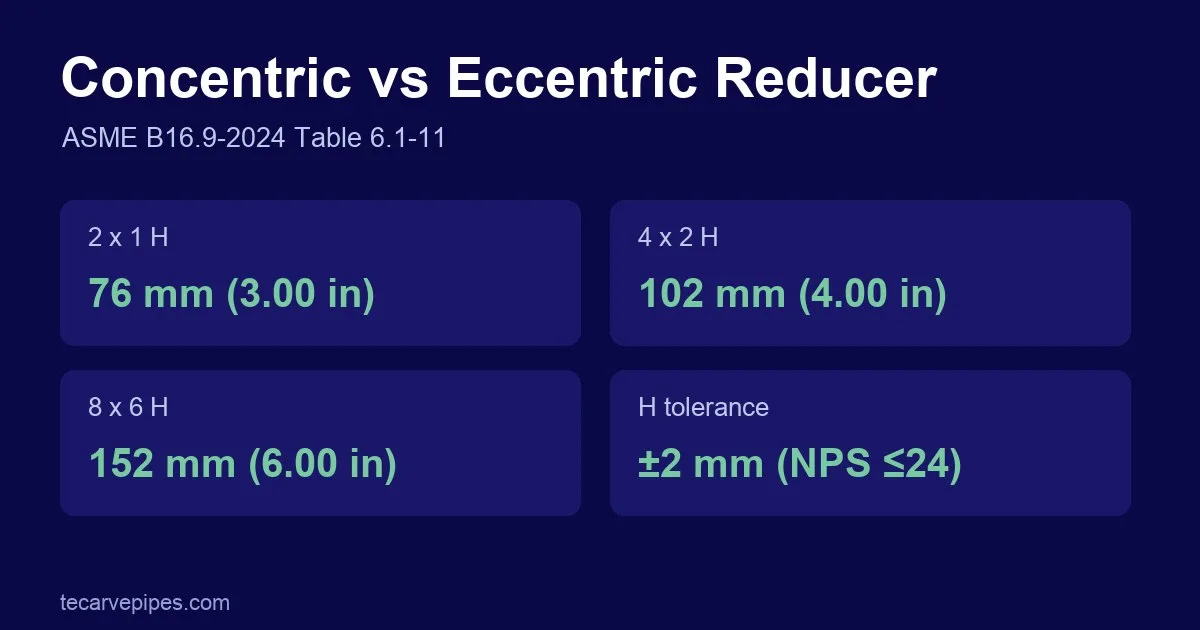

A concentric reducer joins two pipe sizes on a common centreline, like a cone. An eccentric reducer has one side flat, so the centrelines are offset and the flat side stays level. For butt-welding fittings both types are covered by ASME B16.9, which gives them the same end-to-end length H.
Dimensions and tolerances are from ASME B16.9-2024 Table 6.1-11 (Dimensions of Reducers) and Table 11.2-1 (Tolerances). Material requirements for stainless fittings are in ASTM A403.
Concentric vs eccentric reducer
| Concentric reducer | Eccentric reducer | |
|---|---|---|
| Shape | Symmetrical cone; both ends on one centreline | One side flat; centrelines offset |
| Typical use | Vertical lines, and horizontal lines where trapped air or liquid is not a concern | Horizontal lines where a flat top or flat bottom matters |
| Common practice | Pump discharge and general size changes | Pump suction installed flat side up, so air cannot collect at the top; pipe racks installed flat side down to keep a common bottom-of-pipe elevation |
| B16.9 length H | Table 6.1-11 | Same H as concentric (same table) |
B16.9 notes that although its figure shows a bell-shaped reducer, a conical reducer is not prohibited.
Reducer dimensions: ASME B16.9 Table 6.1-11
In B16.9 the end-to-end length H depends only on the large end, so it is listed here once per large-end size together with the small-end sizes the table covers. The small-end outside diameter is the standard OD of that pipe size.
| Large end NPS | Large-end OD at bevel, mm (in.) | End-to-end H, mm (in.) | Small-end NPS listed |
|---|---|---|---|
| 3/4 | 26.7 (1.05) | 38 (1.50) | 1/2, 3/8 |
| 1 | 33.4 (1.32) | 51 (2.00) | 3/4, 1/2 |
| 1 1/4 | 42.2 (1.66) | 51 (2.00) | 1, 3/4, 1/2 |
| 1 1/2 | 48.3 (1.90) | 64 (2.50) | 1 1/4, 1, 3/4, 1/2 |
| 2 | 60.3 (2.38) | 76 (3.00) | 1 1/2, 1 1/4, 1, 3/4 |
| 2 1/2 | 73.0 (2.88) | 89 (3.50) | 2, 1 1/2, 1 1/4, 1 |
| 3 | 88.9 (3.50) | 89 (3.50) | 2 1/2, 2, 1 1/2, 1 1/4 |
| 3 1/2 | 101.6 (4.00) | 102 (4.00) | 3, 2 1/2, 2, 1 1/2, 1 1/4 |
| 4 | 114.3 (4.50) | 102 (4.00) | 3 1/2, 3, 2 1/2, 2, 1 1/2 |
| 5 | 141.3 (5.56) | 127 (5.00) | 4, 3 1/2, 3, 2 1/2, 2 |
| 6 | 168.3 (6.62) | 140 (5.50) | 5, 4, 3 1/2, 3, 2 1/2 |
| 8 | 219.1 (8.62) | 152 (6.00) | 6, 5, 4, 3 1/2 |
| 10 | 273.0 (10.75) | 178 (7.00) | 8, 6, 5, 4 |
| 12 | 323.8 (12.75) | 203 (8.00) | 10, 8, 6, 5 |
| 14 | 355.6 (14.00) | 330 (13.00) | 12, 10, 8, 6 |
| 16 | 406.4 (16.00) | 356 (14.00) | 14, 12, 10, 8 |
| 18 | 457 (18.00) | 381 (15.00) | 16, 14, 12, 10 |
| 20 | 508 (20.00) | 508 (20.00) | 18, 16, 14, 12 |
| 22 | 559 (22.00) | 508 (20.00) | 20, 18, 16, 14 |
| 24 | 610 (24.00) | 508 (20.00) | 22, 20, 18, 16 |
| 26 | 660 (26.00) | 610 (24.00) | 24, 22, 20, 18 |
| 28 | 711 (28.00) | 610 (24.00) | 26, 24, 20, 18 |
| 30 | 762 (30.00) | 610 (24.00) | 28, 26, 24, 20 |
| 32 | 813 (32.00) | 610 (24.00) | 30, 28, 26, 24 |
| 34 | 864 (34.00) | 610 (24.00) | 32, 30, 26, 24 |
| 36 | 914 (36.00) | 610 (24.00) | 34, 32, 30, 26, 24 |
| 38 | 965 (38.00) | 610 (24.00) | 36, 34, 32, 30, 28, 26 |
| 40 | 1 016 (40.00) | 610 (24.00) | 38, 36, 34, 32, 30 |
| 42 | 1 067 (42.00) | 610 (24.00) | 40, 38, 36, 34, 32, 30 |
| 44 | 1 118 (44.00) | 610 (24.00) | 42, 40, 38, 36 |
| 46 | 1 168 (46.00) | 711 (28.00) | 44, 42, 40, 38 |
| 48 | 1 219 (48.00) | 711 (28.00) | 46, 44, 42, 40 |
Tolerances (B16.9 Table 11.2-1)
| NPS | OD at bevel, mm | End-to-end H, mm |
|---|---|---|
| 1/2 to 2 1/2 | +1.6 / −0.8 | ±2 |
| 3 to 4 | ±1.6 | ±2 |
| 5 to 8 | +2.4 / −1.6 | ±2 |
| 10 to 18 | +4.0 / −3.2 | ±2 |
| 20 to 24 | +6.4 / −4.8 | ±2 |
| 26 to 48 | +6.4 / −4.8 | ±5 |
How to order a stainless steel reducer
- Type: concentric or eccentric.
- Size: large end × small end in NPS, for example 4 × 2.
- Wall: schedule of each end (for example 40S × 40S, or 10S × 40S if the ends differ).
- Material: ASTM A403 grade and class, for example WP316L-S (seamless) or WP304-W (welded).
- Dimensional standard: ASME B16.9; MSS SP-43 for light-wall 5S/10S fittings if that is what the line uses.
- Certificate: EN 10204 3.1 with heat number traceable to the marking.
See the stainless steel pipe fittings and flanges page for the fittings TeCarve supplies, sourced from qualified specialist makers and inspected before export, and the pipe schedule chart for pipe ODs and walls.
Frequently asked questions
What is the difference between a concentric and an eccentric reducer?
A concentric reducer keeps both ends on one centreline; an eccentric reducer has one flat side so the centrelines are offset. ASME B16.9 gives both the same end-to-end length.
Why is an eccentric reducer used on pump suction?
Installed flat side up, it avoids a high point where air can collect at the pump inlet. This is common piping practice.
What is the length of a 4 x 2 reducer?
ASME B16.9-2024 Table 6.1-11 gives an end-to-end length H of 102 mm (4.00 in.) for 4-inch large-end reducers, including 4 x 2.
What is the tolerance on reducer length in ASME B16.9?
±2 mm for NPS 1/2 to 24 and ±5 mm for NPS 26 to 48 (Table 11.2-1).