

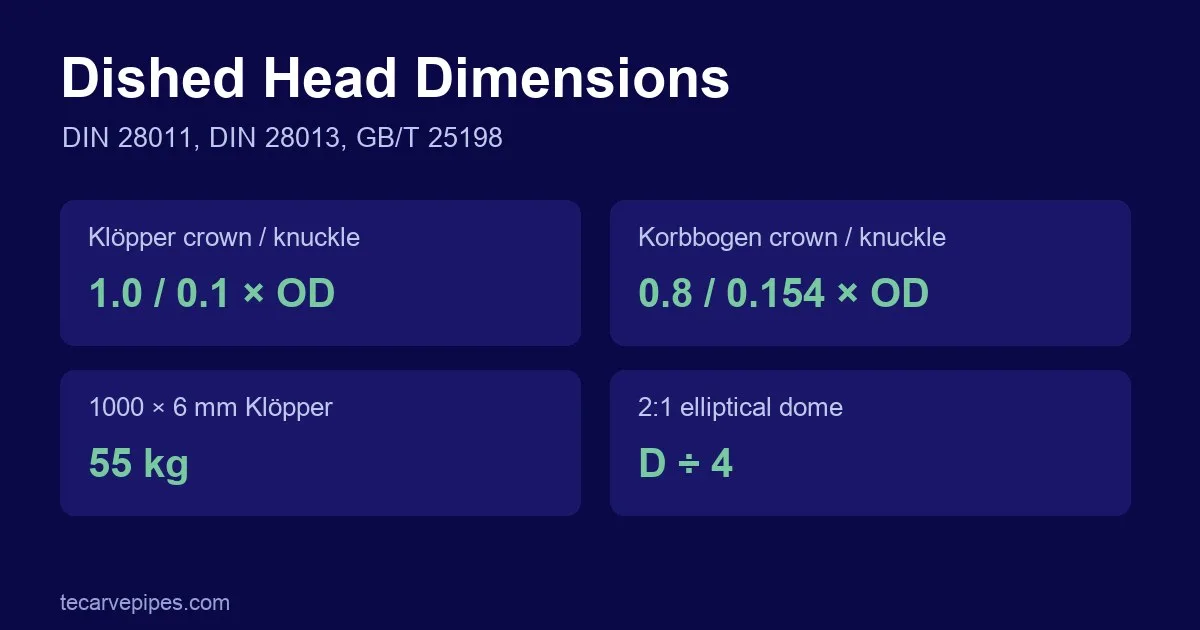

A dished head closes the end of a pressure vessel or tank. Torispherical (Klöpper) heads have a crown radius equal to the outside diameter and a knuckle radius of 0.1 × OD, while 2:1 ellipsoidal heads have a dome depth of a quarter of the diameter. The shape sets the depth, volume and weight, so state the standard and shape when you order.
Dimensions and tolerances are from DIN 28011:2012-06, DIN 28013:2012-06 and GB/T 25198-2023. These standards cover shape and dimensions. DIN 28011 points to AD 2000 or DIN EN 13445-3 for calculating the required wall, so check the wall with your vessel design code.
Dished head types compared
| Head shape | Geometry | Standard and code | Dome depth at 1000 mm OD × 6 mm |
|---|---|---|---|
| Torispherical (Klöpper) | Crown radius = OD, knuckle radius = 0.1 × OD | DIN 28011; GB/T 25198 THA, THB | 190.8 mm |
| Korbbogen | Crown radius = 0.8 × OD, knuckle radius = 0.154 × OD | DIN 28013 | 251.2 mm |
| Ellipsoidal 2:1 | Diameter ÷ (2 × dome depth) = 2, so the inside dome depth is a quarter of the inside diameter | GB/T 25198 EHA, EHB | About 247 mm inside (988 ÷ 4) |
| Hemispherical | Diameter = 2 × radius | GB/T 25198 HHA | About 494 mm inside (988 ÷ 2) |
| Spherical cap | Radius = 1.0 × inside diameter, no knuckle or straight flange | GB/T 25198 SDH | Not calculated here |
| Flat | Flat center with a knuckle: H = r + h | GB/T 25198 FHA | Set by knuckle radius and flange |
| Conical | Cone, with or without knuckles | GB/T 25198 CNA, CSA, CDA | Set by cone angle |
DIN 28013 defines its head by a crown radius and a knuckle radius, not by an ellipse. Check which one your drawing means, because a Korbbogen head and a 2:1 ellipsoidal head of the same diameter are not the same shape.
Torispherical head dimensions (DIN 28011)
Selected rows from Table 2. The standard runs from 168.3 mm to 8000 mm OD and from 3 mm wall upward. Weights are the table values, calculated by the standard at a density of 7.85 kg/dm³, and may differ in production.
| OD da, mm | Crown radius Sr1, mm | Knuckle radius r2, mm | Weight at 3 mm wall, kg | 6 mm wall, kg | 10 mm wall, kg |
|---|---|---|---|---|---|
| 168.3 | 168.3 | 17 | 1 | 2.1 | 4 |
| 219.1 | 219.1 | 22 | 1.6 | 3.4 | 6.2 |
| 273 | 273 | 28 | 2.4 | 4.9 | 9 |
| 323.9 | 323.9 | 32 | 3.2 | 6.7 | 12 |
| 406.4 | 406.4 | 41 | 4.9 | 10.1 | 18 |
| 508 | 508 | 51 | 7.4 | 15.3 | 26.9 |
| 600 | 600 | 60 | 10.2 | 20.9 | 36.4 |
| 800 | 800 | 80 | 17.7 | 36.1 | 62 |
| 1000 | 1000 | 100 | 27.3 | 55 | 95 |
| 1200 | 1200 | 120 | 38.9 | 79 | 134 |
| 1500 | 1500 | 150 | 60 | 121 | 206 |
| 1900 | 1900 | 190 | 96 | 193 | 326 |
Korbbogen head dimensions (DIN 28013)
Selected rows from Table 2, on the same basis. For the same OD and wall, the Korbbogen head is deeper and heavier than the Klöpper head.
| OD da, mm | Crown radius Sr1, mm | Knuckle radius r2, mm | Weight at 3 mm wall, kg | 6 mm wall, kg | 10 mm wall, kg |
|---|---|---|---|---|---|
| 168.3 | 135 | 26 | 1.1 | 2.1 | 4 |
| 219.1 | 175 | 34 | 1.7 | 3.4 | 6.3 |
| 273 | 218 | 42 | 2.5 | 5.1 | 9.2 |
| 323.9 | 254 | 50 | 3.5 | 6.9 | 12.5 |
| 406.4 | 325 | 62 | 5.3 | 10.6 | 18.8 |
| 508 | 406 | 78 | 8.1 | 16.1 | 28.3 |
| 600 | 480 | 92 | 11.1 | 22.2 | 38.6 |
| 800 | 640 | 125 | 19.3 | 38.6 | 66 |
| 1000 | 800 | 155 | 29.7 | 59 | 102 |
| 1200 | 960 | 185 | 42.4 | 85 | 145 |
| 1500 | 1200 | 230 | 66 | 131 | 223 |
| 1900 | 1520 | 290 | 104 | 209 | 353 |
Straight flange height
The straight flange, h1, is the cylinder between the knuckle and the weld. Other heights can be agreed.
| Wall s, mm | DIN 28011 minimum h1, mm | DIN 28013 minimum h1, mm |
|---|---|---|
| Up to 43 | 3.5 × s | 3 × s |
| Over 43 to 50 | 150 | 3 × s |
| Over 50 to 80 | 120 | 120 |
| Over 80 to 100 | 100 | 100 |
| Over 100 to 120 | 75 | 75 |
| Over 120 | 50 | 50 |
Dished head depth, volume and weight formulas
da is the outside diameter and s the wall, both in mm. Volume and area exclude the straight flange.
| Value | DIN 28011 (Klöpper) | DIN 28013 (Korbbogen) |
|---|---|---|
| Calculated dome depth h2, mm | 0.1935 da − 0.455 s | 0.255 da − 0.635 s |
| Volume V, mm³ | ≈ 0.1 (da − 2s)³ | ≈ 0.1298 (da − 2s)³ |
| Outside area, mm² | ≈ 0.99 da² | ≈ 1.08 da² |
| Blank diameter DR, mm | ≈ 1.128 √(0.99 da² + da π h1) | ≈ 1.128 √(1.085 da² + da π h1) |
| Weight G, kg | ≈ (DR²/4) π s × 1.1 × density / 1,000,000 | Same formula |
Worked example for a 1000 mm OD × 6 mm head: the Klöpper dome holds about 96 L and the Korbbogen dome about 125 L. Density is in kg/dm³, and the standard’s tables use 7.85, so use your alloy’s density for a stainless estimate.
Dished head tolerances
DIN 28011 and DIN 28013: circumference for stainless steel (Table 3)
| OD, mm | Circumference tolerance |
|---|---|
| Up to 300 | ±0.4 %, at least ±3 mm |
| Over 300 to 1000 | ±0.4 % |
| Over 1000 to 4500 | +0.5 % / −0.7 % |
| Over 4500 to 8000 | ±0.3 %, at most ±60 mm |
Out-of-roundness is at most 1 % up to 4500 mm OD, with a maximum diameter difference of 30 mm, and at most 0.8 % above that. Other limits are agreed for other materials, clad steel, or heads used in pairs or as inner and outer jacket heads.
GB/T 25198-2023: diameter (Table 5)
| Diameter D, mm | Material thickness, mm | Outside circumference, mm | Inside diameter, mm |
|---|---|---|---|
| 150 to <300 | 3 to <8 | ±4 | ±1.5 |
| 150 to <300 | 8 to <12 | ±5 | ±2 |
| 150 to <300 | 12 to <16 | ±8 | ±3 |
| 300 to <600 | 2 to <4 | ±4 | ±1.5 |
| 300 to <600 | 4 to <6 | ±5 | ±2 |
| 300 to <600 | 6 to 22 | ±9 | ±3 |
| 600 to <1000 | 4 to <10 | ±6 | ±2 |
| 600 to <1000 | 10 to <22 | ±9 | ±3 |
| 600 to <1000 | 22 to 40 | −12 / +18 | −4 / +6 |
| 1000 to <1600 | 6 to <10 | ±9 | ±3 |
| 1000 to <1600 | 10 to <22 | −9 / +12 | −3 / +4 |
| 1000 to <1600 | 22 to <40 | −12 / +18 | −4 / +6 |
| 1000 to <1600 | 40 to 60 | −15 / +18 | −5 / +6 |
The table continues to larger diameters, and the order states whether the head fits the shell by outside circumference or inside diameter. Clad heads use the inside basis: ±4.5 mm on inside circumference or ±1.5 mm on inside diameter, unless agreed otherwise.
Stainless steel tank heads
A tank head is another name for a dished head or dished end, used mostly for storage, food and water tanks. For a stainless steel tank head, give the shape, outside diameter, wall, grade, straight flange height and the surface finish required inside and outside. TeCarve’s thin-wall range of 1.5–5.0 mm is cold-spun or cold-pressed and suits atmospheric tanks, water tanks and food vessels.
What to specify when ordering a head
- Shape and standard: for example torispherical to DIN 28011, or EHA to GB/T 25198.
- Diameter basis: outside or inside diameter, because the codes differ. DIN 28011 and 28013 use outside diameter.
- Wall: nominal or minimum after forming, and state it on the order. DIN 28011 Table 4 sets how far the wall may fall below the ordered thickness when only the wall is given.
- Straight flange, material and end preparation: height, grade, and any weld bevel.
- Documents: certificate type, seam examination and thickness checks.
TeCarve inspects and exports dished heads from DN 50 to DN 4500 with walls of 1.5–60 mm, starting at one piece. The Foshan Plant covers cold-spun and cold-pressed heads with walls of 1.5–5.0 mm, for atmospheric tanks, water tanks, food and decorative vessels. The Wenzhou Plant covers hydraulic-pressed and hot-pressed heads with walls of 6.0–60 mm, for pressure vessels, reactors and petrochemical heat exchangers. More charts are in our technical resources, including the stainless steel tube size chart.
Frequently asked questions
What is a dished head?
A dished head is a formed end cap that closes a pressure vessel or tank. It has a curved dome and usually a short straight flange that is welded to the shell. Common shapes are torispherical, ellipsoidal and hemispherical.
What is a stainless steel tank head?
It is a dished head that closes the end of a tank, usually welded to the shell at a short straight flange. Common shapes are torispherical and 2:1 elliptical.
What is the difference between a torispherical and an elliptical head?
A torispherical head is made from two radii. Under DIN 28011 the crown radius equals the outside diameter and the knuckle radius is 0.1 × OD. A 2:1 ellipsoidal head under GB/T 25198 has a dome depth of a quarter of the diameter, so it is deeper: a 1000 mm × 6 mm Klöpper head has a calculated depth of 190.8 mm.
What does 2:1 mean on an elliptical head?
It is the ratio of diameter to twice the dome depth. In GB/T 25198 type EHA, inside diameter ÷ [2 × (H − h)] = 2, where H is the total height and h the straight flange. A 1000 mm inside diameter therefore has a 250 mm dome.
Is DIN 28013 an elliptical head?
It is a Korbbogen head, defined by a crown radius of 0.8 × OD and a knuckle radius of 0.154 × OD rather than by an ellipse. So confirm the shape on your drawing if you need a true 2:1 ellipsoidal head.
How much does a dished head weigh?
DIN 28011 Table 2 lists a 1000 mm × 6 mm Klöpper head at 55 kg, and DIN 28013 lists the same size of Korbbogen head at 59 kg. Both are calculated at a density of 7.85 kg/dm³ and can differ in production.
What is the tolerance on a stainless dished head?
Under DIN 28011 and DIN 28013, the circumference tolerance for stainless steel is ±0.4 % up to 1000 mm OD, with at least ±3 mm up to 300 mm, and +0.5 % / −0.7 % over 1000 mm to 4500 mm. Out-of-roundness is at most 1 % up to 4500 mm.