

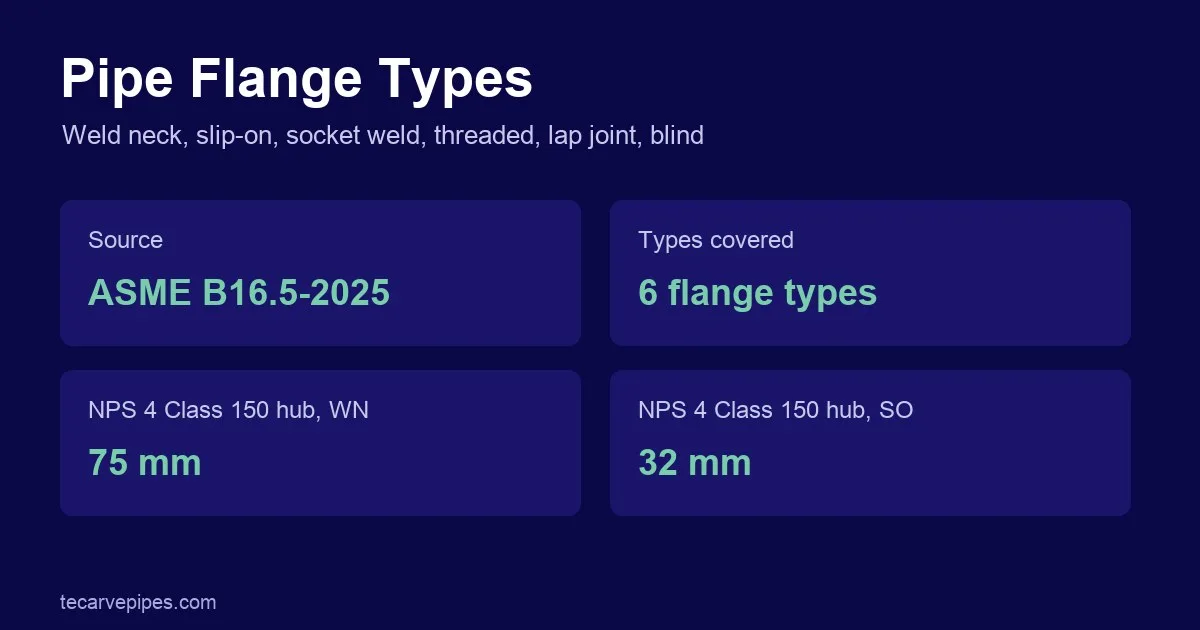

ASME B16.5 pipe flanges come in six types: weld neck, slip-on, socket weld, threaded, lap joint and blind. They share the same outside diameter and bolt pattern for a given size and class, so they bolt to each other. What changes is how each one attaches to the pipe, which sets its hub length, bore and best use.
Dimensions are from ASME B16.5-2025 Table 8, Class 150 flanges in SI units, and its notes. Other pressure classes have their own tables in the standard.
The six flange types at a glance
| Type | How it attaches | Bore | Typical use |
|---|---|---|---|
| Weld neck (WN) | Butt weld to the pipe at the end of a long tapered hub | Matches the pipe ID | High pressure, high or cycling temperature, lines that are radiographed |
| Slip-on (SO) | Slides over the pipe; fillet weld inside and outside | Slightly larger than the pipe OD | Lower pressure, easier fit-up and alignment |
| Socket weld (SW) | Pipe sits in a socket; single fillet weld outside | Socket plus a bore equal to the pipe ID | Small-bore lines; NPS ½ to 3 in Class 150 |
| Threaded | Screwed onto a threaded pipe; no welding | Threaded | Where welding is not allowed or not practical |
| Lap joint (LJ) | Loose flange over a stub end that is welded to the pipe | Slightly larger than the stub end | Lines that need frequent dismantling or bolt-hole alignment |
| Blind | Closes the end of a pipe, valve or vessel nozzle | None | End closures and test points |
The flange outside diameter O and thickness tf are the same for the weld neck, slip-on, socket weld, threaded and blind types of one size. In Class 150 the lap joint flange is slightly thicker. The table below shows where the types differ.
Class 150 flange dimensions by type
ASME B16.5-2025 Table 8, in millimetres. Y is the length through the hub. A dash in the socket depth column means socket weld flanges are not listed for that size.
| NPS | Flange OD O | Min. thickness tf | Lap joint min. thickness | Y, threaded / slip-on / socket weld | Y, lapped | Y, weld neck | Socket depth D |
|---|---|---|---|---|---|---|---|
| ½ | 89 | 9.7 | 11.2 | 14 | 16 | 46 | 10 |
| ¾ | 99 | 11.2 | 12.7 | 14 | 16 | 51 | 11 |
| 1 | 108 | 12.7 | 14.2 | 16 | 18 | 54 | 13 |
| 1¼ | 117 | 14.2 | 15.7 | 19 | 21 | 56 | 14 |
| 1½ | 127 | 15.9 | 17.5 | 21 | 22 | 60 | 16 |
| 2 | 152 | 17.5 | 19.0 | 24 | 25 | 62 | 18 |
| 2½ | 178 | 20.6 | 22.4 | 27 | 28 | 68 | 19 |
| 3 | 190 | 22.4 | 23.9 | 28 | 30 | 68 | 21 |
| 3½ | 216 | 22.4 | 23.9 | 30 | 32 | 70 | – |
| 4 | 229 | 22.4 | 23.9 | 32 | 33 | 75 | – |
| 5 | 254 | 22.4 | 23.9 | 35 | 37 | 87 | – |
| 6 | 279 | 23.9 | 25.4 | 38 | 40 | 87 | – |
| 8 | 343 | 26.9 | 28.4 | 43 | 44 | 100 | – |
| 10 | 406 | 28.4 | 30.2 | 48 | 49 | 100 | – |
| 12 | 483 | 30.2 | 31.8 | 54 | 56 | 113 | – |
| 14 | 533 | 33.3 | 35.1 | 56 | 79 | 125 | – |
| 16 | 597 | 35.1 | 36.6 | 62 | 87 | 125 | – |
| 18 | 635 | 38.1 | 39.6 | 67 | 97 | 138 | – |
| 20 | 698 | 41.1 | 42.9 | 71 | 103 | 143 | – |
| 22 | 749 | 44.4 | 46.0 | 78 | 108 | 148 | – |
| 24 | 813 | 46.0 | 47.8 | 81 | 111 | 151 | – |
Notes from the standard: the minimum thickness of these loose flanges in NPS 3½ and smaller is slightly greater than that of flanges on fittings, which are cast integral with the fitting body. The minimum hub height of a weld neck flange is 2(Y − tf)/3. Bolt holes and bolting are in Table 7.
Bore by flange type
The bore is the main fit difference between types. Slip-on and lap joint bores clear the pipe outside diameter, while the weld neck bore follows the pipe inside diameter. Selected Class 150 sizes from Table 8, in millimetres:
| NPS | Slip-on / socket weld bore B2, min. | Lapped bore B1, min. | Weld neck bore B | Threaded, min. thread length T |
|---|---|---|---|---|
| 2 | 61.9 | 62.5 | 52.6 | 25 |
| 4 | 116.1 | 116.8 | 102.4 | 33 |
| 6 | 170.7 | 171.4 | 154.2 | 40 |
| 8 | 221.5 | 222.2 | 202.7 | 44 |
| 10 | 276.4 | 277.4 | 254.5 | 49 |
| 12 | 327.2 | 328.2 | 304.8 | 56 |
The weld neck bores in Table 8 correspond to standard wall pipe from ASME B36.10M, which is the same as Schedule 40 in NPS 10 and smaller. They are furnished unless the purchaser specifies another bore, which should match the actual pipe schedule. For NPS 14 and larger the weld neck bore is specified by the purchaser.
Weld neck vs slip-on flange
These are the two most common choices. A weld neck flange needs one full-penetration butt weld, and its tapered hub carries load from the pipe into the flange. A slip-on needs two fillet welds and less precise cutting, and it costs less to buy, but it is shorter: an NPS 4 Class 150 slip-on is 32 mm through the hub against 75 mm for a weld neck. Specify weld neck where the line sees high pressure, thermal cycling or bending, or where the welds must be radiographed.
Socket weld and threaded flanges
Socket weld flanges suit small-bore lines. The pipe is pushed into the socket, which has depth D, and welded with one fillet weld. Threaded flanges need no welding and are used where hot work is restricted; the thread is defined in para. 6.9 of the standard. Both types are mostly used in small sizes.
Lap joint flanges and stub ends
A lap joint flange is not welded. It rides loose over a lap joint stub end that is butt welded to the pipe, and the gasket seals on the face of the stub end. Because the flange can turn, bolt holes are easy to line up. The flange does not touch the process fluid, so a stainless steel stub end is often paired with a carbon steel flange. Stub end dimensions are in ASME B16.9.
Blind flanges
A blind flange has no bore. It closes a pipe end or a nozzle and is often used where a line will be extended or opened for inspection. The standard allows blind flanges with or without a hub at the manufacturer’s option.
Facings
The Class 150 dimensions in Table 8 are for the regularly furnished 1.5 mm raised face, except lapped flanges. Class 150 flanges may also be supplied flat face. Other facings are shown in Figure 6 of the standard. Match the facing on both flanges of a joint and choose the gasket to suit it.
What to specify when ordering a flange
- Type and size: for example weld neck, NPS 4.
- Class: 150, 300, 600, 900, 1500 or 2500.
- Facing: raised face, flat face or another facing.
- Bore or schedule: for weld neck and socket weld flanges, so the bore matches the pipe.
- Standard and material: for example ASME B16.5 in ASTM A182 F316L, or EN 1092-1.
TeCarve supplies stainless steel flanges to ASME B16.5, B16.47 and EN 1092-1. They are sourced from qualified specialist makers, inspected and exported by TeCarve. For Class 150 weld neck drilling and dimensions, see weld neck flange dimensions; for fittings, see pipe elbow dimensions and concentric vs eccentric reducers. More references are in our technical resources.
Frequently asked questions
What are the main types of pipe flanges?
ASME B16.5 covers six flange types: weld neck, slip-on, socket weld, threaded, lap joint and blind. They differ in how they attach to the pipe and in hub length. Blind flanges close the end of a line.
What is the difference between a weld neck and a slip-on flange?
A weld neck flange has a long tapered hub that is butt welded to the pipe, and its bore matches the pipe inside diameter. A slip-on flange slides over the pipe and is fillet welded inside and outside. In ASME B16.5-2025 Table 8, an NPS 4 Class 150 weld neck flange is 75 mm through the hub, against 32 mm for a slip-on.
Which flange types does ASME B16.5 limit by size?
In Table 8 for Class 150, socket weld flanges are shown for NPS ½ to 3 only. B16.5 as a whole covers NPS ½ to 24; larger flanges, NPS 26 to 60, are in ASME B16.47.
What is a lap joint flange used with?
A lap joint flange is a loose flange used with a lap joint stub end that is welded to the pipe. The flange can rotate to line up the bolt holes, and it does not touch the process fluid, so it can be a different material from the stub end.
What is the standard flange facing?
ASME B16.5-2025 Table 8 shows Class 150 flanges with a regularly furnished 1.5 mm raised face, except lapped flanges. Other facings are shown in Figure 6 of the standard.
Is a blind flange made with a hub?
ASME B16.5-2025 Table 8 general note (g) says blind flanges may be made with or without hubs at the manufacturer's option.