

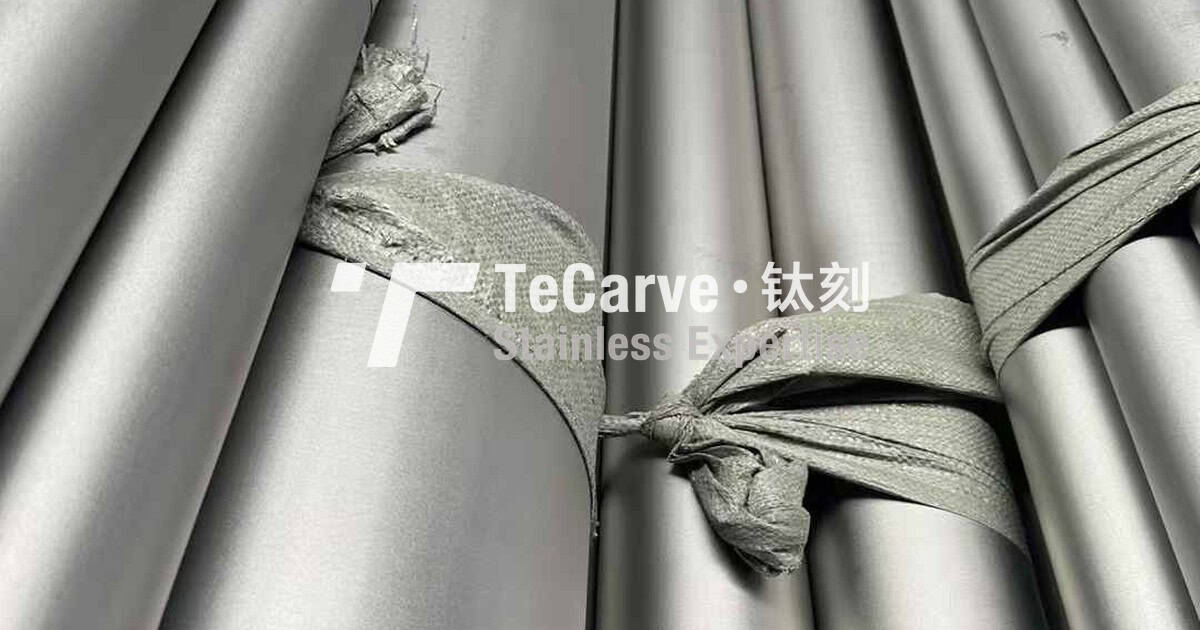

Seamless stainless steel pipe is a tubular product made by piercing a solid billet and cold finishing it, so it contains no longitudinal weld seam. According to ASTM A312, seamless pipe must meet specified chemical composition and tensile requirements before delivery. TeCarve, a manufacturing-backed supplier based in Foshan and Wenzhou, supplies seamless pipe in OD 6mm–610mm and wall thickness 0.5mm–50mm. This guide compares seamless pipe with welded pipe, explains grade selection, and lists applicable standards that govern quality and traceability.
What Is Seamless Pipe?
Seamless pipe is a hollow cross-section formed from a single billet, without any weld bead over its length. The manufacturing route uses rotary piercing and then cold drawing or cold rolling to reach the final diameter and wall. ASTM A312 covers this product for high-temperature and corrosive service. Because the material is homogeneous, grain structure remains continuous around the circumference. That continuity gives seamless pipe a defined mechanical advantage when the line will see cyclic pressure, steam, or corrosive media.
How Is Seamless Pipe Manufactured?
During the production cycle, a solid round billet is heated to roughly 1,100–1,200°C and then rotary pierced to create a hollow shell. After piercing, the shell is elongated on a mandrel mill and reduced to target OD. Cold working and, in some cases, cold drawing follow until final dimensions are achieved. The entire process is performed without any filler metal or welding arc. This is why the finished pipe has no seam to inspect, no weld deposit to match to the base metal, and no heat-affected zone at the surface.
Mechanical Strength and Pressure Integrity
The minimum tensile strength of 304 stainless steel is 515 MPa, while 316L reaches 485 MPa; both values appear on EN 10204 3.1 mill certificates from TeCarve. Because seamless pipe has no longitudinal interface, the hoop stress is carried by the same alloy in every direction. This uniform stress distribution is one of the reasons seamless designs are used for high-pressure steam lines and hydraulic tubing. Wall thickness also remains consistent after cold drawing, which reduces stress concentrations that can originate at a weld crown or root bead.
Corrosion Resistance and Grade Selection
Because a seamless pipe has no weld seam, there is no localized chromium depletion or sigma-phase precipitation at a weld joint. The full circumference retains the alloy’s corrosion resistance, whether the grade is 304L for food service, 316L for chemical plants, or 904L for sulfuric acid service. Nickel content in these grades ranges from about 8% to 28%, and chromium from 17% to 26%, which together build the passive film that protects the surface. For seawater or chloride exposure, duplex 2205 offers higher pitting resistance than standard 304L or 316L.
Dimensional Range and Tolerances
The standard size range for TeCarve’s seamless products is OD 6mm–610mm and wall 0.5mm–50mm, with tolerances aligned to EN 10216-5. Cold-rolled seamless pipe achieves a straighter axis and more uniform wall than many welded alternatives, especially at thin walls. This precision reduces fitting time when the tube is used in heat exchanger bundles or instrumentation lines. Surface finishes available include pickled and annealed, 180–400 grit polished, and bright annealed mirror finishes.
Seamless vs Welded: Key Trade-Offs
In practical terms, the choice between seamless and welded pipe depends on operating pressure, inspection requirements, and project budget. Seamless construction eliminates the risk of weld seam defects, making it the default for high-pressure, high-temperature, or cyclic-loading service. Welded pipe, by contrast, is often faster to produce in very large diameters and can be supplied with a narrower wall if the longitudinal weld has been fully flash trimmed. Both types can be manufactured from the same grades and manufactured to ASTM A312; the decision is not about one being universally superior.

Seamless Pipe Grade Comparison
| Grade | C% max | Ni% | Cr% | Key Property | Best For |
|---|---|---|---|---|---|
| 304 | 0.08 | 8.0–10.5 | 18.0–20.0 | Balanced strength and corrosion resistance | General process lines, storage tanks |
| 304L | 0.030 | 8.0–12.0 | 18.0–20.0 | Low carbon reduces sensitization | Welded assemblies and food equipment |
| 316 | 0.08 | 10.0–14.0 | 16.0–18.0 | Molybdenum improves pitting resistance | Chemical and marine environments |
| 316L | 0.030 | 10.0–14.0 | 16.0–18.0 | Low carbon plus molybdenum | Pharmaceutical and offshore service |
| 321 | 0.08 | 9.0–12.0 | 17.0–19.0 | Titanium stabilization prevents carbide precipitation | High-temperature service 450–800°C |
| 310S | 0.08 | 19.0–22.0 | 24.0–26.0 | Superior oxidation resistance | Furnace parts and heat treatment equipment |
| 2205 | 0.030 | 4.5–6.5 | 22.0–23.0 | Duplex microstructure gives high strength | Chloride stress corrosion environments |
| 904L | 0.020 | 23.0–28.0 | 19.0–23.0 | Extreme resistance to reducing acids | Sulfuric acid and pulp bleaching lines |
Selecting the Right Grade for Your Application
- Define the operating temperature and pressure of the line to determine whether a standard austenitic grade or a duplex grade is needed.
- Identify the corrosive media; for chloride exposure choose 316L or 2205, for hot reducing acids choose 904L.
- Check whether the project requires 3.1 or 3.2 mill certificates; ISO 9001-certified suppliers can provide material traceability.
- Confirm the dimensional range: seamless pipe from TeCarve is available in OD 6mm–610mm and wall 0.5mm–50mm.
- Compare lead time and MOQ: the factory accepts trial orders from 100–300 kg, with delivery 10–25 days after deposit.
- Cross-check available sizes, finishes, and stock positions on tecarvepipes.com before sending the inquiry.
Where It’s Used
- Oil & Gas – seamless pipe is used for downhole tubing, wellhead connections, and high-pressure flowlines because it has no weld seam.
- Chemical & Petrochemical – 316L and 904L seamless tubes carry aggressive acids and solvents in reaction vessels and heat exchangers.
- Food & Beverage – 304L sanitary seamless tubing prevents bacterial growth and tolerates repeated cleaning with caustic chemicals.
- Pharmaceutical & Medical – 316L seamless needle tube and capillary tube are selected for precision dimensional control and purity.
- Energy & Power – heat exchanger tube and boiler tube made from 321 or 310S withstand sustained high-temperature operation.
- Marine & Shipbuilding – duplex 2205 seamless pipe resists chloride pitting and stress corrosion cracking in seawater systems.
Applicable Standards and Certifications
- ASTM A312 – seamless, welded, and heavily cold-worked austenitic stainless steel pipe.
- ASTM A213 – seamless ferritic and austenitic alloy-steel boiler, superheater, and heat-exchanger tubes.
- EN 10216-5 – seamless stainless steel tubes for pressure purposes.
- ISO 9001 – quality management systems; TeCarve’s production and inspection procedures follow ISO 9001 requirements.
- ASME – dimensional and pressure design references for piping systems using seamless pipe.
- – Russian regional standards for seamless stainless steel pipe used in CIS markets.

FAQ
What is the difference between seamless and welded pipe?
Seamless pipe is made from a solid billet and has no longitudinal weld seam, while welded pipe is formed from a plate or strip and closed with a longitudinal weld. Consequently, seamless pipe has no weld metal or heat-affected zone, which makes it preferred for high-pressure and high-temperature lines. ASTM A312 covers both types, but seamless pipe must meet the same chemical and tensile requirements without relying on the weld to carry hoop stress.
Is seamless stainless steel pipe better than welded pipe?
It depends on the service condition, not on an absolute rule. Seamless pipe eliminates weld-seam defects and is often chosen for pressure vessels, steam lines, and cyclic loading. Welded pipe can be produced in larger diameters and lower cost, and modern welding methods can achieve similar mechanical properties when post-weld heat treatment and full inspection are performed. For most petrochemical lines, both are acceptable if they meet ASTM A312 requirements.
What are the advantages of seamless pipe?
The main advantages are the absence of a weld seam, uniform grain structure, and no risk of weld-induced corrosion. Seamless pipe also offers tighter dimensional tolerances and higher pressure integrity because the cross-section is not interrupted. According to ASTM A312, the mechanical properties of 304 seamless pipe include a minimum tensile strength of 515 MPa, which is achieved without additional weld reinforcement. This makes it a reliable choice for critical systems.
Need pricing, mill test certificates, or a custom Seamless Pipe & Tube quote? Contact TeCarve’s engineering team.
What is the pressure rating of seamless stainless steel pipe?
Pressure rating depends on grade, wall thickness, temperature, and the design code used. For example, a 304L pipe with 3mm wall and 25mm OD will have a lower allowable working pressure than a 316L pipe with 6mm wall. The calculation typically follows ASME B31.3 or ASME Boiler and Pressure Vessel Code, not ASTM A312. TeCarve provides wall calculations and certificates on request. Always consult a piping engineer for the exact allowable pressure in your system.
Why is seamless pipe more expensive than welded pipe?
Seamless pipe starts as a solid billet and passes through piercing, rolling, cold drawing, and multiple finishing steps, which consume more energy and yield less material than forming a plate with a longitudinal weld. Manufacturing tolerances are also tighter, and the supply chain for seamless sizes is more specialized. This base cost difference is visible when comparing identical OD and wall in the same grade. However, longer project life and lower inspection repair costs can offset the initial price difference in critical services.
What grades of stainless steel are used for seamless pipe?
Common seamless pipe grades include 304, 304L, 316, 316L, 321, 310S, 2205 duplex, and 904L. The choice determines corrosion resistance, strength, and temperature range. For example, 321 is stabilized with titanium to resist sensitization between 450°C and 800°C, while 2205 provides higher yield strength than 316L. Most of these grades are available from TeCarve with EN 10204 3.1 certificates.
How is seamless stainless steel pipe manufactured?
Seamless pipe begins with a cylindrical billet that is heated to about 1,100–1,200°C and then pierced using a rotary piercer. The hollow shell is elongated on a mandrel mill to reduce the OD and wall. Cold rolling or cold drawing refines dimensions and improves surface finish. The process does not involve welding, so no filler metal is introduced. This method is used for pipe sizes from 6mm OD up to 610mm OD and wall thickness from 0.5mm to 50mm at TeCarve’s partner factories.
What is the difference between ASTM A312 and ASTM A213?
ASTM A312 is the general specification for seamless, welded, and heavily cold-worked austenitic stainless steel pipe, used for high-temperature and corrosive service. ASTM A213 is the specification for seamless ferritic and austenitic alloy-steel boiler tubes, superheater tubes, and heat exchanger tubes. The key difference is product form: A312 covers pipe, while A213 covers tubular products with tighter wall dimension requirements and often stricter tensile requirements for boiler service. Both standards allow the same grade chemistries but differ in inspection frequency.
Can seamless pipe be welded to other pipe?
Yes, seamless pipe can be joined by arc welding, TIG welding, or orbital welding to other pipe or fittings, provided the filler metal is compatible with the base grade. For example, 316L seamless pipe should be welded with 316L filler to maintain corrosion resistance. ASTM A312 does not prohibit welding of seamless pipe; it only defines the base pipe properties. Weld joints on seamless pipe are inspected exactly like joints on welded pipe, using radiography or dye penetrant testing.
How to buy seamless pipe with a small MOQ?
TeCarve accepts trial orders from 100kg to 300kg, so engineers and OEMs can validate the material before a larger production order. The typical lead time is 10–25 days after deposit, and payment terms include T/T and L/C. You can send grade, OD, wall, length, and required certificate (EN 10204 3.1 or 3.2) to sales@tecarve.com or via WhatsApp at +86 189 6804 2695. A response is provided within 24 hours.
Conclusion
Choosing between seamless and welded pipe starts with the operating envelope, not with brand assumptions. If the line carries high pressure, high temperature, or cyclic loads, seamless construction offers a reliable baseline because there is no weld seam to fail. When the project also demands tight wall tolerance, certified material traceability, and low minimum order quantities, a manufacturer-backed supplier like TeCarve can supply seamless pipe in grades 304, 304L, 316, 316L, 321, 310S, 2205, and 904L with EN 10204 3.1 certificates.
TeCarve Stainless supplies seamless pipe manufactured to ASTM A312, ASTM A213, EN 10216-5.
Sizes: OD 6mm-610mm, Wall 0.5mm-50mm
Grades: 304, 304L, 316, 316L, 321, 310S, 201, 430, 904L, Duplex 2205 | MOQ: 100–300 kg (smaller trial orders available) | Lead Time: 10–25 days after deposit
Email: sales@tecarve.com
WhatsApp: +86 189 6804 2695
Website: https://tecarvepipes.com/products/stainless-steel-seamless-pipe-tube/
Response within 24 hours.
Related Resources
Related Resources
- Seamless Pipe for Pharmaceutical Industry – ASTM A312, A213
- Top 10 China Stainless Steel Seamless Pipe Manufacturers
Need pricing, mill test certificates, or a custom Seamless Pipe & Tube quote? Contact TeCarve’s engineering team.