

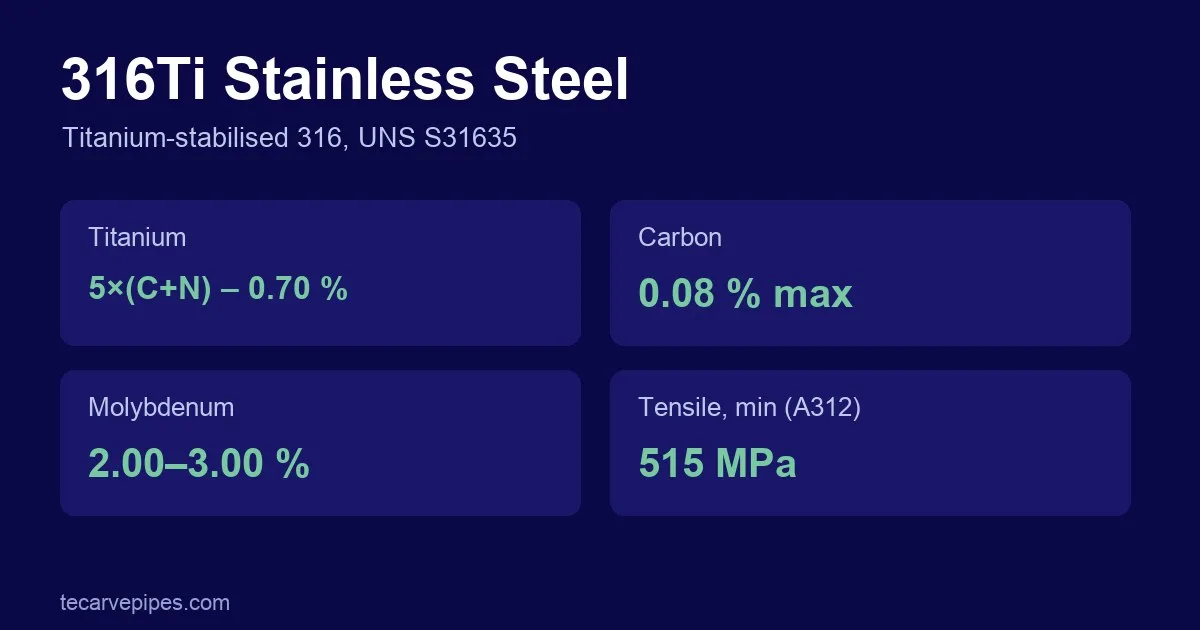

316Ti stainless steel (UNS S31635) is 316 with a titanium addition. Titanium combines with carbon, which stabilises the steel against chromium carbide precipitation, and so against intergranular corrosion, after welding or exposure in the sensitising temperature range. It is commonly matched to European grade 1.4571.
Chemical limits are from ASTM A554-26 Table 1. Tensile values are from ASTM A312/A312M-24b Table 4.
316Ti chemical composition
| Element, % | 316Ti (S31635) | 316L (S31603) for comparison |
|---|---|---|
| Carbon, max | 0.08 | 0.030 |
| Manganese, max | 2.00 | 2.00 |
| Phosphorus, max | 0.045 | 0.045 |
| Sulfur, max | 0.030 | 0.030 |
| Silicon, max | 0.75 | 0.75 |
| Chromium | 16.0–18.0 | 16.0–18.0 |
| Nickel | 10.0–14.0 | 10.0–14.0 |
| Molybdenum | 2.00–3.00 | 2.00–3.00 |
| Nitrogen, max | 0.10 | 0.10 |
| Titanium | 5 × (C + N) min, 0.70 max | — |
The titanium requirement is tied to carbon plus nitrogen, so there is enough titanium to combine with them. Chromium, nickel and molybdenum are the same as 316L, so general corrosion and chloride pitting resistance are similar.
Mechanical properties (A312)
| Grade | Tensile, min | Yield, min |
|---|---|---|
| S31635 (316Ti) | 75 ksi [515 MPa] | 30 ksi [205 MPa] |
| TP316L (S31603) | 70 ksi [485 MPa] | 25 ksi [170 MPa] |
316Ti vs 316L
Both protect against sensitisation, by different routes: 316L keeps carbon at 0.030 % max, 316Ti allows up to 0.08 % carbon and ties it up with titanium. 316Ti is often chosen for long service at elevated temperature, where the higher carbon helps strength and stabilisation keeps it resistant to intergranular attack. For general welded and sanitary service, 316L is the more common choice and is easier to source. See the 316L stainless steel tube guide and the 304 vs 316 vs 316L guide.
In A312 the grade is listed by UNS number, S31635, without a “TP” name, so order it as “ASTM A312, UNS S31635 (316Ti)”. TeCarve supplies 316Ti seamless and welded tube on request; confirm titanium on the mill test certificate.
Frequently asked questions
What is 316Ti stainless steel?
A titanium-stabilised version of 316, UNS S31635, with titanium of at least 5 × (C + N) and no more than 0.70 % (ASTM A554).
What is the difference between 316Ti and 316L?
316L limits carbon to 0.030 %; 316Ti allows up to 0.08 % carbon and adds titanium to bind it. Both resist sensitisation; chromium, nickel and molybdenum ranges are the same.
What is the European equivalent of 316Ti?
316Ti is commonly matched to EN 1.4571.