

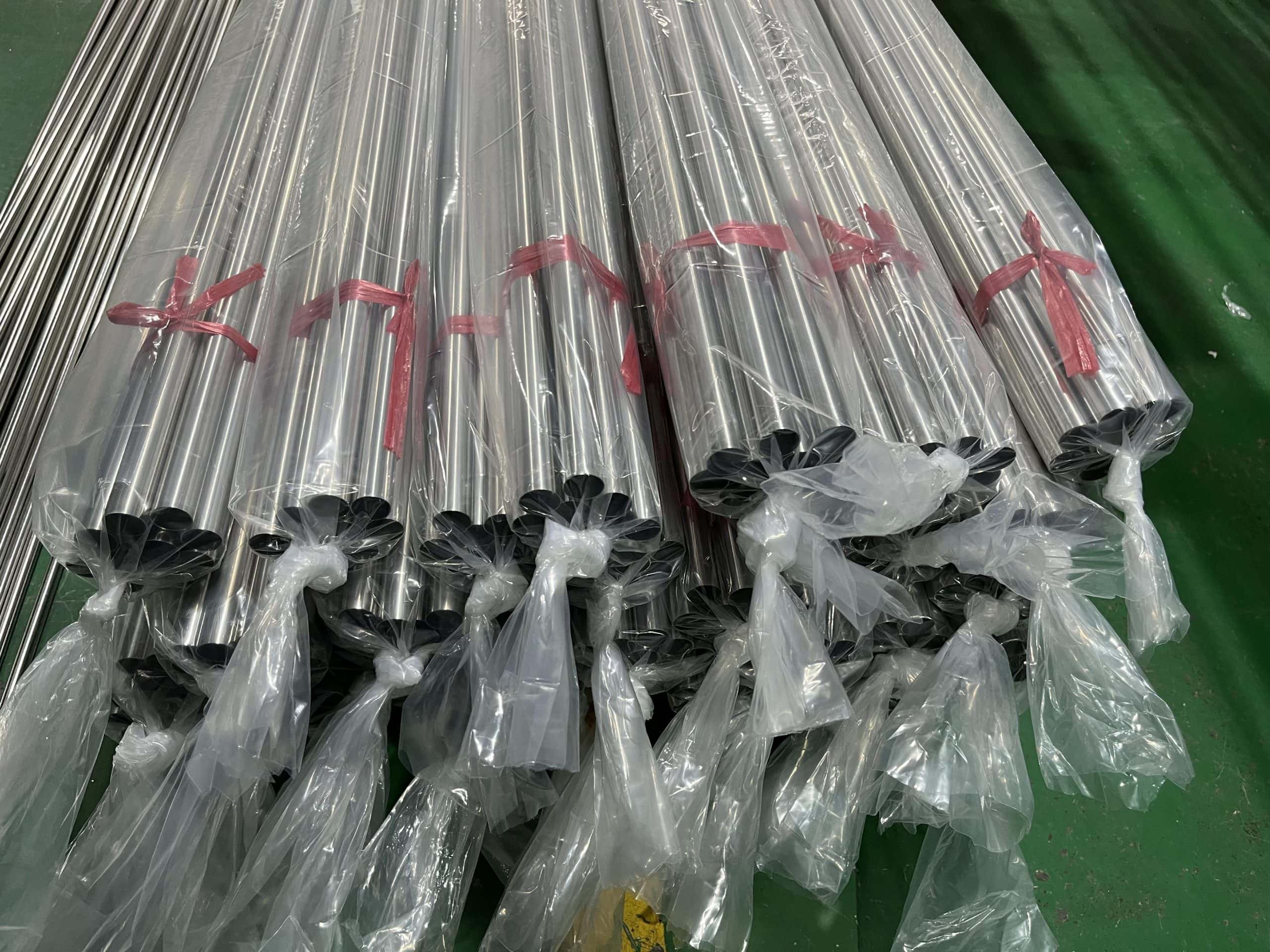

316L stainless steel tube is a low-carbon, molybdenum-bearing austenitic tubular product specified by outside diameter (OD) and wall thickness for chemical processing, heat transfer, and instrumentation circuits.
Specification Notice: 316L tubing is governed by three primary standards: ASTM A269 (general service), ASTM A213 (seamless heat exchangers), and ASTM A249 (welded heat exchangers). For nominal pipe sizes per ASTM A312, visit our 304/316/316L pipe supplier page.
1. Specification Selection: ASTM A269 vs. ASTM A213 vs. ASTM A249
Engineers select 316L tubing specifications based on construction form and service application:
| Specification | Standard Scope | Construction Form | Mechanical Test Focus | Scope (Section 1.1) |
|---|---|---|---|---|
| ASTM A269 / A269M-25 | General corrosion and temperature service | Seamless & Welded | Hardness cap (192 HBW / 90 HRB); no tensile requirements | Nominal-wall tubing for general corrosion-resisting and low- or high-temperature service (1.1) |
| ASTM A213 / A213M-24 | Seamless boiler, superheater, and heat-exchanger tubes | Seamless only | Mandatory tensile (70 ksi min), yield (25 ksi min), elongation (35%) & hardness | Seamless boiler, superheater and heat-exchanger tubes (1.1) |
| ASTM A249 / A249M-24a | Welded boiler, superheater, heat-exchanger, and condenser tubes | Welded only (WLD / HCW) | Mandatory tensile, yield, elongation, hardness & weld reverse-bend test | Boiler, superheater, heat-exchanger and condenser tubes (1.1) |
For detailed technical breakdowns, see our ASTM A269 tubing guide, ASTM A249 welded tube guide, and hydraulic tubing guide.
2. Chemical Composition: Carbon and Nickel Variations (Table 1)
Grade 316L (UNS S31603) contains 2.00–3.00% molybdenum. Chemical limits vary across ASTM tube standards:
| Element (% by wt) | ASTM A269 (TP316L) | ASTM A213 (TP316L) | ASTM A249 (TP316L) | Governing Chemistry Notes |
|---|---|---|---|---|
| Carbon (C), max | 0.035%B | 0.035%D | 0.030%D | A249: 0.030% max; A269/A213: 0.035% max |
| Manganese (Mn), max | 2.00% | 2.00% | 2.00% | Uniform across specifications |
| Phosphorus (P), max | 0.045% | 0.045% | 0.045% | Uniform across specifications |
| Sulfur (S), max | 0.030% | 0.030% | 0.030% | Uniform across specifications |
| Silicon (Si), max | 1.00% | 1.00% | 1.00% | Uniform across specifications |
| Chromium (Cr) | 16.0–18.0% | 16.0–18.0% | 16.0–18.0% | 16.0–18.0% across all |
| Nickel (Ni) | 10.0–15.0% | 10.0–14.0% | 10.0–14.0% | A269: up to 15.0% Ni; A213/A249: up to 14.0% Ni |
| Molybdenum (Mo) | 2.00–3.00% | 2.00–3.00% | 2.00–3.00% | 2.00–3.00% across all |
Small-Tube Carbon Exception: Footnote B in A269 and Footnote D in A213/A249 permit 0.040% max carbon in TP316L for small OD (<0.500 in [12.7 mm]) or light wall (<0.049 in [1.2 mm] min wall) requiring multiple cold drawing passes. Compare alloy grades in our 304 vs. 316 vs. 316L selection guide.
3. Mechanical Properties and Hardness Requirements
Mechanical property criteria differ between general-service tubing and boiler/exchanger equipment tubing:
| Specification | Tensile Strength min, ksi [MPa] | Yield Strength min, ksi [MPa] | Elongation in 2 in (50 mm) min, % | Rockwell Hardness max | Brinell / Vickers Hardness max |
|---|---|---|---|---|---|
| ASTM A269 (TP316L) | — (Not Specified) | — (Not Specified) | — (Not Specified) | 90 HRB | 192 HBW / 200 HV |
| ASTM A213 (TP316L) | 70 [485] | 25 [170] | 35% | 90 HRB | 192 HBW / 200 HV |
| ASTM A249 (TP316L) | 70 [485] | 25 [170] | 35% | 90 HRB (B90) | 200 HV |
- Solution Heat Treatment: All three standards mandate solution heat treatment at 1900 °F [1040 °C] minimum followed by rapid water quenching or cooling to prevent carbide precipitation.
- ASTM A269 Scope: ASTM A269 contains no tensile/yield table; design pressure capability must be calculated by the piping engineer using codes such as ASME B31.3.
- Testing Exclusions: Mechanical property and hardness tests do not apply below 1/8 in [3.2 mm] inside diameter or 0.015 in [0.38 mm] wall thickness.
4. Dimensional Tolerances and Wall Thickness Rules
Tubing standards enforce tight tolerances on outside diameter and wall thickness:
| Specification | Size Range (OD) | OD Permissible Variation | Wall Thickness Tolerance | Cut Length Tolerance |
|---|---|---|---|---|
| ASTM A269 (Group 1) | Up to 1/2 in [13 mm] excl | ±0.005 in [±0.13 mm] | ±15% | +1/8 in [+3.2 mm], −0 |
| ASTM A269 (Group 2) | 1/2 to 1-1/2 in [13 to 38 mm] excl | ±0.005 in [±0.13 mm] | ±10% | +1/8 in [+3.2 mm], −0 |
| ASTM A269 (Group 3) | 1-1/2 to 3-1/2 in [38 to 89 mm] excl | ±0.010 in [±0.25 mm] | ±10% | +3/16 in [+4.8 mm], −0 |
| ASTM A213 (Seamless) | 1/8 in ID to 5 in [127 mm] OD | Per ASTM A1016 Table 2 | ±10% for average wall (cold-formed) | Per ASTM A1016 |
| ASTM A249 (Welded) | 1/8 in ID to 12 in [304.8 mm] OD | Per ASTM A1016 Table 2 | ±10% of nominal wall for all sizes | Per ASTM A1016 |
- Thin-Wall Ovality (A269 Clause 13.2): For thin-walled tubes (Table 4), OD may deviate up to twice Table 4 tolerance, provided mean OD remains within tolerance.
- A249 Weld Seam (Clause 14.2): Weld thickness cannot exceed wall at 90° plus 6% of wall or 0.004 in [0.1 mm] max.
- Surface Condition: Tubes are pickled free of scale; pickling is omitted when bright annealed.
5. Quality Testing and Inspection Requirements
Quality verification ensures structural soundness, leak tightness, and seam ductility across production lots:
- Hydrostatic or NDE Testing: Each tube under ASTM A269, A213, and A249 undergoes NDE (eddy current/ultrasonic) or hydrostatic testing, at the producer’s option unless specified on the order.
- Flaring Test (Seamless): One test per lot under A269 Clause 9.1; one test from each end of one tube per lot under A213 Clause 9.4.
- Flange Test (Welded): One test per lot under A269 Clause 9.2; one test from each end of one tube per lot under A249 Clause 13.
- Reverse Flattening / Bend Tests (Welded): ASTM A269 Clause 9.4 mandates one reverse flattening test per 1,500 ft [460 m] of finished welded tubing. ASTM A249 Clause 11 mandates a reverse-bend test on a 4 in [100 mm] split section bent around a mandrel without cracking along the weld.
- Supplementary Options: S1 (stress-relieved anneal), pneumatic air-under-water leak testing per ASTM A1016, and intergranular corrosion testing per ASTM A262 Practice E.
6. 316L Tube vs. 316L Pipe: Critical Procurement Differences
While both forms carry fluids, their dimensional standards and joint geometries serve distinct engineering functions:
- Dimensional Sizing: Tubing is ordered by exact outside diameter (OD) and nominal wall thickness in millimetres or fractional inches. Piping is ordered by Nominal Pipe Size (NPS) and Schedule per ASME B36.19 (e.g., NPS 2 Sch 40S).
- Governing Standard: 316L pipe is produced to ASTM A312 (see our ASTM A312 pipe guide), whereas 316L tube is ordered to ASTM A269, A213, or A249.
- Wall Thickness Tolerances: ASTM A312 pipe allows a wall undertolerance of −12.5% with overtolerances up to +20.0% or +22.5% (Table 3). Tubing standards enforce tighter nominal wall tolerances of ±10% to ±15%.
- Connections: Tubing connects via compression fittings, flaring, or tubesheets. Pipe is joined by butt-welding, socket-welding, or threaded flanges.
For procurement of large-diameter 316L piping and ASME B36.19 schedules, visit our 304/316/316L stainless steel pipe supplier page.
7. 316L Tubing Purchasing Checklist
Purchase orders referencing ASTM A269, A213, or A249 should specify:
- Standard Designation: ASTM A269, ASTM A213, or ASTM A249.
- Alloy Grade: TP316L (UNS S31603).
- Manufacturing Form: Seamless or welded (WLD/HCW for A249).
- Dimensions: Outside diameter (OD) and wall thickness (nominal, or average/min for A213).
- Length: Specified cut lengths or random mill lengths.
- Surface Finish: Pickled or bright annealed.
- Pressure / NDE Testing: Hydrostatic test or NDE (eddy current / ultrasonic).
- Supplementary Requirements: Note S1 (stress-relieved), S2/S3 (pneumatic test), or S4/S6 (IGC test).
- Documentation: EN 10204 3.1 mill test report detailing heat analysis and test results.
8. TeCarve Supply Range
TeCarve is the exclusive factory-direct export channel for two dedicated manufacturing plants in Foshan (welded & decorative tubing) and Wenzhou (seamless & precision tubing):
- Seamless Precision Tubing: The seamless product page covers cold-drawn and cold-rolled seamless tube to ASTM A213 and other standards. View our seamless stainless pipe and tube catalog.
- Welded Process Tubing: The welded product page lists ASTM A249 among its standards; explore our welded stainless pipe and tube catalog.
- Heat Exchanger Tubes: Straight lengths up to 24 meters and precision U-bends to A213 / A249 via our heat exchanger tube catalog.
- Sanitary Tubing: Ra-controlled internal finishes (food-grade Ra ≤ 0.8 μm, pharma Ra ≤ 0.4 μm) through our sanitary pipe and tube catalog.
- Capillary & Micro-Bore Tubing: Precision seamless 316L capillary lines (OD 0.1–5.0 mm, wall 0.03–1.0 mm) via our capillary tube catalog.
- Stock Inventory: Immediate dispatch including 2,159 seamless tube sizes and 909 welded tube sizes (featuring 258 sizes of 316L from 1–40 mm OD) in our stock list.
- Plant Accreditations: Quality and pressure certificates (ISO 9001/14001/45001, PED/AD 2000-Merkblatt W0, marine approvals) are held by the plants — see https://tecarvepipes.com/verify-our-factories/. Shipments include EN 10204 3.1 certificates.
Need more than 316L? Compare 316Ti (titanium-stabilised), 317L (higher molybdenum) and duplex 2205.
For HRB, HV and Brinell equivalents, use the hardness conversion chart (ASTM E140) and its austenitic stainless steel table.
Frequently Asked Questions (FAQ)
What is the carbon content difference for 316L across ASTM tube specifications?
ASTM A249 limits carbon to 0.030% maximum in TP316L, whereas ASTM A269 and ASTM A213 permit up to 0.035% maximum. For small diameters under 0.500 in [12.7 mm] or light walls under 0.049 in [1.2 mm], all three standards permit up to 0.040% carbon.
Does ASTM A269 specify tensile or yield strength for 316L tubing?
No. ASTM A269 contains no tensile or yield strength requirements; it caps finished hardness at 192 HBW / 200 HV or 90 HRB. Tensile (70 ksi min) and yield (25 ksi min) properties are governed by ASTM A213 or ASTM A249.
What is the primary difference between 316L tube and 316L pipe?
316L tube is specified by outside diameter (OD) and nominal wall thickness with tight tolerances (±10% to ±15%) under ASTM A269/A213/A249. 316L pipe is ordered by Nominal Pipe Size (NPS) and Schedule under ASTM A312.
Can welded 316L tubing be used in heat exchangers?
Yes. Welded 316L tubing produced to ASTM A249 is specifically qualified for boiler, heat exchanger, and condenser service, featuring mandatory weld seam cold reduction and reverse-bend testing.
Is non-destructive testing mandatory for 316L tubing?
Yes. Each tube under ASTM A269, ASTM A213, and ASTM A249 must undergo either a nondestructive electric test (eddy current or ultrasonic) or a hydrostatic pressure test, at the producer’s option unless specified on the order.