

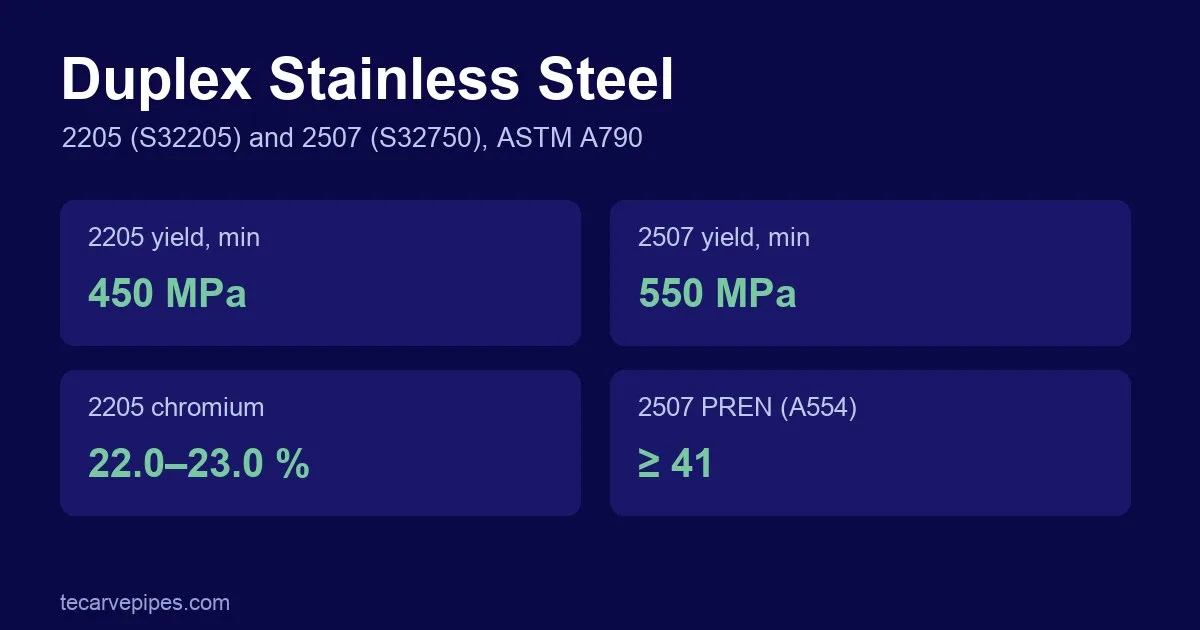

Duplex stainless steel has a mixed structure of austenite and ferrite. Compared with 304 and 316 it has roughly twice the yield strength and better resistance to chloride stress corrosion cracking, with less nickel. The two grades most often specified for pipe and tube are 2205 (UNS S32205, closely related to S31803) and the super duplex 2507 (UNS S32750).
Chemical and tensile values are from ASTM A790/A790M-24 Tables 2 and 3 (duplex pipe). The 2507 pitting index requirement is from ASTM A554-26 Table 1, footnote H.
Chemical composition: 2205, S31803 and 2507
| Element, % | S31803 | 2205 (S32205) | 2507 (S32750) |
|---|---|---|---|
| Carbon, max | 0.030 | 0.030 | 0.030 |
| Manganese, max | 2.00 | 2.00 | 1.20 |
| Phosphorus, max | 0.030 | 0.030 | 0.035 |
| Sulfur, max | 0.020 | 0.020 | 0.020 |
| Silicon, max | 1.00 | 1.00 | 0.80 |
| Nickel | 4.5–6.5 | 4.5–6.5 | 6.0–8.0 |
| Chromium | 21.0–23.0 | 22.0–23.0 | 24.0–26.0 |
| Molybdenum | 2.5–3.5 | 3.0–3.5 | 3.0–5.0 |
| Nitrogen | 0.08–0.20 | 0.14–0.20 | 0.24–0.32 |
| Copper, max | — | — | 0.5 |
S31803 vs S32205
S32205 is the tighter version: its chromium, molybdenum and nitrogen ranges sit inside the S31803 ranges, and its minimum tensile strength is higher. A heat that meets S32205 therefore also meets the S31803 chemical and tensile limits in A790, which is why material is often certified to both.
Mechanical properties (ASTM A790)
| Grade | Tensile, min | Yield, min | Elongation, min | Hardness, max |
|---|---|---|---|---|
| S31803 | 90 ksi [620 MPa] | 65 ksi [450 MPa] | 25 % | 290 HBW / 30 HRC |
| 2205 (S32205) | 95 ksi [655 MPa] | 65 ksi [450 MPa] | 25 % | 290 HBW / 30 HRC |
| 2507 (S32750) | 116 ksi [800 MPa] | 80 ksi [550 MPa] | 15 % | 300 HBW / 32 HRC |
| TP316L for comparison (A312) | 70 ksi [485 MPa] | 25 ksi [170 MPa] | 35 % | — |
The higher yield strength is the main reason designers choose duplex: for the same pressure, a duplex pipe can often use a thinner wall than 316L. Wall thickness still has to be calculated to the governing code.
2205 vs 2507 (super duplex)
2507 has more chromium, molybdenum and nitrogen than 2205. Using PREN = Cr + 3.3 Mo + 16 N, the minimum composition of 2205 gives about 34. For 2507, ASTM A554 sets Cr + 3.3 Mo + 16 N at 41 minimum, which is why 2507 is called super duplex. Typical reasons to step up to 2507 are seawater, brines and other high-chloride service where 2205 is marginal.
| 2205 | 2507 | |
|---|---|---|
| Structure | Austenite + ferrite | Austenite + ferrite |
| Yield, min (A790) | 450 MPa | 550 MPa |
| Pitting index | ≈34 from minimum composition | 41 min (A554) |
| Typical use | Process piping, chemical tankers, heat exchangers, pulp and paper | Seawater, offshore, desalination, high-chloride process |
Things to know when ordering duplex tube and pipe
- Specifications: ASTM A790 for pipe, A789 for tubing; A270 also lists S31803, S32205 and S32750 for sanitary tube.
- Intermetallic phases: wrong heat treatment or welding can form intermetallic phases that reduce toughness and corrosion resistance. ASTM A923 is the test used to detect them; A270 calls up A923 Practice C for these duplex grades as a supplementary requirement.
- Magnetic: duplex grades are magnetic because of the ferrite. That is normal; see is stainless steel magnetic.
- Passivation: ASTM A967 recommends the copper sulfate test (Practice D) and the ferricyanide test (Practice E) for duplex grades; see the passivation guide.
For pipe-specific requirements see the ASTM A790 duplex pipe guide. Where duplex is not enough, compare 904L and nickel alloy tube. TeCarve supplies duplex seamless and welded pipe and tube in 2205 and 2507.
To compare HBW, HRC and other scales, see the hardness conversion chart (ASTM E140).
Frequently asked questions
What is duplex stainless steel?
A stainless steel with a mixed austenite and ferrite structure. Common grades are 2205 (UNS S32205/S31803) and the super duplex 2507 (UNS S32750).
What is the difference between 2205 and 2507?
2507 has more chromium (24–26 %), molybdenum (3–5 %) and nitrogen (0.24–0.32 %) than 2205, a higher minimum yield strength (550 vs 450 MPa in ASTM A790) and a minimum Cr + 3.3Mo + 16N of 41 in ASTM A554.
Is S31803 the same as 2205?
Not exactly. S32205 has tighter chromium, molybdenum and nitrogen ranges than S31803 and a higher minimum tensile strength. Material meeting S32205 also meets S31803, so it is often dual-certified.
Is duplex stainless steel magnetic?
Yes. Its ferrite phase makes it magnetic.