

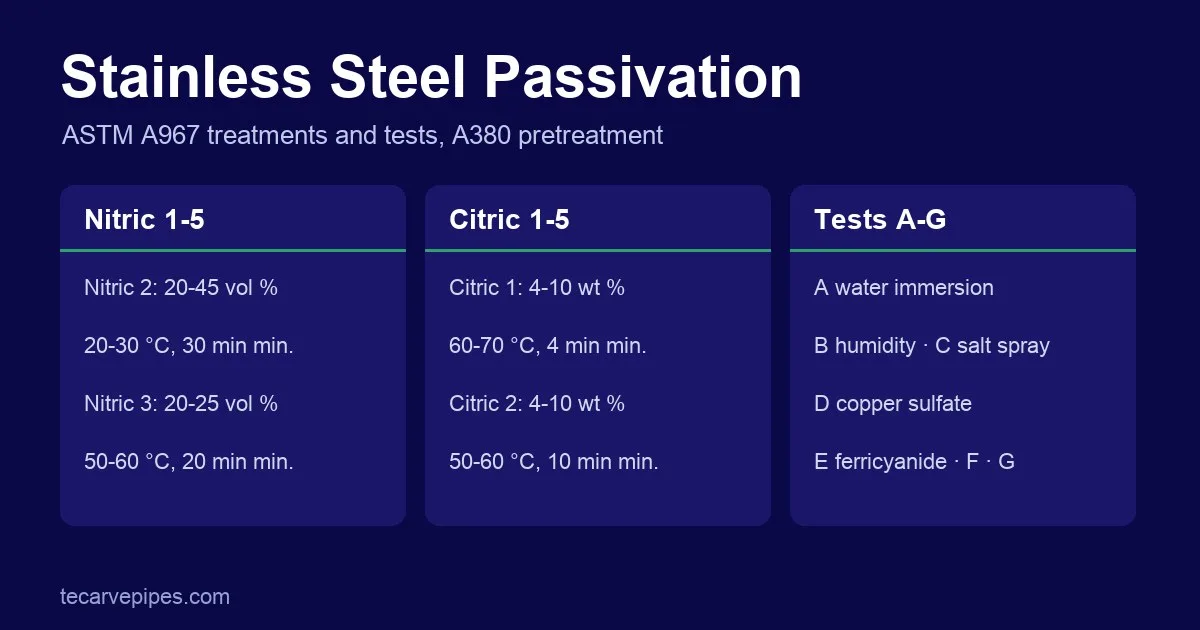

Stainless steel passivation is a chemical treatment, usually in nitric or citric acid, that removes free iron and other contaminants from the surface so the chromium-rich passive film can form evenly. In the US it is specified by ASTM A967/A967M, which defines the treatments and the tests that prove they worked, and by ASTM A380/A380M, the broader practice for cleaning, descaling, pickling and passivation.
All treatment conditions and test details below are taken from ASTM A967/A967M-25 and A380/A380M-25 (both approved January 1, 2025). Where this page summarises, the standard governs.
What passivation does, and what it does not do
Stainless steel forms its passive oxide film on its own in air, as long as the surface is free of scale and foreign matter. A967 says so directly: stainless steels are “autopassivating”. The problem is contamination. Iron particles picked up from steel tooling, grinding media, blasting media, steel hooks, chains or forks, nearby work on carbon steel, or residual pickling salts sit on the surface and rust, and they stop the film forming evenly.
A967 defines passivation as treatment with a nitric or citric acid solution, or other chemical or electrochemical treatment with similar results, to remove contaminant iron, alloyed iron and other foreign matter from the surface. That increases corrosion resistance by allowing a better passive film to form.
- Passivation is not pickling. Pickling removes heat tint and oxide scale and dissolves some of the stainless steel itself. It is substantially more aggressive. A fully pickled surface does not normally need a separate passivation treatment (A967 §3.2.3.5 and §5.3.3).
- Passivation does not remove weld heat tint or scale. Those need descaling or pickling to A380 first.
- Electropolishing also leaves a surface free of scale and contaminant iron and does not need separate passivation (§3.2.3.6). Electropolishing as a passivation method is covered by ASTM B912.
A967 vs A380: which standard to specify
| ASTM A967/A967M | ASTM A380/A380M | |
|---|---|---|
| Type | Standard specification | Standard practice |
| Scope | Chemical passivation treatments for stainless steel parts, with tests and acceptance criteria | Recommendations and precautions for cleaning, descaling, pickling and passivation of parts, assemblies, equipment and installed systems |
| Use on an order | Name the treatment (for example Citric 2 or Nitric 2) and the test practice (A to G) | Pretreatment (descaling, pickling, degreasing) before A967 passivation must follow A380 (A967 §5.3.1) |
| Replaces | Federal Specification QQ-P-35C (cancelled 1998; A967 is used in its place for DoD work other than aerospace) | — |
In practice most purchase orders call up A967 for the passivation and acceptance test, and A380 for any descaling or pickling that has to happen first.
Nitric acid passivation treatments (A967 Section 6)
| Treatment | Solution | Temperature | Minimum time |
|---|---|---|---|
| Nitric 1 | 20–25 vol % nitric acid + 2.5 ± 0.5 wt % sodium dichromate dihydrate | 50–55 °C [120–130 °F] | 20 min |
| Nitric 2 | 20–45 vol % nitric acid | 20–30 °C [70–90 °F] | 30 min |
| Nitric 3 | 20–25 vol % nitric acid | 50–60 °C [120–140 °F] | 20 min |
| Nitric 4 | 45–55 vol % nitric acid | 50–55 °C [120–130 °F] | 30 min |
| Nitric 5 | Other combinations of temperature, time and concentration, with or without other chemicals, that pass the specified test | — | — |
The nitric acid used is commercial concentrated acid of 61.0 to 68.2 wt % HNO3 (42° Baumé). Under QQ-P-35C, Nitric 1 corresponds to Type II, Nitric 2 to Type VI, Nitric 3 to Type VII and Nitric 4 to Type VIII (A967 X1.9.1).
Citric acid passivation treatments (A967 Section 7)
| Treatment | Solution | Temperature | Minimum time |
|---|---|---|---|
| Citric 1 | 4–10 wt % citric acid | 60–70 °C [140–160 °F] | 4 min |
| Citric 2 | 4–10 wt % citric acid | 50–60 °C [120–140 °F] | 10 min |
| Citric 3 | 4–10 wt % citric acid | 20–50 °C [70–120 °F] | 20 min |
| Citric 4 | Other combinations, with or without accelerants, inhibitors or proprietary solutions, that pass the specified test | — | — |
| Citric 5 | As Citric 4, with the bath controlled at pH 1.8–2.2 | — | — |
The percentages are for anhydrous citric acid; with citric acid monohydrate the equivalent range is 4.4 to 10.9 wt %. Citric treatments run at lower concentration and much shorter times than nitric ones. For ferritic, martensitic and precipitation hardening grades A967 notes that citric treatments may benefit from raising the solution pH to no more than 4.5 by buffering (X2.3).
Rinsing and drying
After every treatment the parts are rinsed immediately. The final rinse uses water with a maximum of 200 ppm total dissolved solids, and the parts are then dried. A separate neutralising step is optional. A967 gives as an example 30 minutes minimum in 5 % NaOH at 70–80 °C [160–180 °F], followed by the water rinse.
Which nitric treatment for which grade
A967 Table X1.1 is a nonmandatory guide to nitric treatments by grade. A few common grades:
| Grade | Recommended nitric treatments (Table X1.1) |
|---|---|
| 304, 304L, 316, 316L, 321, 347, 310S, 201 | Nitric 2 or Nitric 3 |
| 304H, 316H, 321H, 347H | Nitric 2 or Nitric 4 |
| 430 | Nitric 3 |
| 410 | Nitric 1 or Nitric 4 |
| 420, 440A/B/C | Nitric 1 (440 grades also Nitric 4) |
| 303 and other free-machining grades | Nitric 1 |
| 17-4 (S17400) | Nitric 1 or Nitric 4 |
Table X1.1 does not list 2205 or other modern duplex grades; for those the treatment is chosen so that the parts pass the specified test. A967 also warns that high-strength grades such as 440C can suffer hydrogen embrittlement or intergranular attack in acids, so mechanical or other chemical cleaning is recommended (X1.10). Carburized surfaces cannot be passivated and nitrided surfaces should not be (X1.7, X1.8). Free-machining grades with high sulfur may benefit from an alkaline pre- or post-treatment at pH 10 or above (X2.5).
How passivation is verified: A967 Practices A to G
At least one test is run on each lot. Unless the purchaser specifies otherwise, one test per lot is enough, and the supplier picks the practice (§4.3, §13.2). All the tests are qualitative.
| Practice | Test | Conditions | Pass criterion |
|---|---|---|---|
| A | Water immersion | Alternately 1 h ± 3 min in distilled water and at least 1 h drying in air, repeated at least 12 times | No rust or staining from embedded iron |
| B | High humidity | 97 ± 3 % humidity at 35–40 °C [95–105 °F] for at least 24 h | No rust or staining |
| C | Salt spray | ASTM B117, 5 % salt solution, at least 2 h | No rust or staining |
| D | Copper sulfate | Acidified copper sulfate solution kept wet on the surface for at least 6 min | No copper deposits |
| E | Potassium ferricyanide–nitric acid | Solution swabbed or misted on; dark blue within 30 s means metallic iron | No dark blue colour |
| F | Damp cloth | Wet cloth pad on at least 130 cm² [20 in²] for at least 60 min at 10 °C [50 °F] or above | No rust or staining |
| G | Boiling water immersion | Distilled water at 95–100 °C [200–212 °F] for at least 30 min, then cooled and air dried | No rust or staining |
Choosing the test
- Copper sulfate (D) is recommended for 200 and 300 series austenitic, duplex, precipitation hardening and ferritic grades with at least 16 % chromium. It is not recommended for martensitic grades or ferritic grades below 16 % Cr, which can give a positive result whether or not contamination is present.
- Ferricyanide (E) detects very small amounts of iron on austenitic and duplex grades, but it shall not be used on parts for food processing (§14.5.1).
- Damp cloth (F) suits large parts that cannot go into a humidity cabinet, salt spray or boiling water.
- Salt spray (C) is typically used for austenitic grades and may not suit all martensitic or ferritic grades.
A lot that fails may be re-passivated and retested; the retest sample is twice the original test frequency, and every sample must pass (§15.1). Visual evaluation is done without magnification unless the purchaser says otherwise.
What to put on the purchase order
A967 X1.2 lists the information a buyer should include. In short:
- ASTM A967/A967M and its year (for example A967/A967M-25).
- The grade and product specification of the material, for example 316L tube to ASTM A270 or A269.
- The passivation treatment (for example Citric 2 or Nitric 2) and the test practice (for example Practice D), if you do not want the supplier to choose.
- Lot size, if different from the A967 definition.
- Required documents. A test report and a record of treatment solutions and process conditions are supplied only when the purchase order asks for them (§17).
If none of this is stated, A967 lets the supplier choose both the treatment and the test (§4.2, §4.3).
Frequently asked questions
What is the difference between ASTM A967 and A380?
A967 is a specification for chemical passivation treatments with acceptance tests (Practices A to G). A380 is a broader practice covering cleaning, descaling, pickling and passivation of parts, equipment and systems. Pretreatment before A967 passivation is done to A380.
Is citric acid passivation as good as nitric?
Under A967 a treatment is judged by whether the parts pass the specified test, not by the acid used. Citric 1 to 5 and Nitric 1 to 5 are all accepted treatments when the parts pass.
Does passivated stainless steel need to be pickled?
Only if there is heat tint or oxide scale. Passivation does not remove scale. A fully pickled surface normally needs no separate passivation.
Which passivation test is used for food-contact parts?
Practice E (potassium ferricyanide–nitric acid) must not be used on parts for food processing. Practices A, B, C, D, F or G are used instead, depending on the grade and part size.
For sanitary tube, see how to specify sanitary stainless steel tubing, the ASTM A270 guide and the ASME BPE tubing guide. TeCarve supplies sanitary stainless steel pipe and tube; state the A967 treatment, test practice and documents on your RFQ.