

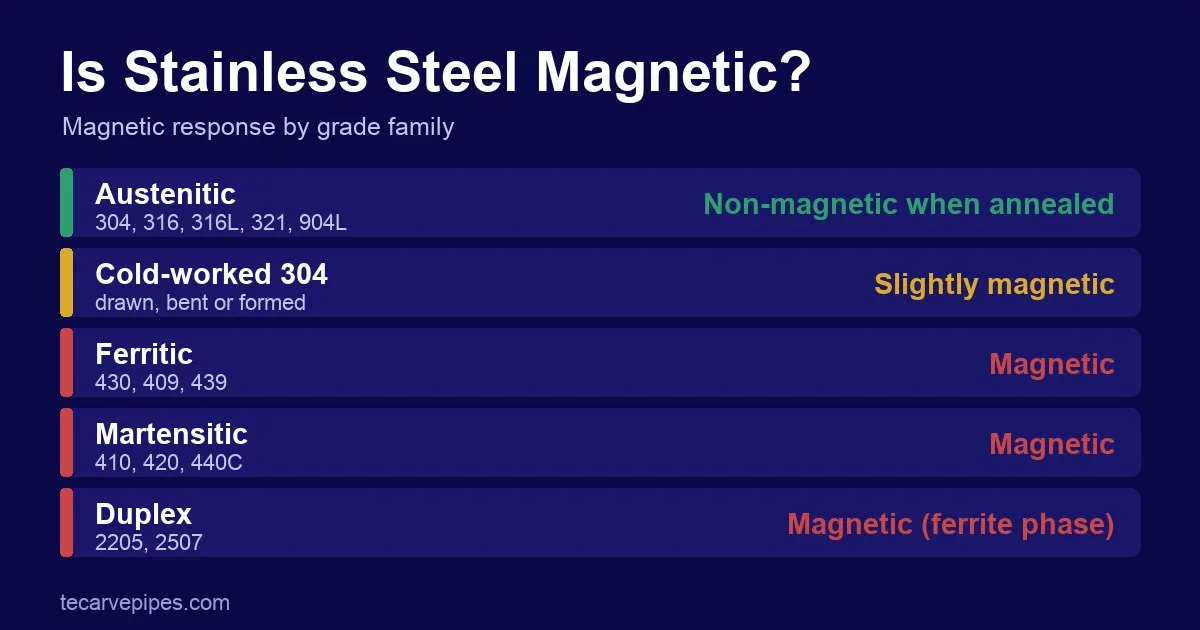

Is stainless steel magnetic? It depends on the grade family. Austenitic grades such as 304 and 316 are essentially non-magnetic in the annealed condition. Ferritic grades such as 430, martensitic grades such as 410 and 420, and duplex grades such as 2205 are magnetic.
Short answer for buyers: a magnet cannot tell you whether a tube is 304 or 316, or whether it is stainless steel of the grade you ordered. A slight pull on 304 tube is normal after cold working. Grade is confirmed by chemical analysis on the mill test certificate and by PMI (positive material identification), not by a magnet.
Why some stainless steels are magnetic and others are not
Magnetism in steel comes from its crystal structure. Iron-based alloys with a body-centred cubic (BCC) structure, called ferrite, and the body-centred tetragonal martensite are ferromagnetic: a magnet attracts them strongly. A face-centred cubic (FCC) structure, called austenite, is not ferromagnetic.
Chromium alone keeps stainless steel ferritic. Adding enough nickel (and in some grades manganese or nitrogen) stabilises austenite at room temperature. That is why the nickel-bearing 300-series grades are non-magnetic when annealed, while the nickel-free 400-series grades are magnetic.
Magnetic behaviour by stainless steel family
| Family | Typical grades | Structure | Response to a magnet |
|---|---|---|---|
| Austenitic | 304, 304L, 316, 316L, 321, 310S, 904L | Austenite | Essentially non-magnetic when annealed; may become slightly magnetic after cold working |
| Austenitic (200 series) | 201 | Austenite | Non-magnetic when annealed; tends to pick up magnetism with cold work |
| Ferritic | 430, 409, 439 | Ferrite | Magnetic |
| Martensitic | 410, 420, 440C | Martensite | Magnetic |
| Duplex | 2205 (S32205/S31803), 2507 (S32750) | Austenite + ferrite, roughly half each | Magnetic, because of the ferrite phase |
Why 304 tube can stick to a magnet
Cold working
Austenite in 304 is only just stable at room temperature. Cold drawing, cold rolling, bending, swaging or flaring can transform part of it into strain-induced martensite, which is magnetic. Small-diameter drawn tube, cold-worked capillary and the bent or formed areas of a part often show a noticeable pull, while the straight, annealed body of the same tube does not.
316 and 316L contain more nickel than 304, so their austenite is more stable and they pick up less magnetism for the same amount of cold work. Solution annealing after cold work returns the structure to austenite and removes most of the induced magnetism.
Welds
Austenitic weld metal is normally designed to contain a small amount of delta ferrite, because it reduces the risk of hot cracking during solidification. The ferrite content of weld metal is measured as a Ferrite Number. As a result the weld seam of a 304 or 316 welded tube may respond slightly to a magnet even when the base metal does not.
Duplex grades
2205 and 2507 are designed with a mixed austenite–ferrite structure. They are always magnetic, and that is a normal property of the grade, not a defect. See the ASTM A790 duplex stainless steel pipe guide for how these grades are specified.
Does magnetism mean lower quality or poor corrosion resistance?
No. A slight magnetic response from cold work or from ferrite in a weld does not, by itself, mean the material is the wrong grade or that it will corrode. Corrosion resistance depends mainly on chemistry (chromium, molybdenum and nitrogen), surface condition and correct heat treatment. Ferritic 430 is magnetic and less corrosion resistant than 304, but that is because of its chemistry, not because it is magnetic.
Where low magnetic permeability is a design requirement, for example near sensitive instruments, it has to be stated on the order as a separate requirement, because the general tube specifications do not limit magnetic response.
How to verify the grade instead of using a magnet
- Mill test certificate: check the heat chemistry against the grade limits in the specification, for example ASTM A269, A312 or A213. An EN 10204 3.1 certificate ties the chemistry to the heat number marked on the tube.
- PMI by handheld XRF: distinguishes 304 from 316 by molybdenum content and catches mixed material within minutes.
- Marking: the specification, grade and heat number marked on each length should match the certificate.
If you are choosing between grades for a project, the 304 vs 316 vs 316L tube selection guide compares them by chemistry and service.
Grade pages: duplex 2205/2507 · 201 · 430 · 904L.
Frequently asked questions
Is 304 stainless steel magnetic?
Annealed 304 is essentially non-magnetic. Cold-worked 304, such as drawn tube, bent sections or formed parts, can become slightly magnetic because part of the austenite transforms to martensite.
Is 316 stainless steel magnetic?
Annealed 316 and 316L are non-magnetic. Because of their higher nickel content they become less magnetic than 304 after the same amount of cold work.
Is 430 stainless steel magnetic?
Yes. 430 is a ferritic grade and is attracted to a magnet in all conditions.
Is duplex 2205 magnetic?
Yes. Duplex grades contain a large proportion of ferrite and are magnetic by design.
Can a magnet tell 304 from 316?
No. Both are non-magnetic when annealed and both can respond slightly after cold work. Use the certificate chemistry or PMI to tell them apart.
TeCarve supplies seamless and welded stainless steel pipe and tube in austenitic, ferritic and duplex grades, with grade confirmed by heat chemistry and PMI before export.