

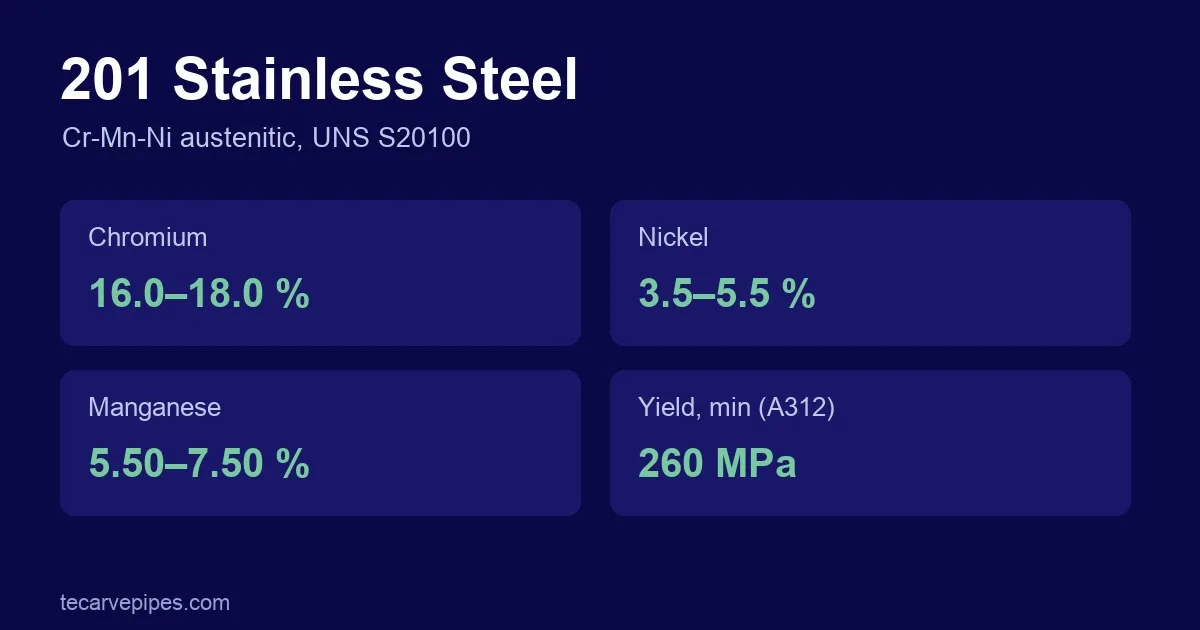

201 stainless steel (UNS S20100) is a chromium-manganese-nickel austenitic grade. It replaces part of the nickel in 304 with manganese and nitrogen, which lowers alloy cost but also lowers corrosion resistance. It is used mainly for decorative and indoor tube, trim and furniture rather than for corrosive or pressure service.
Chemical limits below are from ASTM A554-26 Table 1 (welded mechanical tubing) and match ASTM A312/A312M-24b Table 1 for TP201. Tensile values are from A312/A312M-24b Table 4.
201 stainless steel chemical composition
| Element | 201 (S20100) | 304 (S30400) for comparison |
|---|---|---|
| Carbon, max | 0.15 | 0.08 |
| Manganese | 5.50–7.50 | 2.00 max |
| Phosphorus, max | 0.060 | 0.045 |
| Sulfur, max | 0.030 | 0.030 |
| Silicon, max | 1.00 | 0.75 |
| Chromium | 16.0–18.0 | 18.0–20.0 |
| Nickel | 3.5–5.5 | 8.0–11.0 |
| Nitrogen, max | 0.25 | 0.10 |
The difference that matters is visible in three lines: about half the nickel of 304, roughly two points less chromium, and several times the manganese. Nickel and chromium are what give 304 its corrosion resistance; manganese and nitrogen keep 201 austenitic but do not replace that resistance.
Mechanical properties
| Grade | Tensile strength, min | Yield strength, min |
|---|---|---|
| TP201 (S20100) | 75 ksi [515 MPa] | 38 ksi [260 MPa] |
| TP304 (S30400) | 75 ksi [515 MPa] | 30 ksi [205 MPa] |
In A312, TP201 has the same minimum tensile strength as TP304 and a higher minimum yield strength, because nitrogen strengthens austenite. Higher strength is not a substitute for corrosion resistance, though.
201 vs 304: which to choose
- Indoor decorative tube, furniture, handrails in dry interiors: 201 is widely used where the surface stays dry and cost matters.
- Outdoor, coastal, wet or washdown areas, food contact, chemicals: choose 304 or 316L. Lower chromium and nickel make 201 more prone to staining and pitting in chlorides.
- Cold forming: 201 work-hardens strongly and often becomes slightly magnetic after bending or drawing. See is stainless steel magnetic.
How to tell 201 from 304
The two look the same and a magnet will not separate them reliably. Manganese is the easy marker: 5.50–7.50 % in 201 against 2.00 % maximum in 304. A handheld XRF (PMI) reading or the heat chemistry on the mill test certificate shows it immediately. If a quotation for “304” is far below the market, ask for the certificate chemistry before ordering.
Passivation of 201
ASTM A967 Table X1.1 lists Nitric 2 or Nitric 3 for S20100, the same as for 304. See the stainless steel passivation guide.
TeCarve supplies welded stainless steel tube in 201 for decorative use and in 304 and 316L where corrosion resistance is required; the 304 vs 316 vs 316L guide compares the higher grades.
Frequently asked questions
Is 201 stainless steel good quality?
201 is a standard ASTM grade (UNS S20100) and is suitable for dry, indoor and decorative use. It has less nickel and chromium than 304, so it is not a substitute for 304 in wet, outdoor, coastal or food-contact service.
Will 201 stainless steel rust?
201 resists rust in dry indoor conditions but stains and pits more readily than 304 in chlorides, humidity and outdoor exposure, because of its lower chromium and nickel.
Is 201 stainless steel magnetic?
Annealed 201 is non-magnetic. It work-hardens strongly and often becomes slightly magnetic after cold forming.
How can I check whether tube is 201 or 304?
Check manganese: 5.50–7.50 % for 201 and 2.00 % maximum for 304, by PMI (XRF) or from the heat chemistry on the mill certificate.