

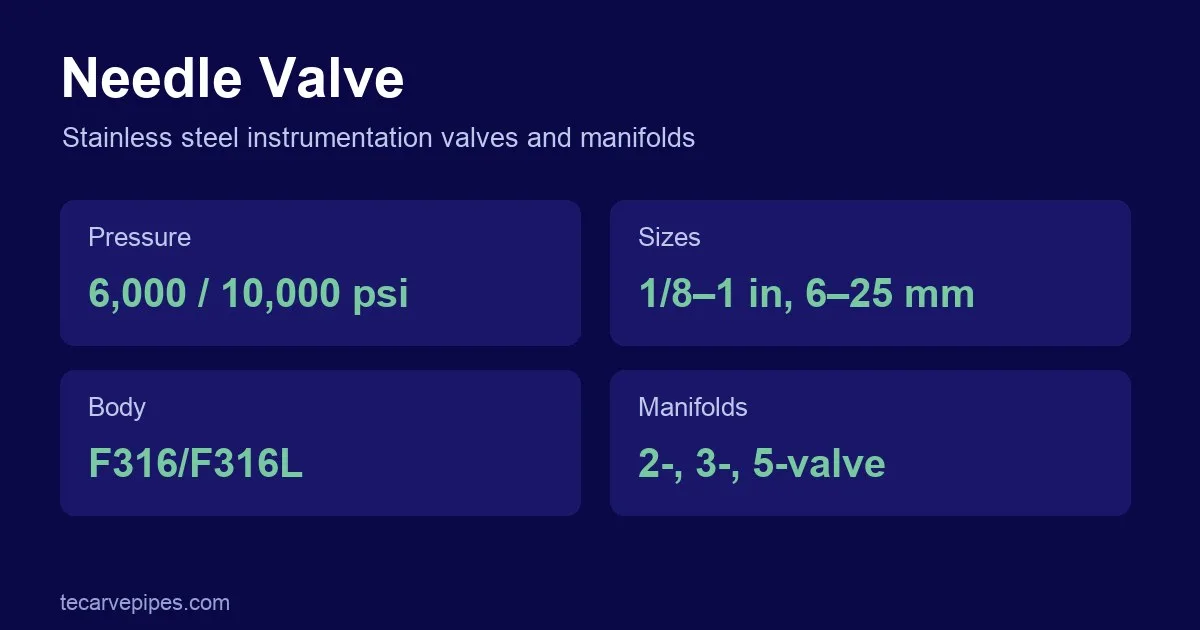

A needle valve is a small valve with a long, tapered stem tip that closes against a matching seat. Many turns of the handle move the tip only a little, so it gives fine control and tight shut-off at high pressure. In instrumentation, stainless steel needle valves and valve manifolds isolate, vent and equalise pressure gauges and pressure or differential pressure transmitters.
Specification ranges below are for the instrumentation needle valves and manifolds TeCarve supplies, sourced from a qualified specialist maker and inspected before export.
How a needle valve works
Turning the handle drives the stem in or out on a fine thread. Because the tip is a long cone, the flow area changes gradually, which makes the valve suitable for metering low flows and for isolating instruments where a quarter-turn valve would open too abruptly. A non-rotating stem tip turns the handle’s rotation into a straight push, so the tip does not grind the seat as it closes.
Needle valve vs ball valve vs globe valve
| Needle valve | Ball valve | Globe valve | |
|---|---|---|---|
| Operation | Multi-turn, tapered stem tip | Quarter-turn, bored ball | Multi-turn, disc on seat |
| Best at | Fine throttling and instrument isolation at small sizes and high pressure | Fast on/off with full bore | Throttling in larger process lines |
| Typical sizes | Instrument sizes, 1/8 to 1 in | Small to large | Small to large |
| Flow restriction | High (small orifice) | Low when open | Moderate |
2-, 3- and 5-valve manifolds
| Manifold | Valves | Typical use |
|---|---|---|
| 2-valve | Block + vent | Pressure gauges and pressure transmitters |
| 3-valve | 2 block + equalize | Differential pressure transmitters |
| 5-valve | 2 block + equalize + 2 vent | Differential pressure transmitters where each side must be vented or tested |
Stainless steel instrumentation needle valve specifications
| Item | Range |
|---|---|
| Sizes | 1/8, 1/4, 3/8, 1/2, 3/4 and 1 in; 6, 8, 10, 12, 14, 16 and 25 mm |
| End connections | Twin-ferrule tube ends for ASTM A269 / A213 instrument tube; NPT (ASME B1.20.1), BSPT (ISO 7-1) or BSPP (ISO 228) male or female; socket-weld or butt-weld; flanged for direct mounting on DP transmitters |
| Pressure rating | 6,000 psi (414 bar) standard; 10,000 psi (690 bar) high-pressure versions |
| Temperature | PTFE packing −54 to 232 °C (−65 to 450 °F); graphite packing −54 to 649 °C (−65 to 1200 °F) |
| Body material | ASTM A182 F316/F316L forgings or ASTM A276 316/316L bar; duplex S31803, super duplex S32750, Alloy C-276 and Alloy 400 on request |
| Stem and seat | Non-rotating stem tip; hardened 316, Stellite or 17-4PH (H900) tips; PTFE, PEEK or graphite packing |
| Testing | 100% shell and seat test at 1.5× and 1.1× rated pressure with nitrogen leak check; EN 10204 3.1 certificate |
| MOQ and lead time | From 5–10 pieces in 316 standard sizes; 1/4 and 1/2 in 6,000 psi valves and 2- or 3-valve manifolds about 5–7 working days; 5-valve manifolds and special alloys about 15–20 working days |
How to order a needle valve
- Size and end connection on each side, for example 1/2 in NPT female × 1/2 in tube end.
- Pressure rating (6,000 or 10,000 psi) and maximum temperature, which decides the packing.
- Body material, usually 316/316L; duplex or nickel alloys for chlorides or sour service.
- Pattern: straight or angle; for manifolds, 2-, 3- or 5-valve and remote or direct mount.
- Tube OD system to match the fittings: fractional inch and metric ODs are not interchangeable (see the mm to inches converter).
See the valves, pumps and instrumentation page for needle valves, manifolds, twin-ferrule fittings and the instrument tubing that connects them.
Frequently asked questions
What is a needle valve used for?
Fine flow control and isolation of instruments such as pressure gauges and transmitters, especially at small sizes and high pressure.
What pressure rating do stainless needle valves have?
The instrumentation needle valves TeCarve supplies are rated 6,000 psi (414 bar) as standard and 10,000 psi (690 bar) in high-pressure versions.
What is the difference between a 3-valve and a 5-valve manifold?
A 3-valve manifold has two block valves and one equalizing valve; a 5-valve manifold adds two vent valves.
Can a needle valve be used for on/off service?
Yes, it gives tight shut-off, but it is slower to operate and more restrictive than a ball valve, so ball valves are usually preferred for frequent on/off duty.