

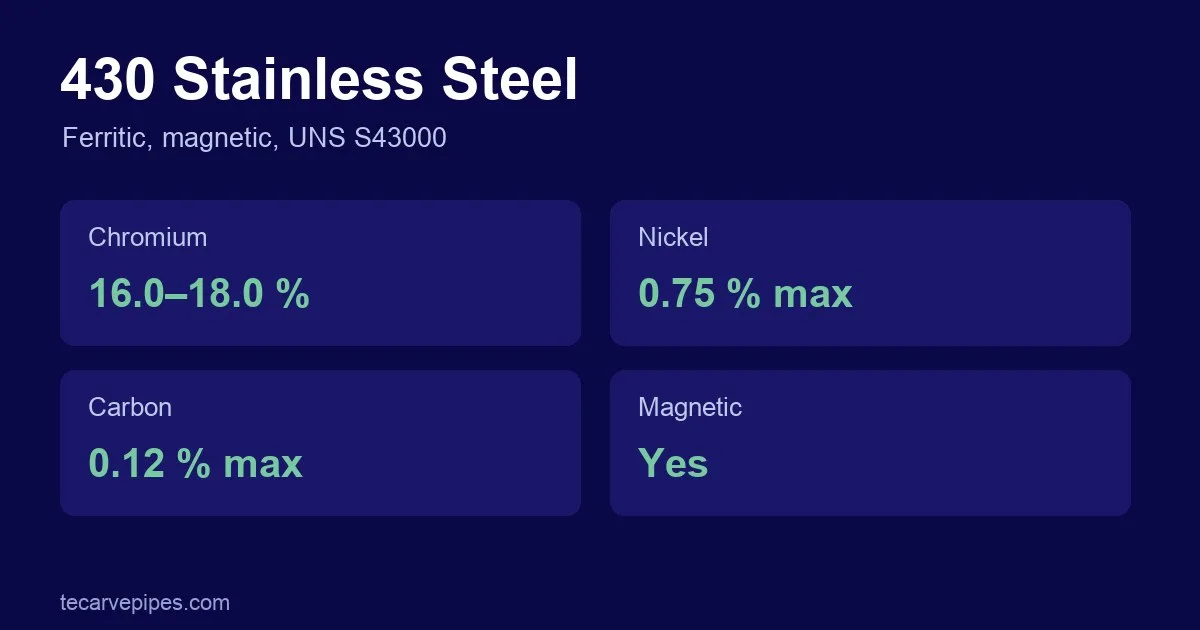

430 stainless steel (UNS S43000) is a ferritic chromium grade with 16–18 % chromium and almost no nickel. It is magnetic, cannot be hardened by heat treatment, and costs less than 304. Typical uses are decorative tube and trim, appliance parts and indoor architectural work.
Chemical limits are from ASTM A554-26 Table 1 (welded stainless steel mechanical tubing). Passivation and test notes are from ASTM A967/A967M-25.
430 stainless steel chemical composition
| Element | 430 (S43000) | 304 (S30400) for comparison |
|---|---|---|
| Carbon, max | 0.12 | 0.08 |
| Manganese, max | 1.00 | 2.00 |
| Phosphorus, max | 0.040 | 0.045 |
| Sulfur, max | 0.030 | 0.030 |
| Silicon, max | 1.00 | 0.75 |
| Chromium | 16.0–18.0 | 18.0–20.0 |
| Nickel | 0.75 max | 8.0–11.0 |
With nickel limited to 0.75 % the structure stays ferritic. That is what makes 430 magnetic and what separates it from the 300 series.
Properties that matter in use
- Magnetic: 430 is attracted to a magnet in every condition. See is stainless steel magnetic.
- Corrosion resistance: good in mild indoor atmospheres; lower than 304 in chlorides, coastal air and wet service, because it has less chromium and no nickel.
- Forming and welding: 430 is less ductile than austenitic grades, and welds tend to lose toughness. It suits decorative and light-duty parts better than welded pressure equipment.
- Not hardenable: unlike martensitic 410 or 420, 430 does not harden by quenching.
Which tube specification covers 430
For ornamental, structural and mechanical welded tube, 430 is ordered to ASTM A554, which lists S43000 in Table 1. For pressure and heat-exchanger service, ferritic tube is ordered to ASTM A268 instead. State the specification, grade, size and surface finish on the order.
Passivation and testing of 430
ASTM A967 Table X1.1 recommends Nitric 3 for S43000. For the verification test, the copper sulfate test (Practice D) is recommended for ferritic grades with at least 16 % chromium, which includes 430; A967 notes the salt spray test may not suit all ferritic grades. See the stainless steel passivation guide.
430 vs 304
| 430 | 304 | |
|---|---|---|
| Family | Ferritic | Austenitic |
| Magnetic | Yes | No when annealed |
| Nickel | 0.75 % max | 8.0–11.0 % |
| Corrosion resistance | Mild indoor | Indoor, outdoor, food contact |
| Typical tube use | Decorative, trim, appliance | General, sanitary, process |
TeCarve supplies welded stainless steel tube in 430 for decorative and indoor applications, and 304 or 316L where corrosion resistance matters; see the 304 vs 316 vs 316L guide.
Frequently asked questions
Is 430 stainless steel magnetic?
Yes. 430 is a ferritic grade and is magnetic in all conditions.
Does 430 stainless steel rust?
430 resists rust in dry, mild indoor conditions. In wet, coastal or chloride environments it stains and pits more readily than 304.
What is the difference between 430 and 304 stainless steel?
430 is ferritic with 16–18 % chromium and no more than 0.75 % nickel; it is magnetic and less corrosion resistant. 304 is austenitic with 18–20 % chromium and 8–11 % nickel.
Which ASTM specification covers 430 tube?
ASTM A554 for welded ornamental and mechanical tube; ASTM A268 for ferritic tube in pressure and heat-exchanger service.