

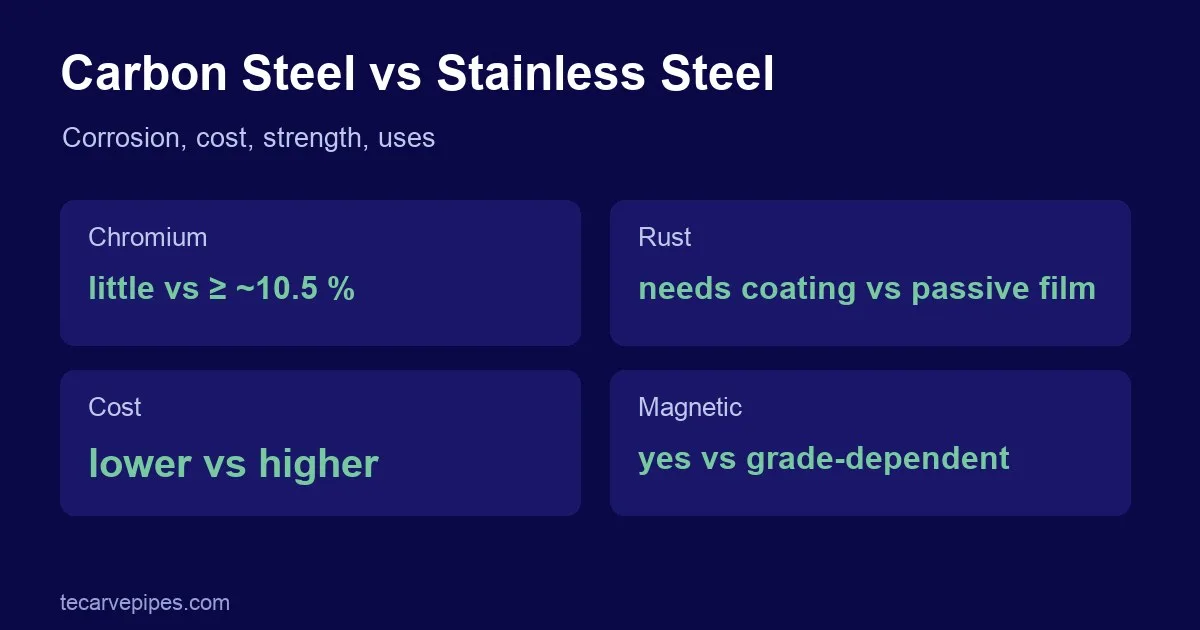

Carbon steel vs stainless steel: both are iron-based steels. Stainless steel contains at least about 10.5 % chromium, which forms a thin self-repairing oxide film and stops ordinary rusting. Carbon steel has no such film, so it costs less but needs coating, painting or a corrosion allowance.
The main differences
| Carbon steel | Stainless steel | |
|---|---|---|
| Alloying | Iron and carbon with small amounts of manganese and silicon | Iron with at least about 10.5 % chromium; 300 series also contains nickel, 316 adds molybdenum |
| Corrosion | Rusts in moist air and water; needs paint, galvanizing, lining or extra wall thickness | Passive chromium oxide film; resistance depends on grade |
| Cost | Lower material cost | Higher material cost; often lower life-cycle cost where corrosion would force replacement or maintenance |
| Strength | Wide range by grade and heat treatment | Austenitic pipe grades such as TP304 and TP316: 75 ksi [515 MPa] tensile, 30 ksi [205 MPa] yield minimum (ASTM A312) |
| Magnetism | Magnetic | Austenitic grades non-magnetic when annealed; ferritic, martensitic and duplex grades magnetic |
| Hygiene and product purity | Rust and scale can contaminate the product | Used for food, pharmaceutical and high-purity service |
| Welding | Straightforward with common processes | Needs control of heat input and removal of heat tint; filler metal matched to grade |
| Typical pipe specifications | ASTM A53, A106 | ASTM A312 (pipe), A269 (tubing), A270 (sanitary) |
When carbon steel is the right choice
- Dry or non-corrosive service such as structural members, oil, steam and many hydrocarbon lines where the fluid does not attack carbon steel.
- Large-diameter, high-volume pipelines where material cost dominates and coating or cathodic protection is practical.
- Applications where paint and inspection are routine and cheap.
When stainless steel pays back
- Water, chlorides, acids, food, beverage, pharmaceutical and other services where rust is not acceptable in the product.
- Thin-wall tube and instrument lines, where a carbon steel corrosion allowance would double the wall.
- Places where painting, maintenance or shutdown for replacement costs more than the material difference.
Which stainless grade
304/304L is the general-purpose choice; 316/316L adds molybdenum for chlorides; duplex 2205 adds strength; ferritic 430 and 201 are lower-cost options for dry decorative use. See the 304 vs 316 vs 316L guide, 430 stainless steel and 201 stainless steel.
A middle option: stainless clad pipe
For large, thick-walled pipe in corrosive service, stainless steel clad pipe bonds a stainless layer to a carbon steel base: the carbon steel carries the pressure and the stainless layer resists corrosion. See also thick-walled stainless pipe vs carbon steel in reactors.
Can carbon and stainless steel be joined?
Yes, by welding with a suitable dissimilar-metal filler, or with flanges. In a wet environment the carbon steel side corrodes faster where the two are in electrical contact, so insulating gaskets and sleeves are used at flanged joints where that matters. Carbon steel tools and brushes should not be used on stainless steel, because embedded iron particles rust on the surface; see the passivation guide.
Frequently asked questions
Is stainless steel stronger than carbon steel?
Not necessarily. Strength depends on grade and heat treatment for both. Austenitic stainless pipe such as TP304 has 515 MPa minimum tensile and 205 MPa minimum yield strength in ASTM A312; many carbon steels are comparable or stronger, and duplex stainless grades are stronger still.
Why is stainless steel more expensive than carbon steel?
Its alloying elements, mainly chromium and nickel and, in 316, molybdenum, cost more than iron, and processing such as annealing and pickling adds cost.
Does stainless steel rust?
Stainless steel resists ordinary rusting because of its chromium oxide film, but it can stain or pit in chlorides, and embedded iron from carbon steel tools can rust on its surface.
Can I weld carbon steel to stainless steel?
Yes, with a suitable dissimilar-metal filler metal and procedure. Where the joint is wet, galvanic corrosion of the carbon steel side should be considered.