

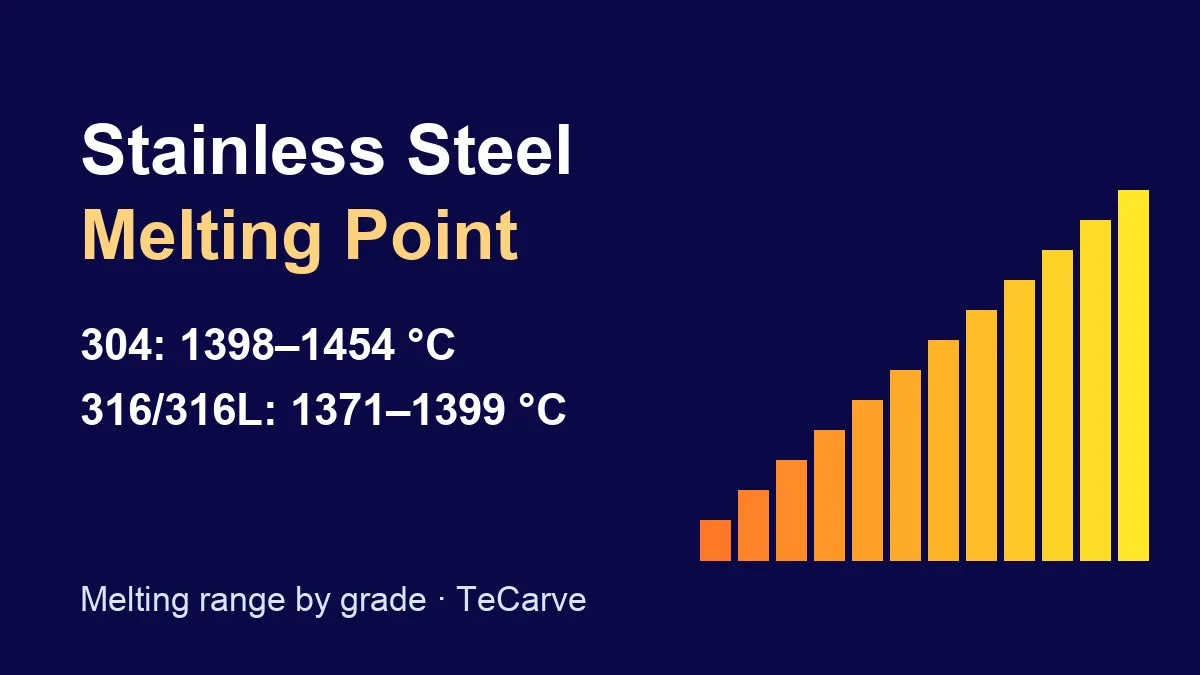

Stainless steel does not melt at a single temperature. It melts over a range, from the solidus, where melting starts, to the liquidus, where it is fully liquid. Type 304 melts at about 1,398–1,454 °C (2,550–2,650 °F) and 316 and 316L at about 1,371–1,399 °C (2,500–2,550 °F). The table below lists melting ranges by grade, each taken from a named producer or industry data sheet.
Melting range of stainless steel by grade
| Grade | UNS | EN | Melting range, °C | °F | Source |
|---|---|---|---|---|---|
| 304 | S30400 | 1.4301 | 1398–1454 | 2550–2650 | SSINA Designer Handbook, Table 10; AK Steel 304/304L data sheet (2007) gives 1399–1454 °C |
| 304L | S30403 | 1.4307 | 1399–1454 | 2550–2650 | AK Steel 304/304L product data sheet (2007) |
| 316 | S31600 | 1.4401 | 1371–1399 | 2500–2550 | ASM Alloy Digest SS-865, AK Steel 316 (Oct 2002) |
| 316L | S31603 | 1.4404 | 1371–1399 | 2500–2550 | ASM Alloy Digest SS-872, AK Steel 316L (Jan 2003) |
| 321 | S32100 | 1.4541 | 1371–1399 | 2500–2550 | AK Steel 321 product data bulletin (Rev. 04.25.13) |
| 2205 duplex | S32205 / S31803 | 1.4462 | 1385–1440 | 2525–2625 | ATI AL 2205 Technical Data Blue Sheet (2008) |
| 430 | S43000 | 1.4016 | 1427–1510 | 2600–2750 | SSINA Designer Handbook, Table 10 |
| 410 | S41000 | 1.4006 | 1483–1532 | 2700–2790 | SSINA Designer Handbook, Table 10 |
| PH 13-8 Mo | S13800 | — | 1404–1440 | 2560–2625 | SSINA Designer Handbook, Table 10 |
The values are typical data, not specification limits; the data sheets state that their figures are for general information and not for design. The exact range for a heat depends on its actual composition. EN numbers are linked to UNS numbers through EN 10088-1:2023, Annex A. EN 10088-1 itself does not list melting ranges, so they are not given here for grades without a producer or industry source, such as 310S, 904L and 2507.
Melting point of steel: carbon steel vs stainless steel
Steel is an alloy, so it has no single melting point; the value depends on composition. Carbon steel safety data sheets often give a single figure; for example, the Gerdau carbon steel safety data sheet (revision 12/21/2017) lists a melting point of 1540 °C (2804 °F). The stainless grades in the table above melt over ranges that start lower: 304 begins to melt at about 1398 °C and 316 / 316L at about 1371 °C, roughly 86 to 169 °C below that carbon steel figure, while ferritic 430 (1427–1510 °C) and martensitic 410 (1483–1532 °C) come closer to it.
| Steel | Melting point or range | Source |
|---|---|---|
| Carbon steel | 1540 °C (2804 °F) | Gerdau carbon steel SDS, rev. 2017 (single value) |
| 304 / 304L | 1398–1454 °C (2550–2650 °F) | SSINA Designer Handbook, Table 10 |
| 316 / 316L | 1371–1399 °C (2500–2550 °F) | ASM Alloy Digest SS-865 / SS-872 |
| 430 | 1427–1510 °C (2600–2750 °F) | SSINA Designer Handbook, Table 10 |
| 410 | 1483–1532 °C (2700–2790 °F) | SSINA Designer Handbook, Table 10 |
Why the melting range matters less than the service limits
Stainless steel tubes and pipes are used far below their melting range. The practical limits are the scaling temperature in air, the solution-annealing temperature used in manufacture, and the allowable stress of the design code at temperature. The same data sheets give, for example:
- 304 / 304L: maximum about 899 °C (1,650 °F) in continuous service and about 816 °C (1,500 °F) intermittently without appreciable scaling; annealing at 1,038–1,121 °C (1,900–2,050 °F) followed by rapid cooling (AK Steel 304/304L data sheet).
- 316L: about 927 °C (1,700 °F) continuous and 871 °C (1,600 °F) intermittent; annealing at 1,065–1,116 °C (1,950–2,040 °F) (ASM Alloy Digest SS-872).
For pressure service, use the allowable stresses of the applicable code rather than these scaling limits.
Melting point vs melting range
A pure metal melts at one temperature; an alloy such as stainless steel melts between its solidus and liquidus. Chromium, nickel, molybdenum and carbon contents shift both ends of the range, which is why 316 and 316L, with molybdenum and higher nickel, list a lower range than 304 in the sources above, and the 13–17% chromium ferritic and martensitic grades 410 and 430 list higher ranges.
Related data
Designations of each grade across UNS, EN, JIS and GB are in the stainless steel grades chart.
Density, thermal expansion, thermal conductivity and specific heat by grade are listed in stainless steel density and physical properties. Minimum tensile and yield strength from ASTM A312 and A790 are in the ksi to MPa converter.