

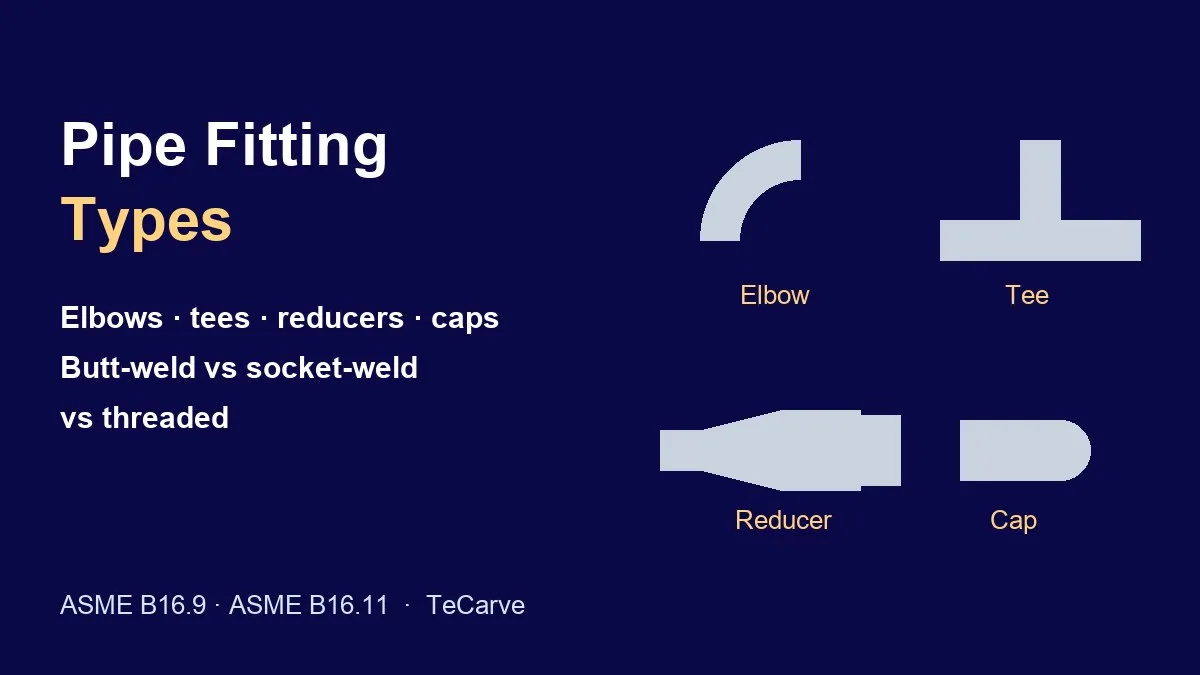

Pipe fittings join lengths of pipe and change the direction, size or branching of a line. The main types are elbows, returns, tees, crosses, reducers, caps, stub ends, couplings, plugs and bushings. In steel piping they are made in three connection families: butt-weld fittings to ASME B16.9, and socket-weld and threaded forged fittings to ASME B16.11. This guide lists each fitting type, which standard covers it, and how the three families differ.
Types of pipe fittings and their standards
Fitting types listed in the dimension tables of ASME B16.9-2024 and in Table 1.1.1-1 of ASME B16.11-2021:
| Fitting | What it does | Butt-weld (ASME B16.9) | Socket-weld / threaded (ASME B16.11) |
|---|---|---|---|
| 90° and 45° elbow | Changes direction. Butt-weld elbows come in long radius, short radius and 3D radius | Yes (Tables 6.1-1, 6.1-4, 6.1-6); see elbow dimensions | Yes |
| Reducing elbow | Changes direction and size in one fitting | Yes, long radius (Table 6.1-2) | – |
| 180° return | Turns the line back on itself | Yes, long and short radius (Tables 6.1-3, 6.1-5) | – |
| Street elbow | Elbow with one male and one female thread | – | Yes, threaded only |
| Straight (equal) tee and cross | Branch of the same size as the run | Yes (Table 6.1-7) | Yes |
| Reducing tee and reducing cross | Branch smaller than the run | Yes, reducing outlet (Table 6.1-8) | Yes |
| Concentric and eccentric reducer | Joins two pipe sizes on a common or offset axis | Yes (Table 6.1-11); see concentric vs eccentric reducer | – |
| Cap | Closes the end of a pipe | Yes (Table 6.1-10) | Yes |
| Lap joint stub end | Used with a lap joint flange so the flange can rotate | Yes (Table 6.1-9); see flange types | – |
| Coupling, half-coupling, couplet, boss | Joins two pipes, or provides a branch connection on a pipe or vessel | – | Yes |
| Plug and bushing | Plug closes a female thread; bushing reduces a thread size | – | Yes, threaded only (not identified by class; up to Class 6000) |
Butt-weld vs socket-weld vs threaded fittings
| Butt-weld fittings | Socket-weld fittings | Threaded fittings | |
|---|---|---|---|
| Standard | ASME B16.9 (factory-made wrought) | ASME B16.11 (forged) | ASME B16.11 (forged) |
| Sizes | NPS 1/2 to 48 (DN 15 to 1200) | Up to NPS 4 in Table 1.1.1-1, depending on fitting and class | Up to NPS 4 in Table 1.1.1-1, depending on fitting and class |
| Pressure rating | Calculated as for straight seamless pipe of equivalent material and wall; the fitting is marked with the wall or schedule instead of a pressure rating | Class 3000, 6000 or 9000 | Class 2000, 3000 or 6000 |
| Joint | Welded to the pipe end; B16.9 section 8 covers the welding bevel | Pipe inserted into the socket and fillet welded | Screwed onto a threaded pipe end (pipe thread sizes: NPT thread size chart) |
- Butt-weld fittings (ASME B16.9): the standard covers overall dimensions, tolerances, ratings, testing and markings for factory-made wrought buttwelding fittings. Fabricated laterals and other fittings made with circumferential or intersection welds count as pipe fabrication and are outside its scope; fabricated lap joint stub ends are the exception, provided they meet the ASTM material specification.
- Socket-weld fittings (ASME B16.11): the minimum body wall must be at least the nominal wall of the pipe used, and the average socket wall at least 1.25 times the nominal pipe wall, never less than 1.09 times at any point.
- Threaded fittings (ASME B16.11): the minimum body wall must be at least the nominal wall of the pipe used. Threaded pipe needs enough wall left under the thread; ASME B36.19 states that Schedule 5S and 10S stainless walls do not permit threading to ASME B1.20.1.
- Neither standard sets criteria for choosing fitting types or materials for a particular fluid service; that is left to the piping code and the designer. Installation welding is also outside both standards.
Socket-weld and threaded fitting classes
ASME B16.11 relates each class to a pipe schedule or wall designation for calculating the rating:
| Fitting class | Type | Pipe used for the rating basis (Table 2.1.1-1) |
|---|---|---|
| 2000 | Threaded | Schedule 80 / XS |
| 3000 | Threaded | Schedule 160 |
| 6000 | Threaded | XXS |
| 3000 | Socket-weld | Schedule 80 / XS |
| 6000 | Socket-weld | Schedule 160 |
| 9000 | Socket-weld | XXS |
Note (1) to Table 2.1.1-1: the table does not restrict the use of thinner or thicker pipe. When thinner pipe is used, its strength may govern the rating; when thicker pipe is used, the strength of the fitting governs.
How fittings are marked and how reducing sizes are read
- Butt-weld marking (B16.9, 4.1): manufacturer’s name or trademark, ASTM or ASME grade, wall thickness identification (STD, XS, XXS or schedule number per ASME B36.10 and B36.19) or nominal wall, and NPS. A “WP” prefix in the grade marking certifies that the fitting conforms to B16.9, including all dimensional requirements.
- Forged fitting marking (B16.11, 4.1.1): manufacturer’s name or trademark, material, conformance (“WP” or “B16”), class (2000, 3000, 6000, 9000, or 2M, 3M, 6M, 9M) and NPS.
- Reducing tees and crosses (B16.11, 3.2): the largest run opening is given first, then the opposite end of the run; for a tee the branch is given last.
- Size: NPS is related to DN; for NPS above 4, DN = 25 × NPS (B16.9, section 3). See the pipe size and schedule chart.
Stainless steel fittings: material specification
ASTM A403/A403M-26 covers wrought austenitic stainless steel fittings for pressure piping. Its grades carry the prefix WP (fittings to ASME dimensional and rating standards such as B16.9) or CR (fittings to MSS standards), and for each WP grade the class shows whether the fitting is seamless or welded and the extent of nondestructive examination. Flanges are a separate family under ASME B16.5; see flange types and weld neck flange dimensions. Sanitary process lines use clamp fittings instead; see tri-clamp dimensions.
More charts and standards guides are listed under technical resources.
Sources: ASME B16.9-2024, Factory-Made Wrought Buttwelding Fittings, sections 1 to 4 and the list of dimension tables; ASME B16.11-2021, Forged Fittings, Socket-Welding and Threaded, sections 1 to 4, Tables 1.1.1-1 and 2.1.1-1; ASTM A403/A403M-26, section 1; ASME B36.19, section 7.