

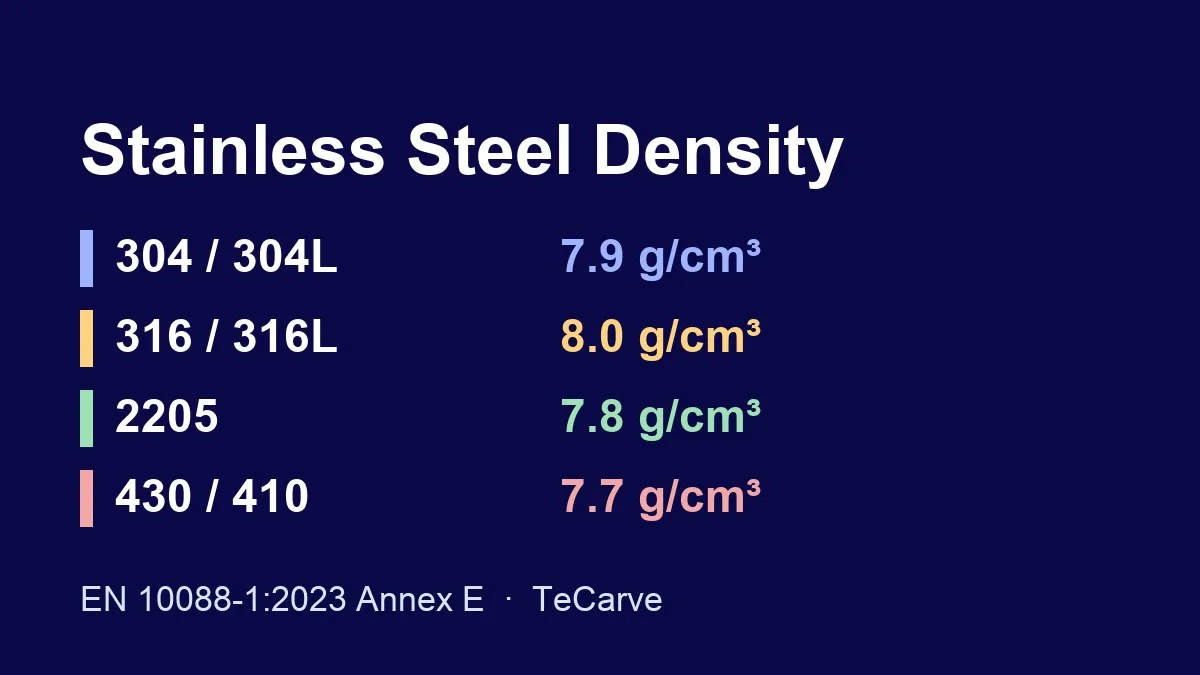

The density of stainless steel is 7.9 g/cm³ (7,900 kg/m³) for 304 and 304L, 8.0 g/cm³ for 316 and 316L, 7.8 g/cm³ for duplex grades such as 2205, and 7.7 g/cm³ for ferritic and martensitic grades such as 430 and 410. These are the guidance values in EN 10088-1:2023, Annex E. The tables below give density by grade, with modulus of elasticity, thermal expansion, thermal conductivity, specific heat and electrical resistivity from the same source.
Stainless steel density by grade
Density is given in EN 10088-1 to one decimal place in kg/dm³, which equals g/cm³. The kg/m³ and lb/in³ columns are unit conversions of that value (1 g/cm³ = 1,000 kg/m³ = 0.036127 lb/in³). Grade names are linked to EN numbers and UNS numbers through EN 10088-1:2023, Annex A, Table A.1.
| Grade | EN number | UNS | Density g/cm³ | kg/m³ | lb/in³ | Family |
|---|---|---|---|---|---|---|
| 304 | 1.4301 | S30400 | 7.9 | 7900 | 0.285 | Austenitic |
| 304L | 1.4307 | S30403 | 7.9 | 7900 | 0.285 | Austenitic |
| 321 | 1.4541 | S32100 | 7.9 | 7900 | 0.285 | Austenitic |
| 347 | 1.4550 | S34700 | 7.9 | 7900 | 0.285 | Austenitic |
| 316 | 1.4401 | S31600 | 8.0 | 8000 | 0.289 | Austenitic |
| 316L | 1.4404 | S31603 | 8.0 | 8000 | 0.289 | Austenitic |
| 316Ti | 1.4571 | S31635 | 8.0 | 8000 | 0.289 | Austenitic |
| 317L | 1.4438 | S31703 | 8.0 | 8000 | 0.289 | Austenitic |
| 6Mo (254 type) | 1.4547 | S31254 | 8.0 | 8000 | 0.289 | Austenitic |
| 904L | 1.4539 | N08904 | 8.0 | 8000 | 0.289 | Austenitic |
| 309S | 1.4833 | S30908 | 7.9 | 7900 | 0.285 | Heat-resistant austenitic |
| 310S | 1.4845 | S31008 | 7.9 | 7900 | 0.285 | Heat-resistant austenitic |
| 2304 | 1.4362 | S32304 | 7.8 | 7800 | 0.282 | Duplex |
| 2205 | 1.4462 | S32205 | 7.8 | 7800 | 0.282 | Duplex |
| 2507 | 1.4410 | S32750 | 7.8 | 7800 | 0.282 | Super duplex |
| 409 | 1.4512 | S40900 | 7.7 | 7700 | 0.278 | Ferritic |
| 430 | 1.4016 | S43000 | 7.7 | 7700 | 0.278 | Ferritic |
| 439 | 1.4509 | S43940 | 7.7 | 7700 | 0.278 | Ferritic |
| 410 | 1.4006 | S41000 | 7.7 | 7700 | 0.278 | Martensitic |
| 420 | 1.4021 | S42000 | 7.7 | 7700 | 0.278 | Martensitic |
Physical properties of stainless steel grades at 20 °C
Modulus of elasticity at 20 °C, mean coefficient of thermal expansion between 20 °C and 100 °C, and thermal conductivity, specific heat capacity and electrical resistivity at 20 °C, all from EN 10088-1:2023, Annex E. “—” means the table gives no value for that temperature (Table E.5 for heat-resistant grades starts thermal expansion at 200 °C: 15.5 × 10⁻⁶/K for 1.4845 and 16.0 for 1.4833 between 20 °C and 200 °C).
| Grade | EN | E, GPa | α 20–100 °C, 10⁻⁶/K | λ, W/(m·K) | c, J/(kg·K) | ρe, Ω·mm²/m | Magnetizable |
|---|---|---|---|---|---|---|---|
| 304 | 1.4301 | 200 | 16.0 | 15 | 500 | 0.73 | No |
| 304L | 1.4307 | 200 | 16.0 | 15 | 500 | 0.73 | No |
| 321 | 1.4541 | 200 | 16.0 | 15 | 500 | 0.73 | No |
| 347 | 1.4550 | 200 | 16.0 | 15 | 500 | 0.73 | No |
| 316 | 1.4401 | 200 | 16.0 | 15 | 500 | 0.75 | No |
| 316L | 1.4404 | 200 | 16.0 | 15 | 500 | 0.75 | No |
| 316Ti | 1.4571 | 200 | 16.5 | 15 | 500 | 0.75 | No |
| 317L | 1.4438 | 200 | 16.0 | 14 | 500 | 0.85 | No |
| 6Mo (254 type) | 1.4547 | 195 | 16.5 | 14 | 500 | 0.85 | No |
| 904L | 1.4539 | 195 | 15.8 | 12 | 450 | 1.00 | No |
| 309S | 1.4833 | — | — | 15 | 500 | 0.78 | No |
| 310S | 1.4845 | — | — | 15 | 500 | 0.85 | No |
| 2304 | 1.4362 | 200 | 13.0 | 15 | 500 | 0.8 | Yes |
| 2205 | 1.4462 | 200 | 13.0 | 15 | 500 | 0.8 | Yes |
| 2507 | 1.4410 | 200 | 13.0 | 15 | 500 | 0.8 | Yes |
| 409 | 1.4512 | 220 | 10.5 | 25 | 460 | 0.60 | Yes |
| 430 | 1.4016 | 220 | 10.0 | 25 | 460 | 0.60 | Yes |
| 439 | 1.4509 | 220 | 10.0 | 25 | 460 | 0.60 | Yes |
| 410 | 1.4006 | 215 | 10.5 | 30 | 460 | 0.60 | Yes |
| 420 | 1.4021 | 215 | 10.5 | 30 | 460 | 0.60 | Yes |
Austenitic grades are listed as not magnetizable in the annealed condition; EN 10088-1 notes that martensite formed by cold deformation, or small amounts of ferrite, increase magnetizability.
Why data sheets show 7.93, 8.03 or 7.99 instead of 7.9
EN 10088-1 gives one guidance value per grade, rounded to 0.1 g/cm³. Producer data sheets quote typical values to more digits, and they differ slightly from one another:
- 304 / 304L: EN 10088-1 7.9 g/cm³; AK Steel 304/304L product data sheet (2007) 8.03 g/cm³; SSINA Designer Handbook, Table 10, 8,060 kg/m³ for Type 304; Atlas Steels Technical Handbook, Appendix 3, 7,900 kg/m³.
- 316 / 316L: EN 10088-1 8.0 g/cm³; ASM Alloy Digest SS-865 (AK Steel 316, 2002) and SS-872 (AK Steel 316L, 2003) 7,990 kg/m³; Atlas Steels 8,000 kg/m³.
- 2205: EN 10088-1 7.8 g/cm³; ATI AL 2205 Technical Data Blue Sheet (2008) 7.82 g/cm³.
- Pipe weight tables (JIS): JIS G3459:2016, Table 10, which defines how the unit mass of stainless steel pipe is calculated, uses 7.93 for 304/304L/321; 7.98 for 309S/310S/316/316L/317L/347; 7.80 for SUS329J1/J3L/J4L (duplex, including the 2205 type); 7.75 for 405/409L/444; 7.70 for 430/436L; 8.06 for SUS836L and 8.05 for SUS890L (904L type). This is where the common figures 7.93 and 7.98 come from.
For weight estimates the difference is about 1–2%. If a contract or drawing names a density, use that value; otherwise the EN 10088-1 figure is a documented, neutral reference. The stainless steel weight calculator uses the EN 10088-1 values and lets you enter a custom density.
Related data
UNS, EN, JIS and GB equivalents for these grades are listed in the stainless steel grades chart.
Thermal expansion from 20 to 500 °C and modulus of elasticity at temperature for the same grades are in stainless steel thermal expansion and thermal conductivity by grade.
For melting ranges by grade, see stainless steel melting point; for strength values, the ksi to MPa converter lists minimum tensile and yield strength from ASTM A312 and A790; for pipe weights by schedule, the pipe schedule chart.