

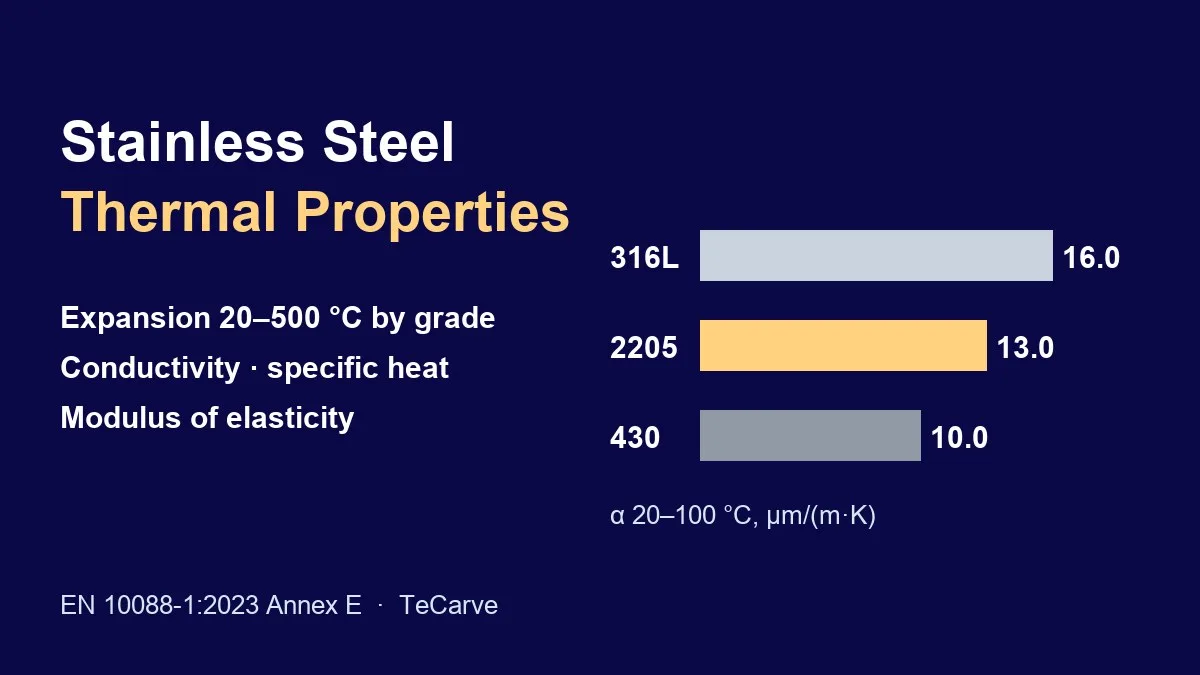

Austenitic stainless steels such as 304 and 316 have a thermal conductivity of about 15 W/(m·K) at 20 °C and a mean coefficient of thermal expansion of 16.0 × 10⁻⁶/K between 20 and 100 °C, rising to 18.0 × 10⁻⁶/K between 20 and 500 °C. Ferritic grades such as 430 conduct heat better (25 W/(m·K)) and expand less (10.0 × 10⁻⁶/K), and duplex 2205 sits between them (15 W/(m·K), 13.0 × 10⁻⁶/K). The tables below give the values by grade and temperature from EN 10088-1:2023, Annex E.
Stainless steel thermal conductivity and specific heat by grade (20 °C)
Guidance values at 20 °C from EN 10088-1:2023 Annex E, Tables E.1 to E.4. Annex E gives thermal conductivity and specific heat at 20 °C only. UNS numbers are those listed against each EN number in Table A.1 of the same standard.
| Grade | EN number | UNS | Family | Thermal conductivity at 20 °C, W/(m·K) | Specific heat at 20 °C, J/(kg·K) | Mean thermal expansion 20–100 °C, 10⁻⁶/K |
|---|---|---|---|---|---|---|
| 304 | 1.4301 | S30400 | Austenitic | 15 | 500 | 16.0 |
| 304L | 1.4307 | S30403 | Austenitic | 15 | 500 | 16.0 |
| 316 | 1.4401 | S31600 | Austenitic | 15 | 500 | 16.0 |
| 316L | 1.4404 | S31603 | Austenitic | 15 | 500 | 16.0 |
| 316Ti | 1.4571 | S31635 | Austenitic | 15 | 500 | 16.5 |
| 317L | 1.4438 | S31703 | Austenitic | 14 | 500 | 16.0 |
| 321 | 1.4541 | S32100 | Austenitic | 15 | 500 | 16.0 |
| 347 | 1.4550 | S34700 | Austenitic | 15 | 500 | 16.0 |
| 904L | 1.4539 | N08904 | Austenitic | 12 | 450 | 15.8 |
| 2304 | 1.4362 | S32304 | Duplex | 15 | 500 | 13.0 |
| 2205 | 1.4462 | S32205 | Duplex | 15 | 500 | 13.0 |
| 2507 | 1.4410 | S32750 | Duplex | 15 | 500 | 13.0 |
| 409 | 1.4512 | S40900 | Ferritic | 25 | 460 | 10.5 |
| 430 | 1.4016 | S43000 | Ferritic | 25 | 460 | 10.0 |
| 439 | 1.4509 | S43940 | Ferritic | 25 | 460 | 10.0 |
| 410 | 1.4006 | S41000 | Martensitic | 30 | 460 | 10.5 |
Coefficient of thermal expansion of stainless steel by temperature
Mean coefficient of linear thermal expansion between 20 °C and the temperature in each column, 10⁻⁶/K (equal to µm/(m·K)). A dash means Annex E gives no value at that temperature: the duplex table stops at 300 °C and the martensitic table at 400 °C.
| Grade | EN number | 20–100 °C | 20–200 °C | 20–300 °C | 20–400 °C | 20–500 °C |
|---|---|---|---|---|---|---|
| 304 | 1.4301 | 16.0 | 16.5 | 17.0 | 17.5 | 18.0 |
| 304L | 1.4307 | 16.0 | 16.5 | 17.0 | 18.0 | 18.0 |
| 316 | 1.4401 | 16.0 | 16.5 | 17.0 | 17.5 | 18.0 |
| 316L | 1.4404 | 16.0 | 16.5 | 17.0 | 17.5 | 18.0 |
| 316Ti | 1.4571 | 16.5 | 17.5 | 18.0 | 18.5 | 19.0 |
| 317L | 1.4438 | 16.0 | 16.5 | 17.0 | 17.5 | 18.0 |
| 321 | 1.4541 | 16.0 | 16.5 | 17.0 | 17.5 | 18.0 |
| 347 | 1.4550 | 16.0 | 16.5 | 17.0 | 17.5 | 18.0 |
| 904L | 1.4539 | 15.8 | 16.1 | 16.5 | 16.9 | 17.3 |
| 2304 | 1.4362 | 13.0 | 13.5 | 14.0 | – | – |
| 2205 | 1.4462 | 13.0 | 13.5 | 14.0 | – | – |
| 2507 | 1.4410 | 13.0 | 13.5 | 14.0 | – | – |
| 409 | 1.4512 | 10.5 | 11.0 | 11.5 | 12.0 | 12.0 |
| 430 | 1.4016 | 10.0 | 10.0 | 10.5 | 10.5 | 11.0 |
| 439 | 1.4509 | 10.0 | 10.0 | 10.5 | 10.5 | – |
| 410 | 1.4006 | 10.5 | 11.0 | 11.5 | 12.0 | – |
Modulus of elasticity of stainless steel by temperature
Modulus of elasticity in GPa from the same tables. The austenitic grades fall from 200 GPa at 20 °C to 165 GPa at 500 °C; the ferritic grades start higher, at 220 GPa.
| Grade | EN number | 20 °C | 100 °C | 200 °C | 300 °C | 400 °C | 500 °C |
|---|---|---|---|---|---|---|---|
| 304 | 1.4301 | 200 | 194 | 186 | 179 | 172 | 165 |
| 304L | 1.4307 | 200 | 194 | 186 | 179 | 172 | 165 |
| 316 | 1.4401 | 200 | 194 | 186 | 179 | 172 | 165 |
| 316L | 1.4404 | 200 | 194 | 186 | 179 | 172 | 165 |
| 316Ti | 1.4571 | 200 | 194 | 186 | 179 | 172 | 165 |
| 317L | 1.4438 | 200 | 194 | 186 | 179 | 172 | 165 |
| 321 | 1.4541 | 200 | 194 | 186 | 179 | 172 | 165 |
| 347 | 1.4550 | 200 | 194 | 186 | 179 | 172 | 165 |
| 904L | 1.4539 | 195 | 190 | 182 | 174 | 166 | 158 |
| 2304 | 1.4362 | 200 | 194 | 186 | 180 | – | – |
| 2205 | 1.4462 | 200 | 194 | 186 | 180 | – | – |
| 2507 | 1.4410 | 200 | 194 | 186 | 180 | – | – |
| 409 | 1.4512 | 220 | 215 | 210 | 205 | 195 | – |
| 430 | 1.4016 | 220 | 215 | 210 | 205 | 195 | – |
| 439 | 1.4509 | 220 | 215 | 210 | 205 | 195 | – |
| 410 | 1.4006 | 215 | 212 | 205 | 200 | 190 | – |
Heat-resistant grades 309S and 310S up to 1000 °C
For the heat-resistant austenitic steels, EN 10088-1 Table E.5 gives the mean coefficient of thermal expansion between 20 °C and 200 °C to 1000 °C (10⁻⁶/K):
| Grade | EN number | UNS | 20–200 °C | 20–400 °C | 20–600 °C | 20–800 °C | 20–1000 °C | Thermal conductivity at 20 °C, W/(m·K) |
|---|---|---|---|---|---|---|---|---|
| 310S | 1.4845 | S31008 | 15.5 | 17.0 | 17.5 | 18.5 | 19.0 | 15 |
| 309S | 1.4833 | S30908 | 16.0 | 17.5 | 18.0 | 18.5 | 19.5 | 15 |
How much does a stainless steel tube expand?
Use the mean coefficient for the temperature range: ΔL = α × L × (T − 20 °C). For a 6 m (6000 mm) tube heated from 20 °C to 200 °C:
| Grade | α, 20–200 °C (10⁻⁶/K) | Expansion of 6 m tube, 20 → 200 °C |
|---|---|---|
| 316L | 16.5 | 17.8 mm |
| 2205 | 13.5 | 14.6 mm |
| 430 | 10.0 | 10.8 mm |
- Heat exchangers: in a fixed tubesheet exchanger, tubes and shell at different temperatures, or of different metals, expand by different amounts; this differential expansion is why an expansion joint, a U-tube bundle or a floating head may be needed (see the shell and tube heat exchanger guide).
- Piping: between 20 and 100 °C an austenitic stainless line expands about 60% more than a ferritic stainless line (16.0 vs 10.0 × 10⁻⁶/K), so the routing, loops and supports must allow for it.
- Heat transfer through the wall: austenitic grades conduct heat less well than ferritic grades (15 vs 25 W/(m·K) at 20 °C), so the tube wall thickness matters more; wall thickness by gauge is in the tube gauge chart.
Notes on the data
- EN 10088-1:2023 Annex E is informative: the values are guidance data, not guaranteed properties of a delivered tube.
- Annex E lists the austenitic grades as not magnetizable, with a footnote that martensite caused by cold deformation or small amounts of ferrite increase magnetizability; see is stainless steel magnetic.
- Density for the same grades is in stainless steel density by grade; melting ranges are in stainless steel melting point; grade equivalents are in the stainless steel grades chart.
Source: EN 10088-1:2023, Stainless steels, Part 1: List of stainless steels, Annex E (informative), Tables E.1 to E.5, and Table A.1 for UNS numbers.