

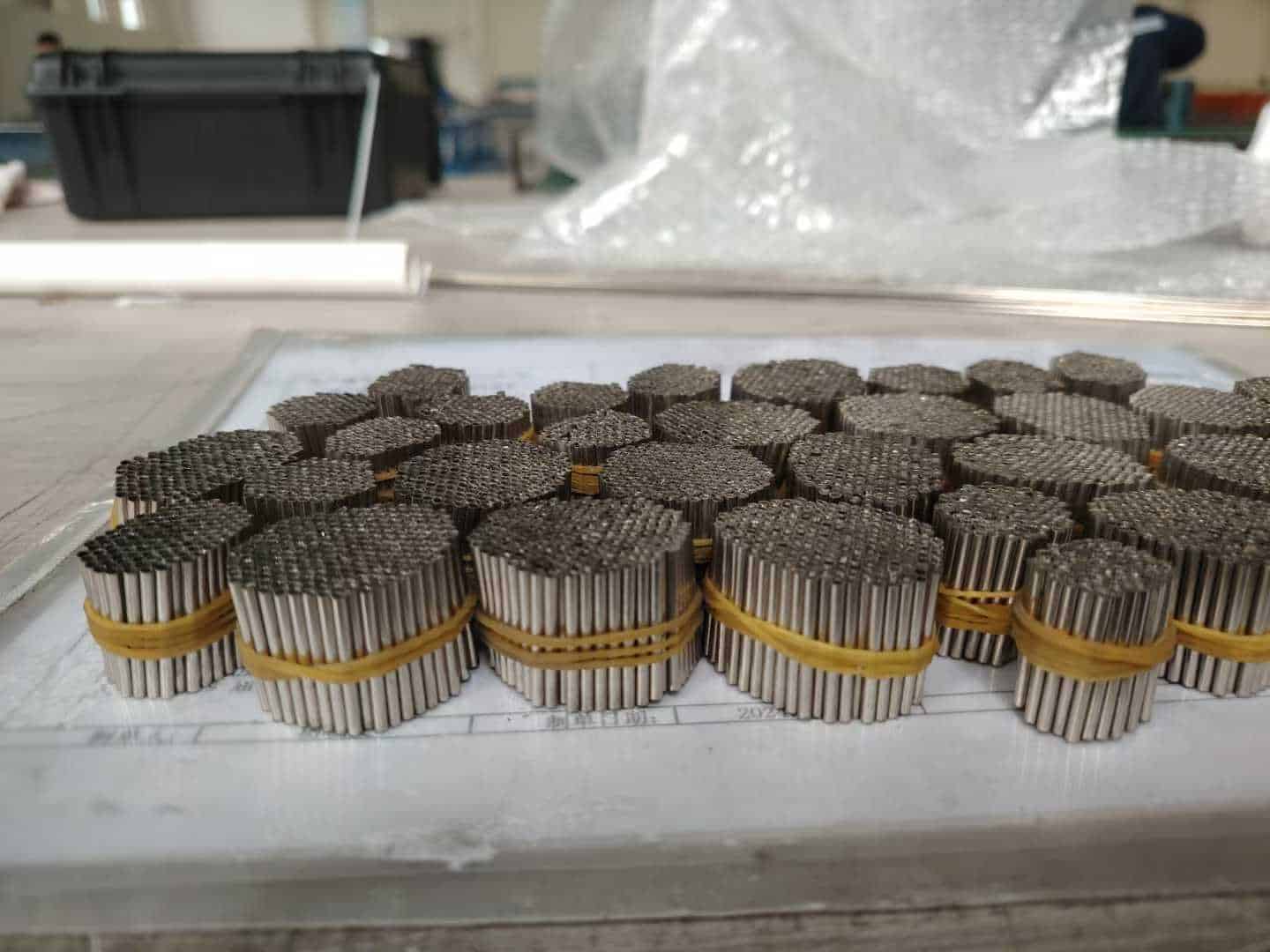

ISO 9626 is the international standard governing rigid stainless steel needle tubing used in the manufacture of hypodermic needles and other medical devices primarily for human use. The current edition, EN ISO 9626:2016 (which supersedes EN ISO 9626:1995 and ISO 9626:1991), establishes dimensional tolerances, wall thickness classifications, surface cleanliness, and mechanical performance requirements across needle sizes from 0.18 mm (34G) to 3.40 mm (10G). This engineering guide outlines the scope of ISO 9626:2016, material selection criteria, dimensional designation methods, the complete needle gauge size table, stiffness and breakage requirements, and procurement guidelines for precision medical tubing.
Hypotube is the name used in medical device manufacturing for long, thin-walled metal tubing, most often stainless steel, used for needles, catheter shafts and other minimally invasive devices. Stainless steel hypotube sizes are usually specified by gauge and wall type using the ISO 9626 designations described below.
Summary for buyer reference; consult the current edition of the standard for full requirements. Governed by ISO 9626:2016 / EN ISO 9626:2016.
1. Scope: What ISO 9626 Covers
- Product type: Rigid stainless steel needle tubing suitable for use in the manufacture of hypodermic needles and other medical devices primarily for human use.
- Size range: Designated metric sizes from 0.18 mm (34 Gauge) to 3.40 mm (10 Gauge), defining outer diameter boundaries and minimum inner diameters.
- Wall thickness classes: Regular Wall (RW), Thin Wall (TW), Extra Thin Wall (ETW), and Ultra Thin Wall (UTW).
- Standard history: The second edition (ISO 9626:2016) cancels and replaces the first edition (ISO 9626:1991 / Amd 1:2001) and EN ISO 9626:1995. Key technical updates include the addition of specifications for stainless steel needle tubing for metric sizes 0.18 mm, 0.20 mm, 0.23 mm, and 0.25 mm to reflect the introduction of thinner tubing to allow greater comfort when injecting, particularly for infants and in paediatric use; the addition of wall thickness designations beyond regular-walled and thin-walled tubing (ETW and UTW); the addition of minimum inner diameters for additional items where possible; revision of the means of specifying steels to be used; and revision of the table of tubing dimensions and stiffness parameters.
- Exclusions: It does not apply to flexible stainless steel tubing because the mechanical properties differ from those specified for rigid tubing in this International Standard. However, manufacturers and purchasers of flexible tubing are encouraged to adopt the dimensional specifications given in this International Standard.
2. Materials and Biocompatibility
Clause 4 of ISO 9626:2016 specifies that tubing shall be made of stainless steels listed in ISO 15510 (Stainless steels — Chemical composition). The chosen materials shall be in accordance with the requirements indicated in the standard. Selection of specific stainless steel material shall be made in consideration with the intended use, e.g. long-term contact with drugs, and should consider biocompatibility requirements (suitable biocompatibility requirements can be found in ISO 10993-1).
Furthermore, in accordance with Clause 5.1, a risk-based approach shall be applied for the selection of tubing for a specific application and intended use.
3. Size Designation and Ordering Examples
Clause 5.5 of ISO 9626 specifies a standardized size designation formula combining the metric nominal outer diameter, corresponding gauge size, and wall thickness category:
Designated Metric Size (mm) + Gauge Size + Wall Thickness Type
Representative designation examples include:
0,25 mm (31G) ETW— Designated metric size 0.25 mm, 31 Gauge, Extra Thin Wall.0,50 mm (25G) RW— Designated metric size 0.50 mm, 25 Gauge, Regular Wall.0,80 mm (21G) TW— Designated metric size 0.80 mm, 21 Gauge, Thin Wall.1,10 mm (19G) UTW— Designated metric size 1.10 mm, 19 Gauge, Ultra Thin Wall.
4. Wall Thickness Classifications: RW, TW, ETW, and UTW
ISO 9626 recognizes four distinct wall thickness classes to balance structural column strength against fluid delivery capacity:
- Regular Wall (RW): Standard heavy-wall construction providing maximum rigidity, pushability, and resistance to bending deflection. Defined across all 25 metric sizes from 34G to 10G.
- Thin Wall (TW): Reduced wall thickness providing an enlarged internal bore while preserving mechanical stability. Defined across all 25 metric sizes from 34G to 10G.
- Extra Thin Wall (ETW): Ultra-reduced wall thickness engineered for fine-gauge applications, reducing puncture trauma while supporting rapid fluid flow. Defined for 16 sizes between 34G and 14G.
- Ultra Thin Wall (UTW): Maximum inner diameter configuration designed for high-viscosity biopharmaceutical injection and micro-volume delivery. Defined for 8 designated sizes (32G, 31G, 30G, 29G, 21G, 20G, 19G, and 17G).
Inner diameter rule: Note 3 of Table 1 explicitly states that ISO 9626 does not specify maximum inner diameter. The standard governs outer diameter boundaries (ODmin and ODmax) and enforces a minimum inner diameter (IDmin) for each wall type to guarantee minimum flow area.
5. Complete ISO 9626 Table 1: Dimensions of Needle Tubing
The following table provides the full dimensional criteria specified in Table 1 of ISO 9626:2016 for all 25 designated metric sizes (0.18 mm to 3.40 mm / 34G to 10G). All values are in millimetres (mm).
| Designated Metric Size (mm) | Gauge | ODmin (mm) | ODmax (mm) | RW IDmin (mm) | TW IDmin (mm) | ETW IDmin (mm) | UTW IDmin (mm) |
|---|---|---|---|---|---|---|---|
| 0.18 | 34G | 0.178 | 0.191 | 0.064 | 0.091 | 0.105 | – |
| 0.20 | 33G | 0.203 | 0.216 | 0.089 | 0.105 | 0.125 | – |
| 0.23 | 32G | 0.229 | 0.241 | 0.089 | 0.105 | 0.125 | 0.146 |
| 0.25 | 31G | 0.254 | 0.267 | 0.114 | 0.125 | 0.146 | 0.176 |
| 0.30 | 30G | 0.298 | 0.320 | 0.133 | 0.165 | 0.190 | 0.240 |
| 0.33 | 29G | 0.324 | 0.351 | 0.133 | 0.190 | 0.240 | 0.265 |
| 0.36 | 28G | 0.349 | 0.370 | 0.133 | 0.190 | – | – |
| 0.40 | 27G | 0.400 | 0.420 | 0.184 | 0.241 | – | – |
| 0.45 | 26G | 0.440 | 0.470 | 0.232 | 0.292 | – | – |
| 0.50 | 25G | 0.500 | 0.530 | 0.232 | 0.292 | – | – |
| 0.55 | 24G | 0.550 | 0.580 | 0.280 | 0.343 | – | – |
| 0.60 | 23G | 0.600 | 0.673 | 0.317 | 0.370 | 0.460 | – |
| 0.70 | 22G | 0.698 | 0.730 | 0.390 | 0.440 | 0.522 | – |
| 0.80 | 21G | 0.800 | 0.830 | 0.490 | 0.547 | 0.610 | 0.645 |
| 0.90 | 20G | 0.860 | 0.920 | 0.560 | 0.635 | 0.687 | 0.713 |
| 1.10 | 19G | 1.030 | 1.100 | 0.648 | 0.750 | 0.850 | 0.891 |
| 1.20 | 18G | 1.200 | 1.300 | 0.790 | 0.910 | 1.041 | – |
| 1.40 | 17G | 1.400 | 1.510 | 0.950 | 1.156 | 1.244 | 1.276 |
| 1.60 | 16G | 1.600 | 1.690 | 1.100 | 1.283 | 1.390 | – |
| 1.80 | 15G | 1.750 | 1.900 | 1.300 | 1.460 | 1.560 | – |
| 2.10 | 14G | 1.950 | 2.150 | 1.500 | 1.600 | 1.727 | – |
| 2.40 | 13G | 2.300 | 2.500 | 1.700 | 1.956 | – | – |
| 2.70 | 12G | 2.650 | 2.850 | 1.950 | 2.235 | – | – |
| 3.00 | 11G | 2.950 | 3.150 | 2.200 | 2.464 | – | – |
| 3.40 | 10G | 3.300 | 3.500 | 2.500 | 2.819 | – | – |
Source: EN ISO 9626:2016, Table 1. Notes from standard:
1. RW = Regular Wall; TW = Thin Wall; ETW = Extra Thin Wall; UTW = Ultra Thin Wall.
2. For needle sizes below 0.25 mm, consideration can be made to the measurement uncertainty of existing measurement equipment.
3. This International Standard does not specify maximum inner diameter.
4. OD = outer diameter; ID = inner diameter.
6. Mechanical, Chemical, and Surface Requirements
Beyond dimensional tolerances, ISO 9626 defines strict physical and metallurgical benchmarks to ensure patient safety and device integrity during clinical procedures:
- Stiffness (Clause 5.8 & Table 2): When tested in accordance with Annex B using a three-point bending fixture, the needle tubing must show a deflection not greater than the relevant maximum value specified in Table 2. Test conditions specify span length (mm ± 0.1) and applied bending force (N ± 0.1) according to outer diameter and wall thickness class. For sizes where parameters are marked “a” in Table 2 (no standard data available), the device manufacturer establishes stiffness criteria based on application risk assessment.
- Resistance to Breakage (Clause 5.9 & Annex C): Tubing is bent through (25 ± 1)° for RW, (20 ± 1)° for TW, or (15 ± 1)° for ETW and UTW, first in one direction and then the reverse, for 20 complete cycles at 0.5 Hz (Annex C), and must show no visible breakage when examined by normal or corrected vision.
- Resistance to Corrosion (Clause 5.10 & Annex D): With about half its length immersed in 0.5 mol/l sodium chloride solution at (23 ± 2) °C for 7 h ± 5 min (Annex D), the immersed half of the tubing must show no evidence of corrosion resulting from the test.
- Limits for Acidity and Alkalinity (Clause 5.4 & Annex A): When determined using a laboratory pH meter with a general-purpose electrode, the pH value of an aqueous extract prepared in accordance with Annex A must fall within 1 pH unit of the control fluid.
- Cleanliness (Clause 5.3): When examined by normal or corrected vision, the surfaces of the tubing must be free from metal soil and processing agents. Cleanliness specifications may differ based on the final function of the medical device, in which case the device manufacturer should prepare specific specifications.
- Surface Finish and Straightness (Clause 5.2): When examined by normal or corrected vision, the outside surface must be smooth and free from defects, and the needle tube must appear straight and of regular roundness.
How TeCarve Supplies ISO 9626 Needle Tubing
TeCarve is a specialized Chinese stainless steel piping solutions provider and the exclusive factory-direct export channel for two dedicated manufacturing plants in Foshan (welded & decorative tubing) and Wenzhou (seamless & precision tubing). Precision stainless steel needle tube production is anchored at the Wenzhou plant (seamless & precision tubing).
Our supply capabilities for medical and precision needle tubing include:
- Full ISO 9626 dimensional coverage: Precision cold-drawing across metric sizes from 0.18 mm (34G) to 3.40 mm (10G), supporting RW, TW, ETW, and UTW wall thickness configurations. Exact wall thickness class, cut length, and custom tolerances are confirmed upon inquiry.
- Complementary product range: Alongside standard needle tubing, the Wenzhou plant produces precision stainless steel capillary tube and fabricated medical devices & components. For engineering comparisons between tubing types, consult our capillary tube vs. needle tube guide.
- Material traceability: Every order ships with an EN 10204 3.1 mill test certificate issued by the producing plant, documenting melt heat numbers, optical emission chemical analysis, tensile values, and dimensional inspection.
- Order quantities and lead times: For available sizes and order quantities, see our needle tube page. Standard production lead times run 10–25 days from order to shipment approval, with technical RFQ evaluations completed within 24 hours.
Submit your designated metric size or gauge, wall thickness class, quantity, and length requirements to sales@tecarve.com.
Frequently Asked Questions
What gauge is 0.5 mm needle tubing?
According to ISO 9626:2016 Table 1, designated metric size 0.50 mm corresponds to 25 Gauge (25G). Its outer diameter limits are 0.500 mm minimum to 0.530 mm maximum. It is available in Regular Wall (RW) with a minimum inner diameter of 0.232 mm, and Thin Wall (TW) with a minimum inner diameter of 0.292 mm.
What is the difference between RW, TW, ETW, and UTW needle tubing?
These designations denote wall thickness classes: Regular Wall (RW), Thin Wall (TW), Extra Thin Wall (ETW), and Ultra Thin Wall (UTW). As wall thickness decreases from RW to UTW, the minimum inner diameter increases for the same nominal outer diameter, providing higher flow rates and reduced fluid delivery resistance, while RW offers maximum column strength.
Does ISO 9626 specify a maximum inner diameter for needle tubing?
No. Note 3 of Table 1 in ISO 9626 explicitly states that the standard does not specify maximum inner diameter. It defines the outer diameter range (minimum and maximum) and the minimum inner diameter (ID min) for each wall thickness class, leaving the exact wall tolerance and maximum ID to manufacturing design.
What stainless steel materials are permitted under ISO 9626?
Clause 4 of ISO 9626:2016 specifies that tubing shall be made of stainless steels listed in ISO 15510. Selection of specific stainless steel material shall be made in consideration with the intended use, such as long-term contact with drugs, and should consider biocompatibility requirements in accordance with ISO 10993-1.
How should buyers specify ISO 9626 needle tubing when requesting a quote?
Inquiries should state the designated metric size or gauge, wall thickness class (RW, TW, ETW, or UTW), length requirements, and required stainless steel grade. Precision needle tubing from TeCarve’s dedicated Wenzhou plant is supplied with an EN 10204 3.1 mill test certificate issued by the producing plant.
Related reading: Stainless Steel Needle Tube · Stainless Steel Capillary Tube · “Capillary Tube vs. Needle Tube” · Medical Devices & Components · EN 10204 3.1 Guide