

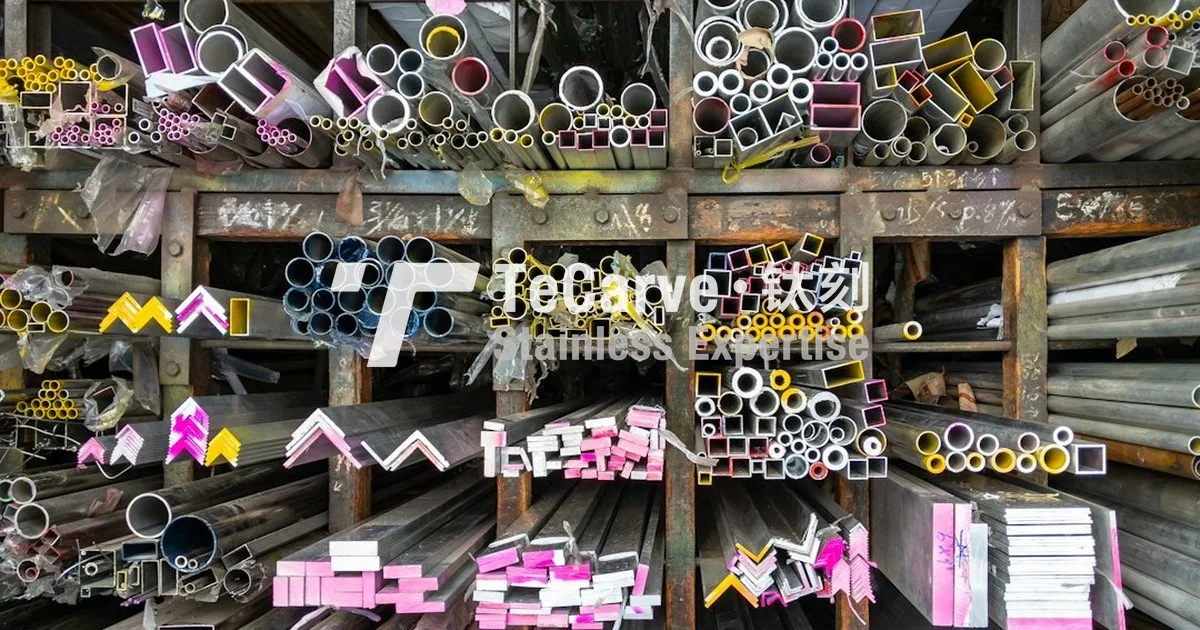

Thick walled stainless steel pipe is an engineered pressure-bearing and corrosion-resistant product used in chemical reactor circuits where process media can attack ordinary steel in a short operating cycle. TeCarve supplies seamless and welded stainless steel tubes for this duty from factories in Foshan and Wenzhou, China, under ASTM A312, EN 10216-5, and EN 10217-7. A practical supplier comparison China exercise must therefore review material grade, wall schedule, mill test certificates, QC methods, and service lead time rather than price alone.
Wall Thickness Adds Corrosion Allowance without Replacing Alloy Selection
Reactor corrosion control begins with a pipe wall thick enough to tolerate predictable metal loss while still holding design pressure. Thick walled stainless steel pipe prevents premature failure by adding corrosion allowance above the code minimum wall, but it does not make an unsuitable grade immune to chemical attack. The passive chromium oxide film formed on stainless steel provides the real corrosion barrier, so a thicker 304 pipe will still pit in chloride service more readily than a 316L pipe containing 2.0–3.0% molybdenum. Specify wall thickness and alloy chemistry together.
Low-Carbon Chemistry Protects Heavy-Section Welds
ASTM A312 specifies low-carbon limits for 304L and 316L pipe to reduce chromium carbide precipitation during welding and high-temperature service. When thick walled stainless steel pipe is welded, the heat-affected zone may remain in the sensitization range long enough to deplete chromium at grain boundaries. A carbon content at or below 0.03% keeps chromium available for the passive film and prevents intergranular corrosion. TeCarve supplies 304L and 316L with EN 10204 3.1 mill test certificates that document carbon, nickel, and chromium values for each heat.
Surface Finish Determines Where Corrosion Can Start
Pickled and annealed surface finish removes heat tint, embedded iron, and chromium-depleted layers from production, allowing a uniform protective oxide to form on thick walled stainless steel pipe. For reactor media that can leave deposits, polished finishes from 180 grit to mirror bright annealed are specified because rough surfaces create crevices for chloride concentration. TeCarve offers pickled and annealed, polished 180/240/320/400 grit, mirror, matte or satin finishes, and custom surface options. Surface roughness should be matched to the reactor fluid, cleaning regime, and corrosion risk.
Seamless Thick-Walled Pipe Removes Longitudinal Weld Attack Paths
High-pressure reactor loops often specify seamless thick walled stainless steel pipe because solid billet construction contains no longitudinal weld seam that can concentrate residual stress or sensitized microstructure. Reference standards such as ASTM A213 and EN 10216-5 cover seamless stainless steel tubes for pressure service, while ASTM A269 covers general service tubing. The Foshan plant produces welded and decorative tubing (welded, sanitary, square, rectangular, oval, special-shaped, decoration, corrugated and clad pipe), while the Wenzhou plant produces seamless and precision tubing (seamless, heat exchanger, capillary, needle, coiled, thick-walled, low fin and helical coil tube, and medical components). Hydro testing and eddy current testing are used to detect through-wall leaks and surface discontinuity before shipment.
Compare Chinese Suppliers by Documentation, Not Only Price
Any supplier comparison China should start with the same documentation request: an EN 10204 3.1 or 3.2 mill test certificate that reports chemical analysis, mechanical testing, hydro testing, eddy current testing, and dimensional inspection against the ordered ASTM or EN specification. ISO 9001 requires documented control of production and traceability, but it is not a substitute for product-specific testing. TeCarve exports to buyers worldwide including the USA, Germany, UAE, Brazil, and India, with MOQ from 100–300 kg and typical lead time of 10–25 days after deposit. Full background information is published at tecarvepipes.com.

Grade Comparison: 304, 304L, 316, and 316L
| Grade | C% max | Ni% | Cr% | Key Property | Best For |
|---|---|---|---|---|---|
| 304 | 0.08 | 8.0–11.0 | 18.0–20.0 | Good general corrosion resistance and formability | Non-chloride process lines and reactor shells |
| 304L | 0.03 | 8.0–12.0 | 18.0–20.0 | Low-carbon variant lowers weld sensitization risk | Welded thick-wall equipment for mild chemical media |
| 316 | 0.08 | 10.0–14.0 | 16.0–18.0 | Adds 2.0–3.0% Mo for improved pitting resistance | Moderate chloride environments without heavy welding |
| 316L | 0.03 | 10.0–14.0 | 16.0–18.0 | Low-carbon chemistry plus molybdenum for aggressive service | Chloride-bearing chemical reactor piping and pressure systems |
Grade Selection Guide for Your Application
- Define the reactor environment: operating temperature, pH, chloride concentration, and oxidizing species must be recorded before selecting any pipe material.
- Calculate the required pressure wall and corrosion allowance using the applicable mechanical design code; decide whether seamless or welded construction is acceptable.
- Select the grade family: choose 304 for low-chloride media and 316L for chloride or acidic streams where pitting susceptibility is higher.
- Check weld fabrication conditions; use 304L or 316L for thick walled stainless steel pipe if post-weld heat treatment cannot be guaranteed.
- Request the same documentation set from every Chinese supplier: EN 10204 3.1 or 3.2 certificate, chemical analysis, mechanical test results, and NDT reports.
- Compare practical order terms such as MOQ, lead time, payment method, and incoterm. TeCarve supports trial orders from 100–300 kg and offers 10–25 day delivery after deposit.
Applications Across Industries
- Oil & Gas: thick-walled 316L seamless pipe is used for chemical injection lines and process piping that handles sour fluids.
- Chemical & Petrochemical: reactor outlet lines, acid transfer systems, and polymer plant coils require certified low-carbon stainless pipe.
- Food & Beverage: heat exchanger and sanitary pipes with polished surfaces prevent bacterial hold-up in process tanks.
- Pharmaceutical & Medical: bioreactor and sterile distribution loops rely on 316L pipe with bright annealed or mirror finish and full traceability.
- Energy & Power: boiler and heat exchanger tubes specified to ASTM A213 are selected for high-temperature corrosion resistance.
- Marine & Shipbuilding: seawater-handling lines and hydraulic systems use 316L pipe for chloride tolerance.
Compliance & Certification Requirements
- ASTM A312/A312M — seamless and welded austenitic stainless steel pipe for high-temperature and general corrosive service.
- ASTM A213/A213M — seamless ferritic and austenitic boiler, superheater, and heat-exchanger tubes.
- ASTM A269 — seamless and welded stainless steel tubing for general service.
- EN 10216-5 — seamless stainless steel tubes for pressure purposes.
- EN 10217-7 — welded stainless steel tubes for pressure purposes.
- EN 10204 3.1 or 3.2 — mill test certificate types accepted for pressure equipment.
- ISO 9001:2015 — quality management system requirement used as a baseline for supplier comparison.
Frequently Asked Questions
How does thick walled stainless steel pipe prevent corrosion in chemical reactors?
Thick walled stainless steel pipe prevents corrosion by providing corrosion allowance on top of the pressure-retaining wall and by maintaining a chromium-rich oxide film on the internal surface. The 18.0–20.0% chromium content in 304 and 316L supports this passive film. A heavier wall does not eliminate pitting; use low-carbon grade and correct surface finish, plus documented QC.
What is the difference between 304 and 316L stainless steel pipe?
304 stainless steel contains 18.0–20.0% chromium and 8.0–11.0% nickel, while 316L adds 2.0–3.0% molybdenum and keeps carbon at 0.03% max. Molybdenum improves resistance to chlorides, acids, and pitting. For chemical reactors, 316L is usually safer when detailed process chemistry is not yet fixed. Ask for EN 10204 3.1 test certificates.
Why choose seamless stainless steel pipe for high pressure reactors?
Seamless pipe is formed from a solid billet, so there is no longitudinal weld seam to act as a stress raiser or sensitized region. High-pressure reactor coils and thick-walled lines are often specified to ASTM A213 and EN 10216-5. The Wenzhou plant produces seamless pipe and tube, with eddy current and hydro testing available before shipment.
Which Chinese stainless steel pipe supplier is reliable for chemical reactor applications?
A reliable Chinese supplier should state factory location, product standards, material grades, and QC methods on its website or quotation. TeCarve works with dedicated plants in Foshan and Wenzhou, China, and exports to the USA, Germany, UAE, Brazil, and India. Verify EN 10204 3.1 or 3.2 mill certificates and request third-party inspection before production.
Need pricing, mill test certificates, or a custom Seamless Pipe & Tube quote? Contact TeCarve’s engineering team.
How do I verify stainless steel pipe mill certificates?
Ask for the EN 10204 3.1 or 3.2 certificate containing the heat number, chemical analysis, mechanical test results, hydro or eddy current testing, and dimensional inspection. Compare reported values with the ordered ASTM or EN specification. A 316L certificate should show molybdenum in the 2.0–3.0% range and carbon at or below 0.03%. TeCarve provides these documents with each shipment.
Can welded stainless steel pipe be used in chemical reactor service?
Welded stainless steel pipe can be used in chemical reactor service when the weld is fully penetrated, pickled, and tested, and when the governing standard permits. ASTM A312 covers both seamless and welded austenitic pipe, while ASTM A249 covers welded heat exchanger tube. For severe cyclic pressure or thick-wall hydrogen service, seamless pipe is usually preferred.
What is the minimum order quantity for custom stainless steel pipe from China?
The practical MOQ at TeCarve is 100–300 kg, and smaller trial orders are available for buyers that need to validate material quality. For custom thick walled stainless steel pipe, lead time is typically 10–25 days after deposit, depending on surface finish and testing. This makes mill-direct supply feasible for reactor maintenance spares as well as project orders.
How long does TeCarve take to deliver stainless steel pipe?
TeCarve quoted lead time is 10–25 days after deposit, subject to grade, size, surface finish, and third-party inspection. Payment options include T/T, L/C, and Bill of Lading terms, while incoterms include FOB, CIF, CFR, and DDP. International shipments are packed for sea or air transport with full documentation support.
Does 316L stainless steel pipe resist chloride stress corrosion cracking?
316L stainless steel performs better than 304 in chloride media because 2.0–3.0% molybdenum improves pitting resistance, but 316L can still suffer stress corrosion cracking at high chloride concentration, high temperature, and tensile stress. For severe chloride service, duplex 2205 or higher alloys are often considered. The reactor environment should dictate chemistry; TeCarve also supplies duplex 2205 on request.
What standards apply to thick wall stainless steel pipe from China?
Common standards are ASTM A312/A213/A269, EN 10216-5 for seamless pressure tube, EN 10217-7 for welded tube, and EN 10204 3.1/3.2 mill test certificates. Chinese manufacturers also work to ISO 9001. TeCarve supplies tube made to ASTM, DIN, EN, and ISO and can confirm project-specific requirements on request.
Start any reactor piping purchase with a clear corrosion and stress profile, and treat the wall schedule as corrosion allowance backed by a low-carbon grade. Compare Chinese suppliers on EN 10204 documentation, QC equipment, and order flexibility. TeCarve supplies buyers in the USA, Germany, UAE, Brazil and India from China with custom sizes and grades, making its plant-backed supply chain suitable for chemical reactor maintenance and new projects.
TeCarve supplies stainless steel pipes and tubes manufactured to ASTM / EN / GB.
Sizes: custom
Grades: 304, 304L, 316, 316L, 321, 310S, 201, 430, 904L, Duplex 2205 | MOQ: 100–300 kg (smaller trial orders available) | Lead Time: 10–25 days after deposit
Email: sales@tecarve.com
WhatsApp: +86 189 6804 2695
Website: https://tecarvepipes.com
Response within 24 hours.
Related Resources
- Where to Buy Stainless Seamless Pipes for Refineries
- Best Quality Stainless Seamless Pipe for Refinery
- Stainless Steel Tube Suppliers with MTC & Inspection
- Thick Walled Stainless Pipe vs Carbon Steel in Reactors
Need pricing, mill test certificates, or a custom Seamless Pipe & Tube quote? Contact TeCarve’s engineering team.