

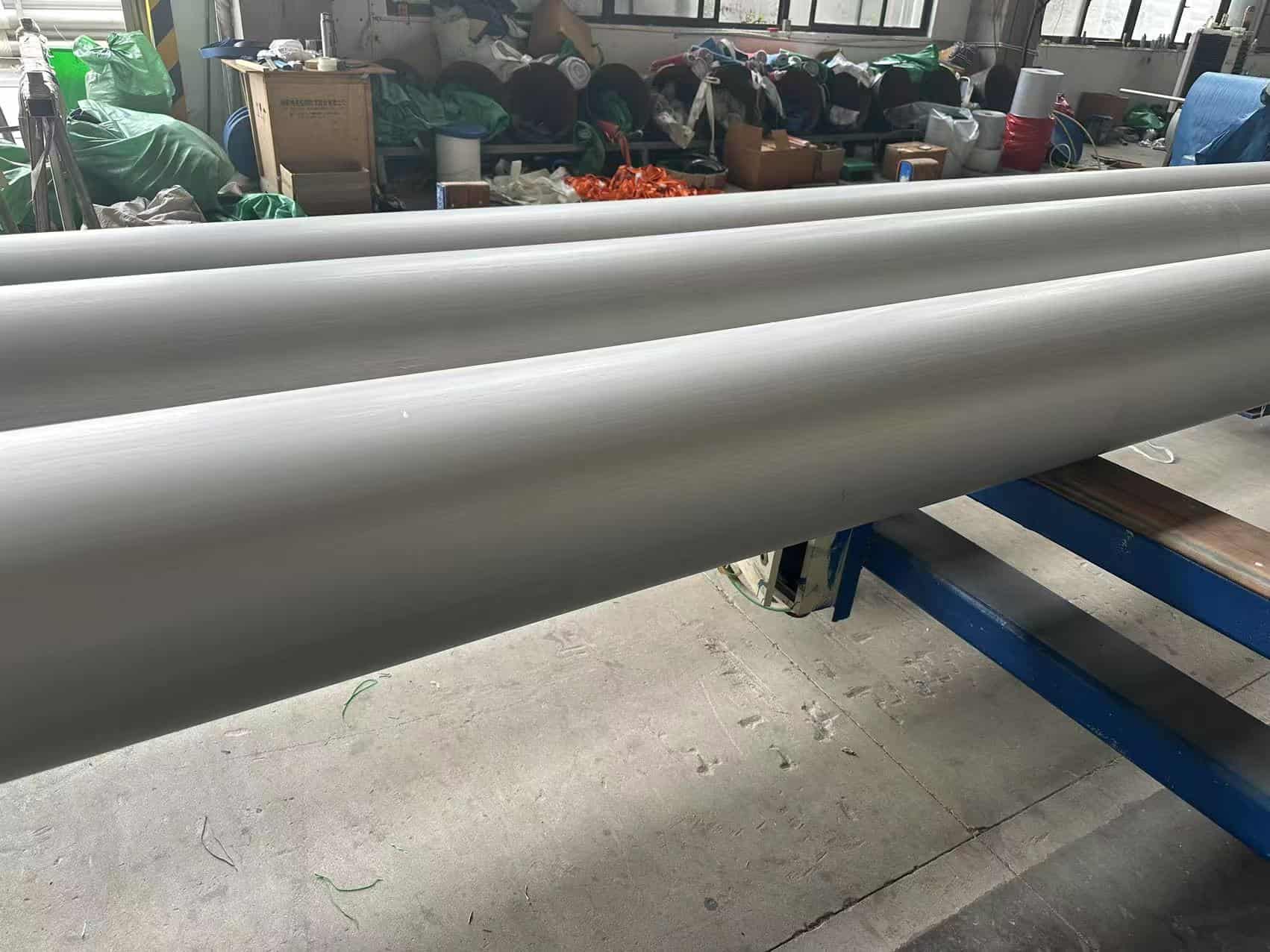

ASTM A790/A790M-24 is the standard specification for seamless and straight-seam welded ferritic/austenitic (duplex) stainless steel pipe for general corrosive service, with particular emphasis on resistance to stress corrosion cracking (SCC). Published in March 2024 by ASTM Subcommittee A01.10, this edition governs pipe ordered by nominal pipe size (NPS) and schedule or outside diameter and average wall thickness across standard duplex, lean duplex, and super duplex alloys.
Executive Summary: ASTM A790 specifies dual-phase piping balancing ~50% ferrite and 50% austenite. Duplex UNS S32205 (2205) delivers minimum yield strength of 65 ksi [450 MPa]—over double austenitic ASTM A312 TP316L (30 ksi [205 MPa])—with superior chloride pitting and SCC resistance in marine and chemical process environments.
1. Scope and Service Limitations
ASTM A790/A790M covers seamless and straight-seam welded duplex pipes without filler metal in initial welding for corrosive service where chloride SCC threatens 300-series austenitics.
Values are stated separately in inch-pound and SI units (A790M). Sizing follows ANSI B36.19 (Appendix X1). Custom dimensions may be furnished provided they fulfill all other standard requirements.
Elevated Temperature Service Warning (Section 1.1): Duplex alloys suffer embrittlement during prolonged high-temperature exposure. Ferrite spinodal decomposition occurs near 475 °C [885 °F] (“475 °C embrittlement”), and intermetallic phases (sigma σ, chi χ) precipitate between 600 °C and 1000 °C [1110 °F to 1830 °F]. Design codes (ASME B31.3, Section VIII) limit continuous service to between −50 °C and +300 °C [−58 °F to 572 °F]. The ASME Boiler and Pressure Vessel Code counterpart is Specification SA-790 in Section II.
2. Duplex Stainless Steel Grades & Chemical Composition
ASTM A790/A790M-24 includes 28 standardized UNS duplex grades in Table 2. Dual-phase stability is maintained by balancing chromium, molybdenum, nickel, and nitrogen:
- Standard Duplex 2205 (UNS S32205 / S31803): UNS S32205 tightens legacy S31803 limits to Cr 22.0–23.0%, Mo 3.0–3.5%, N 0.14–0.20% (vs S31803: Cr 21.0–23.0%, Mo 2.5–3.5%, N 0.08–0.20%), ensuring PREN ≥ 35 and improved weld-zone pitting resistance.
- Lean Duplex (UNS S32304 / S32101): Economical grades lowering nickel and molybdenum. UNS S32304 (2304) has 21.5–24.5% Cr, 3.0–5.5% Ni, and 0.05–0.60% Mo for storage and water piping.
- Super Duplex (UNS S32750 / S32760): Highly alloyed for offshore service. UNS S32750 (2507) mandates Table 2 Footnote D:
% Cr + 3.3 × % Mo + 16 × % N ≥ 41. UNS S32760 adds W and Cu per Footnote E:% Cr + 3.3 × (% Mo + 0.5 % W) + 16 × % N ≥ 41.
| UNS | Type / Name | C | Mn | P | S | Si | Ni | Cr | Mo | N | Other |
|---|---|---|---|---|---|---|---|---|---|---|---|
| S31803 | Standard Duplex | 0.030 | 2.00 | 0.030 | 0.020 | 1.00 | 4.5–6.5 | 21.0–23.0 | 2.5–3.5 | 0.08–0.20 | — |
| S32205 | 2205 | 0.030 | 2.00 | 0.030 | 0.020 | 1.00 | 4.5–6.5 | 22.0–23.0 | 3.0–3.5 | 0.14–0.20 | — |
| S32304 | 2304 | 0.030 | 2.50 | 0.040 | 0.040 | 1.00 | 3.0–5.5 | 21.5–24.5 | 0.05–0.60 | 0.05–0.20 | Cu 0.05–0.60 |
| S32101 | Lean Duplex | 0.040 | 4.0–6.0 | 0.040 | 0.030 | 1.00 | 1.35–1.70 | 21.0–22.0 | 0.10–0.80 | 0.20–0.25 | Cu 0.10–0.80 |
| S32750 | 2507 | 0.030 | 1.20 | 0.035 | 0.020 | 0.80 | 6.0–8.0 | 24.0–26.0 | 3.0–5.0 | 0.24–0.32 | Cu 0.5 max; PREN ≥ 41 |
| S32760 | Super Duplex | 0.030 | 1.00 | 0.030 | 0.010 | 1.00 | 6.0–8.0 | 24.0–26.0 | 3.0–4.0 | 0.20–0.30 | Cu 0.5–1.0; W 0.5–1.0; PREN ≥ 41 |
Values are maximum percent unless range indicated. Summary based on ASTM A790/A790M-24 Table 2; refer to standard for full text.
3. Dimensions, Schedules & Manufacturing Tolerances
Pipe dimensions conform to ANSI B36.19 (Stainless Steel Pipe) as indexed in Appendix X1 Table X1.1 across Schedules 5S, 10S, 40S, and 80S.
| NPS | OD (in.) | OD (mm) | Sch 5S (mm) | Sch 10S (mm) | Sch 40S (mm) | Sch 80S (mm) |
|---|---|---|---|---|---|---|
| 1/2 | 0.840 | 21.34 | 1.65 | 2.11 | 2.77 | 3.73 |
| 1 | 1.315 | 33.40 | 1.65 | 2.77 | 3.38 | 4.55 |
| 2 | 2.375 | 60.33 | 1.65 | 2.77 | 3.91 | 5.54 |
| 3 | 3.500 | 88.90 | 2.11 | 3.05 | 5.49 | 7.62 |
| 4 | 4.500 | 114.30 | 2.11 | 3.05 | 6.02 | 8.56 |
| 6 | 6.625 | 168.28 | 2.77 | 3.40 | 7.11 | 10.97 |
| 8 | 8.625 | 219.08 | 2.77 | 3.76 | 8.18 | 12.70 |
| 10 | 10.750 | 273.05 | 3.40 | 4.19 | 9.27 | 12.70 |
| 12 | 12.750 | 323.85 | 3.96 | 4.57 | 9.52 | 12.70 |
Summary based on ASTM A790/A790M-24, Appendix X1, Table X1.1 (ANSI B36.19). Refer to standard for sizes up to NPS 30.
Manufacturing Tolerances under ASTM A999/A999M
General dimensional tolerances follow ASTM A999/A999M:
- Wall Thickness: Minimum wall at any point shall not be more than 12.5% under nominal wall.
- Outside Diameter: NPS 1 1/2 to 4 is ±1/32 in. [±0.8 mm]; NPS over 4 to 8 is +1/16 in. [+1.6 mm], −1/32 in. [−0.8 mm].
- Lengths (Section 11): NPS 1/8 to 8 is furnished in random lengths of 15 to 24 ft [4.6 to 7.3 m]. Cut lengths permit +1/4 in. [+6 mm], −0 mm. Jointers are prohibited unless specified.
- Workmanship (Section 12): Straight with workmanlike finish. Grinding is permitted provided remaining wall meets the 12.5% limit.
4. Mechanical Properties & Heat Treatment Requirements
Duplex alloys provide yield strengths over double conventional austenitics, enabling wall down-gauging under ASME B31.3 or Section VIII to reduce system weight.
| UNS | Type | Tensile min, ksi [MPa] | Yield min, ksi [MPa] | Elong. min, % | Hardness (HBW) | Hardness (HRC) | Solution Temp. Range | Quench Method |
|---|---|---|---|---|---|---|---|---|
| S31803 | Standard Duplex | 90 [620] | 65 [450] | 25 | 290 max | 30 max | 1870–2010 °F [1020–1100 °C] | Rapid cooling in water / other |
| S32205 | 2205 | 95 [655] | 65 [450] | 25 | 290 max | 30 max | 1870–2010 °F [1020–1100 °C] | Rapid cooling in water / other |
| S32304 | 2304 | 87 [600] | 58 [400] | 25 | 290 max | 30 max | 1700–1920 °F [925–1050 °C] | Rapid cooling in water / other |
| S32101 | Lean Duplex | 94 [650] (t > 5mm) 101 [700] (t ≤ 5mm) | 65 [450] (t > 5mm) 77 [530] (t ≤ 5mm) | 30 | 290 max | — | 1870 °F [1020 °C] | Rapid cooling in water / other |
| S32750 | 2507 | 116 [800] | 80 [550] | 15 | 300 max | 32 max | 1880–2060 °F [1025–1125 °C] | Rapid cooling in water / other |
| S32760 | Super Duplex | 109 [750] | 80 [550] | 25 | 310 max | 32 max | 1960–2085 °F [1070–1140 °C] | Rapid cooling in water / other |
Summary based on ASTM A790/A790M-24, Table 1 and Table 3. Refer to standard for all 28 grades.
Heat Treatment Specifics and the “HT-O” Option
Section 6.3 mandates solution annealing and rapid cooling per Table 1 to suppress intermetallics (σ, χ) between 600 °C and 1000 °C:
- Direct Quenching (Section 6.3.1): Seamless pipe immediately after hot forming may be quenched in water if temperature exceeds the Table 1 minimum.
- Option “HT-O” (Section 6.3.2): For welded pipe made from solution-annealed plate, post-weld heat treatment may be omitted if a weld prolongation passes ASTM A923 Method B (impact) or Method C (ferric chloride corrosion) on base metal, weld, and HAZ. Pipe is stenciled “HT-O”.
5. Quality Testing & Inspection Requirements
ASTM A790 mandates lot mechanical testing alongside individual pipe integrity examination. Under Section 14.1, “Each pipe shall be subjected to the nondestructive electric test or the hydrostatic test. The type of test shall be at the option of the manufacturer, unless otherwise specified in the purchase order.” Key inspection requirements include:
- Hydrostatic Testing (Section 14.2): When selected under Section 14.1, allowable fiber stress
Sis set to 50% of specified minimum yield strength per ASTM A999/A999M. - Nondestructive Electric Test (Section 14.3): When chosen in place of hydrotesting, ultrasonic (E213) or eddy-current (E309 / E426) examination is performed on each pipe. Calibration notch depth shall not exceed 12.5% of nominal wall or 0.004 in. [0.102 mm]. Drilled calibration holes range from 0.039 in. [1.0 mm] to 0.106 in. [2.7 mm] per Section 14.9.2 with SNT-TC-1A qualified personnel.
- Tension Tests (Section 13.1): One test per lot for ≤ 100 pipes; two tests per lot for > 100 pipes.
- Flattening Tests (Section 13.3): Performed on 5% of pipes per lot (minimum two pipes). Guided face bend tests per ASTM A370 may be substituted for welded pipe; two side bend tests may replace face bends if wall ≥ 3/8 in. [9.52 mm].
- Hardness Testing (Section 13.4): Specimens from two pipes per lot must meet Table 3 limits (290 HBW / 30 HRC max for S32205).
- Weld Seam Repairs (Section 15): Permitted only on welded pipe NPS 6 or larger with wall ≥ 0.188 in. [4.8 mm]. Total repair length cannot exceed 20% of seam length. Requires GTAW with AWS ER2209 (UNS S39209) filler metal per Table 4, completed before solution annealing, and stenciled “WR”.
6. Technical Comparison: ASTM A790 vs Related Standards
Technical comparison between A790 and related standards:
| Parameter | ASTM A790 / A790M | ASTM A312 / A312M | ASTM A789 / A789M | EN 10217-7 (1.4462) |
|---|---|---|---|---|
| Material Class | Duplex (ferritic/austenitic) | Austenitic (304L, 316L) | Duplex (ferritic/austenitic) | Austenitic & Duplex |
| Product Form | Pipe (NPS / Schedule) | Pipe (NPS / Schedule) | Tube (OD × Wall) | Tube (OD × Wall, Metric) |
| Yield Strength (2205 vs 316L) | ≥ 450 MPa [65 ksi] | ≥ 205 MPa [30 ksi] | ≥ 450 MPa [65 ksi] | ≥ 450 MPa (Duplex 1.4462) |
| Chloride SCC Resistance | Exceptional (dual-phase) | Prone to chloride SCC | Exceptional (dual-phase) | Exceptional (Duplex grades) |
| Service Temperature | −50 °C to +300 °C | Cryogenic to > 550 °C | −50 °C to +300 °C | Grade dependent |
| Primary Use | Process & marine pipe lines | General chemical piping | Heat exchangers, condensers | European pressure systems |
Comparison based on ASTM A790/A790M-24, ASTM A312/A312M-25, ASTM A789/A789M-24, and EN 10217-7:2021.
- A790 vs ASTM A312: S32205 yields 450 MPa vs 205 MPa for ASTM A312 TP316L pipe, permitting thinner walls. A312 remains preferred outside the −50 °C to 300 °C duplex envelope.
- A790 vs ASTM A789: Each has its own tensile table: A789/A789M-24 Table 4 sets S32205 yield at 70 ksi [485 MPa], against 65 ksi [450 MPa] in A790. A790 governs NPS pipe, while A789 covers tubing ordered to exact OD and wall thickness.
7. ASTM A790 Purchase Order Checklist
Procurement inquiries and purchase orders should specify (Section 4.1):
- Specification: ASTM A790/A790M-24 (or ASME SA-790).
- Quantity: Total footage, meters, or pieces.
- Manufacturing Route: Seamless or straight-seam welded duplex pipe.
- Grade: UNS designation (e.g., UNS S32205 / 2205, UNS S32750 / 2507).
- Dimensions: NPS and schedule (e.g., NPS 4 Sch 40S) or OD and average wall.
- Lengths: Standard random (15 to 24 ft) or cut (+1/4 in. [+6 mm], −0 mm).
- End Preparation: Plain end square cut or beveled per ASME B16.25.
- Pressure & NDT Selection (Section 14.1): Specify hydrostatic test (S = 50% yield) or nondestructive electric test (UT per E213 / ET per E309/E426); otherwise at manufacturer option.
- Supplementary: S1 Product Analysis, S2 Transverse Tension, S3 Flattening, S4 Etch, or ASTM A923 Method B/C.
- Certification: EN 10204 3.1 Mill Test Certificate with chemical, mechanical, and NDT results.
- Special Marking: Stencil “WR” if weld repaired, or “HT-O” if unannealed welded plate passing A923.
How TeCarve Supplies ASTM A790 Duplex Stainless Steel Pipe
TeCarve is a specialized Chinese stainless steel piping solutions provider and export channel for dedicated manufacturing plants in Foshan and Wenzhou, supplying duplex process piping for global engineering projects.
Factory supply capabilities for duplex stainless steel piping include:
- Seamless Stainless Steel Pipe Range: OD 6 mm to 1600 mm (NPS 1/8 to 24, OD 10.3 to 610 mm in Sch 5S, 10S, 40S, 80S, 160, XXS), wall thicknesses 0.5 mm to 100 mm, in 1 to 12 m lengths or custom cut lengths. Available in Duplex 2205 (UNS S32205/S31803) and standard austenitics. Finishes: annealed & pickled, polished, or bright annealed.
- Thick-Walled Stainless Steel Pipe Range: Heavy walls from ≥ 5 mm up to 100 mm, OD 6 mm to 1600 mm seamless and up to 2000 mm welded for high-pressure process containment.
- Quality Control & Testing: Plant testing includes ultrasonic (UT), eddy-current (ET), hydrostatic testing, and mechanical checks. Pre-shipment inspection by TeCarve QC inspectors verifies dimensions, wall thickness, bevels, and surfaces.
- Documentation & Certification: Every shipment includes an EN 10204 3.1 Mill Test Certificate issued by the producing plant with complete heat-batch traceability and test records; EN 10204 3.2 inspection with third-party witnessing (SGS, BV, TÜV) is available on request. The Foshan plant that produces TeCarve’s welded pipe holds a NORSOK M-650 qualification (TÜV SÜD) for S31803, S32205 and S32750 welded pipes; the certificate can be reviewed on the verification page. Plant certificates can be reviewed on https://tecarvepipes.com/verify-our-factories/.
- Stock & Delivery: 2205 and 2507 seamless sizes are listed in our stock list. Custom production runs ship within 10–25 days. Pipe ends feature protective plastic caps and are packed in seaworthy wooden cases or pallets for international ocean freight.
For technical inquiries or project quotes, contact our engineering export team at sales@tecarve.com.
For a grade-level comparison of 2205, S31803 and super duplex 2507, see duplex stainless steel: 2205 vs 2507.
Frequently Asked Questions
What is the main scope of ASTM A790/A790M?
ASTM A790 covers seamless and straight-seam welded duplex pipe for corrosive service. It governs process lines requiring high yield strength and chloride SCC resistance, sized per ANSI B36.19.
What is the difference between UNS S31803 and UNS S32205 (Duplex 2205)?
UNS S32205 tightens Cr to 22.0–23.0%, Mo to 3.0–3.5%, and N to 0.14–0.20% (vs S31803), raising PREN and improving weld HAZ corrosion resistance.
Why is ASTM A790 duplex pipe restricted in operating temperature?
Duplex alloys embrittle at elevated temperatures: 475 °C [885 °F] causes spinodal ferrite decomposition, while sigma and chi intermetallics form between 600 °C and 1000 °C. Codes limit continuous service to −50 °C to +300 °C [−58 °F to 572 °F].
What is the difference between ASTM A790 pipe and ASTM A789 tube?
ASTM A790 governs process pipe ordered to NPS and schedule wall thickness. ASTM A789 covers heat exchanger and general-service tubing ordered to exact OD and wall thickness.
What hydrostatic test pressure or NDT is required by ASTM A790?
Under Section 14.1, each pipe shall be subjected to the nondestructive electric test or the hydrostatic test. The type of test shall be at the option of the manufacturer, unless otherwise specified in the purchase order. When hydrostatic testing is conducted under Section 14.2, test pressure is calculated per ASTM A999/A999M with fiber stress S set to 50% of specified minimum yield strength.
Can ASTM A790 welded pipe be repaired by welding during manufacture?
Yes, under Section 15: seam repairs are permitted only on pipe NPS 6 or larger with wall ≥ 0.188 in. [4.8 mm]. Repairs cannot exceed 20% of seam length, must use GTAW with ER2209 filler metal prior to heat treatment, and require stenciling “WR”.
What filler metal is specified for welding ASTM A790 UNS S32205 pipe?
Table 4 specifies AWS A5.9 Class ER2209 (UNS S39209) filler metal. ER2209 features enriched nickel to promote austenite reformation during weld cooling, preserving corrosion resistance and impact toughness.
Related technical guides: ASTM A312 Stainless Steel Pipe Guide · Stainless Steel Seamless Pipe & Tube · Stainless Steel Thick-Walled Pipe · Stainless Steel Stock List · TeCarve Editorial Policy