

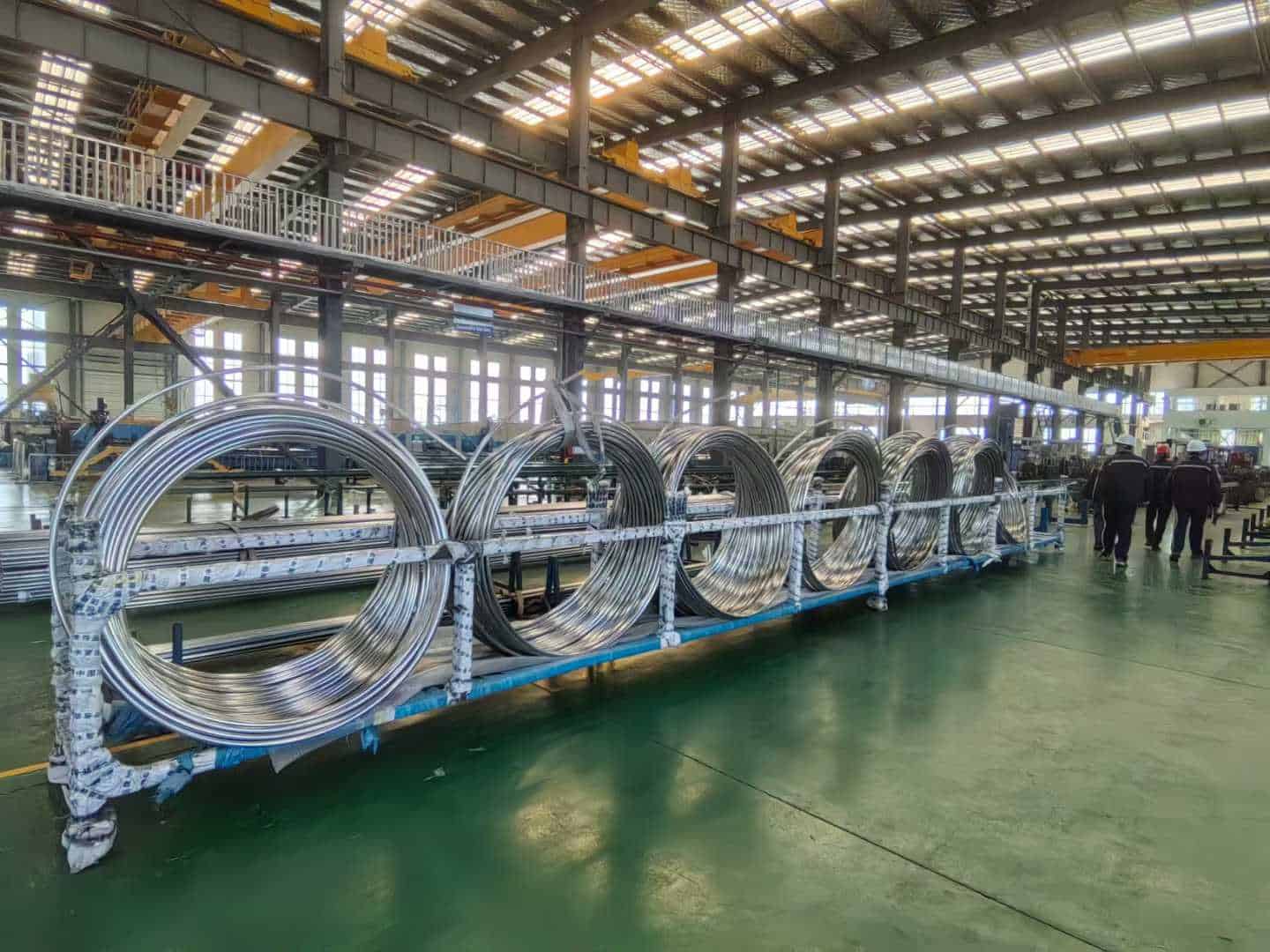

321 stainless steel tube and pipe (Grade TP321 / UNS S32100 and high-carbon TP321H / UNS S32109) is a titanium-stabilized austenitic stainless steel engineered for high-temperature and general corrosive service. By adding titanium at a minimum ratio of five times carbon plus nitrogen, Grade 321 binds carbon as titanium carbonitrides, preventing chromium carbide precipitation at grain boundaries.
Key Specification Summary: Grade 321 Tubular Products
Grade 321 is governed by three ASTM standards: ASTM A213 (seamless boiler/heat exchanger tubes), ASTM A269 (general service tubing), and ASTM A312 (seamless and welded pipe). Composition: 17.0–19.0% Cr, 9.0–12.0% Ni, Ti ≥ 5×(C+N) to 0.70% max. Tensile baseline: 75 ksi [515 MPa] tensile and 30 ksi [205 MPa] yield (reduced to 70 [485] / 25 [170] for A312 seamless pipe with wall > 3/8 in [9.5 mm]).
1. Which Standard for Which Product Form
Specifying Grade 321 requires matching the governing ASTM standard to the intended product form:
| ASTM Standard | Manufacturing Scope & Product Form | Dimensional Framework | Mandatory Mechanical Criteria |
|---|---|---|---|
| ASTM A213 / A213M | Seamless boiler, superheater, and heat exchanger tubes. | Usually 1/8 in [3.2 mm] ID to 5 in [127 mm] OD; minimum (or average) wall. | Tensile, yield, elongation, hardness (90 HRB max), flaring, flattening. |
| ASTM A269 / A269M | Seamless and welded general service tubing. | OD and nominal wall (ID ≥ 1/4 in, wall ≥ 0.020 in). | Hardness only (90 HRB max); flaring or flange/flattening. No tensile table. |
| ASTM A312 / A312M | Seamless, welded, and heavily cold worked (HCW) pipe. | ASME B36.19 dimensions (Table X1.1); other sizes permitted. | Tensile, yield, elongation per lot; flattening or guided bend; hydro or NDE. |
For process piping design, review our ASTM A312 stainless steel pipe guide. For general tubing specifications, consult our ASTM A269 stainless steel tubing guide.
2. Chemical Composition: TP321 vs. TP321H
Chemical composition limits across ASTM A213 (Table 2), ASTM A269 (Table 1), and ASTM A312 (Table 1) are concordant:
| Element (% by weight) | ASTM Grade TP321 (UNS S32100) | ASTM Grade TP321H (UNS S32109) |
|---|---|---|
| Carbon (C) | 0.08 max | 0.04–0.10 |
| Manganese (Mn) | 2.00 max | 2.00 max |
| Phosphorus (P) | 0.045 max | 0.045 max |
| Sulfur (S) | 0.030 max | 0.030 max |
| Silicon (Si) | 1.00 max | 1.00 max |
| Chromium (Cr) | 17.0–19.0 | 17.0–19.0 |
| Nickel (Ni) | 9.0–12.0 | 9.0–12.0 |
| Nitrogen (N) | 0.10 max (A312) | 0.10 max (A312) |
| Titanium (Ti) | 5 × (C + N) min, 0.70 max | 4 × (C + N) min, 0.70 max |
Titanium stabilization is the primary metallurgical feature of Grade 321. Because titanium has a higher thermodynamic affinity for carbon and nitrogen than chromium, it forms stable Ti(C,N) particles, keeping chromium in solid solution to preserve corrosion resistance.
3. Mechanical Properties & Heavy-Wall Strength Rules
Mechanical requirements depend on the governing product standard and pipe wall thickness:
| Specification & Product Form | Tensile min | Yield (0.2%) min | Elongation in 2 in min | Hardness max |
|---|---|---|---|---|
| ASTM A213 TP321 / TP321H (Seamless Tube) | 75 ksi [515 MPa] | 30 ksi [205 MPa] | 35% | 192 HBW / 90 HRB |
| ASTM A312 Welded Pipe (all walls) | 75 ksi [515 MPa] | 30 ksi [205 MPa] | 35% long / 25% trans | — |
| ASTM A312 Seamless (wall ≤ 0.375 in [9.5 mm]) | 75 ksi [515 MPa] | 30 ksi [205 MPa] | 35% long / 25% trans | — |
| ASTM A312 TP321 Seamless (wall > 0.375 in [9.5 mm]) | 70 ksi [485 MPa] | 25 ksi [170 MPa] | 35% long / 25% trans | — |
| ASTM A312 TP321H Seamless (wall > 0.375 in [9.5 mm]) | 70 ksi [480 MPa] | 25 ksi [170 MPa] | 35% long / 25% trans | — |
| ASTM A269 TP321 (General Tubing) | — | — | — | 192 HBW / 90 HRB |
Two essential normative rules govern Grade 321 mechanical properties:
- A312 Heavy-Wall Rule (Clause 1.5): Seamless TP321/TP321H pipe with wall > 3/8 in [9.5 mm] has lower specified strength (70 ksi [485/480 MPa] tensile and 25 ksi [170 MPa] yield) than thinner seamless or welded pipe.
- A269 Hardness-Only Scope: ASTM A269 contains no tensile, yield, or elongation criteria, evaluating tubes solely through hardness limits (90 HRB max). Tensile values must never be attributed to A269.
4. Heat Treatment, Footnote H Warning, and Stabilizing Annealing
Thermal treatment parameters for Grade 321 are specified across standards:
| Grade | Standard | Solution Temperature min | Grain Size (ASTM E112) | Cooling Protocol |
|---|---|---|---|---|
| TP321 | A213 / A269 / A312 | 1900 °F [1040 °C] | No mandatory requirement | Water quench or rapid cool. |
| TP321H (Cold Finished) | A213 / A312 | 2000 °F [1090 °C (A213) / 1100 °C (A312)] | ASTM No. 7 or coarser | Water quench or rapid cool. |
| TP321H (Hot Finished) | A213 / A312 | 1925 °F [1050 °C] | ASTM No. 7 or coarser | Water quench or rapid cool. |
Footnote H Warning: In ASTM A213 Table 3, Footnote H states that solution treating temperatures above 1950 °F [1065 °C] may impair resistance to intergranular corrosion after subsequent sensitizing exposure. When specified on the purchase order, a lower-temperature stabilization or re-solution anneal must follow.
In ASTM A269, stabilizing heat treatment is provided under Supplementary Requirement S3, while stress-relief annealing after roll straightening is specified under Supplementary Requirement S1 (1550–1650 °F [845–900 °C]). Intergranular corrosion testing capability is demonstrable by passing ASTM A262 Practice E.
5. Dimensional Standards and Permissible Tolerances
Dimensional tolerances vary by product specification and manufacturing method:
- ASTM A213 Tubes: Minimum wall variations follow ASTM A1016. For average wall, cold formed tubes have a permissible wall tolerance of ±10% (Clause 13.2).
- ASTM A312 Pipe: Nominal wall under-tolerance is fixed at −12.5% across all sizes per Table 3. Over-tolerance is +15.0% to +22.5% based on NPS and t/D ratio.
- ASTM A269 Tubing: Outside diameter tolerance is ±0.005 in [0.13 mm] up to 1-1/2 in OD. Wall tolerance is ±15% under 1/2 in OD and ±10% for 1/2 in to 1-1/2 in OD per Table 4.
For pressure piping design calculations and allowable stresses, consult our pipe pressure rating chart. To compare high-alloy alternatives, review our 310S stainless steel pipe guide.
6. Mandatory Testing and Production Inspection Protocols
ASTM standards establish strict nondestructive and mechanical lot verification for tubular goods:
- Mandatory NDE or Hydrostatic Test: Under A213 Clause 10.1, A269 Clause 10.1, and A312 Clause 12.1, each tube or pipe length must undergo either a nondestructive electric test (eddy current or ultrasonic) or a hydrostatic test. NDE-tested tubes are marked “NDE” per A269 Clause 15.2.
- Tension Testing Frequency: One tension test per lot of 50 tubes under A213 (two for lots > 50). One test per lot of 100 pipes under A312 (two for lots > 100).
- Forming & Flare Tests: ASTM A213 mandates flattening (Clause 9.3) and flaring (Clause 9.4) per lot. ASTM A269 mandates flaring for seamless tubing and flange or reverse flattening for welded tubing (Clause 9).
7. ASTM 321 Tube and Pipe Purchase Order Checklist
Procurement documents should define the following technical parameters:
- Quantity: Total footage, meters, or piece count.
- Standard: ASTM A213, ASTM A269, or ASTM A312 with year date.
- Grade: Grade TP321 (UNS S32100) or TP321H (UNS S32109).
- Method: Seamless (hot or cold finished), welded, or HCW.
- Dimensions: OD and wall for tube; NPS and Schedule for pipe.
- Length: Cut lengths, random lengths, or coiled tubing.
- Thermal Options: Stabilizing anneal (A269 S3), stress relief (A269 S1), or IGC testing (A262 Practice E).
- Testing: Hydrostatic proof test or nondestructive electric test.
- Certification: EN 10204 Type 3.1 inspection certificate per ASTM A999.
8. TeCarve Welded and Seamless Stainless Steel Supply Range
TeCarve is the exclusive factory-direct export channel for two dedicated manufacturing plants in Foshan (welded & decorative tubing) and Wenzhou (seamless & precision tubing). Plant certifications (ISO 9001, ISO 14001, ISO 45001, PED/AD 2000-Merkblatt W0, and marine classifications) are held by the dedicated manufacturing plants — see https://tecarvepipes.com/verify-our-factories/ for details.
From the dedicated manufacturing plants, TeCarve supplies Grade 321 across core product categories:
- Seamless Stainless Pipe: ASTM A312, ASTM A213, and EN 10216-5 in Grade 321 from NPS 1/8 in to NPS 24 in (wall thicknesses 0.89 to 59.54 mm), with larger diameters up to 1,600 mm OD on request per our stainless steel seamless pipe and tube catalog.
- Heat Exchanger Tubing: ASTM A213 seamless and ASTM A249 welded in Grade 321 up to 24 m or U-bent configurations per our stainless steel heat exchanger tubes catalog.
- Heavy-Wall Pipe: Grade 321 seamless pipe covering Schedule 80S, 160, and XXS per our heavy-wall seamless stainless steel pipe specifications.
- Welded Tubing: Grade 321 tubing per our welded stainless steel pipe and tube catalog.
- Live Seamless Stock: 36 active stock items of TP321 seamless tube (OD range 273–457 mm, wall thickness 4–12 mm) on our seamless stainless steel stock list.
- Certification: EN 10204 3.1 certificates issued by the producing plant. For guidance, see our EN 10204 3.1 mill test certificate guide.
9. Frequently Asked Questions (FAQ)
What is the primary metallurgical feature of 321 stainless steel?
Grade 321 is titanium-stabilized austenitic stainless steel. Titanium is added at a minimum ratio of 5 × (C + N) up to 0.70% maximum to bind carbon and nitrogen as titanium carbonitrides, preventing chromium carbide precipitation at grain boundaries.
Which ASTM standard applies to 321 stainless steel tubing and piping?
ASTM A213 governs seamless boiler and heat exchanger tubes. ASTM A269 covers general service tubing (specifying hardness without tensile requirements). ASTM A312 covers seamless, welded, and heavily cold worked pipe ordered to ASME B36.19 nominal pipe sizes.
Why does heavy-wall seamless ASTM A312 TP321 pipe have lower tensile limits?
Under ASTM A312 Clause 1.5 and Table 4, seamless TP321/TP321H pipes with nominal wall exceeding 3/8 in [9.5 mm] have lower specified minimum strength: 70 ksi [485 MPa] tensile (480 MPa for 321H) and 25 ksi [170 MPa] yield, versus 75 [515] / 30 [205] for thinner walls.
What does Footnote H in ASTM A213 state regarding heat treatment?
Footnote H warns that solution treatment above 1950 °F [1065 °C] may impair intergranular corrosion resistance after subsequent sensitizing exposure. When specified on the purchase order, a lower-temperature stabilization or re-solution anneal must follow.
Does ASTM A269 specify tensile strength for Grade TP321 tubing?
No. ASTM A269/A269M-25 specifies no tensile, yield, or elongation criteria. It evaluates mechanical properties strictly through hardness limits (maximum 192 HBW / 200 HV or 90 HRB per Table 2), flaring tests, and flange or reverse flattening tests.
Values per ASTM A213/A213M-24, A312/A312M-24b and A269/A269M-25; refer to the purchased standards for the full text.