

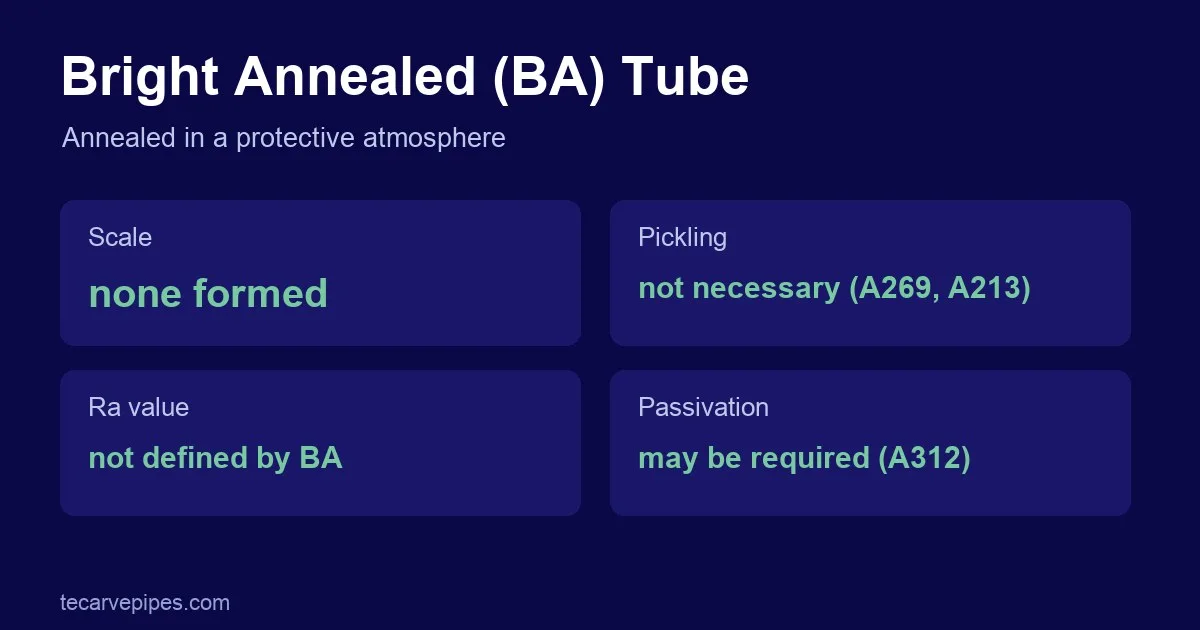

Bright annealed (BA) stainless steel tube is tube whose final solution anneal is done in a protective atmosphere, so the surface does not oxidise and leaves the furnace bright and free of scale. Because there is no scale to remove, the ASTM tube specifications allow BA tube to skip the pickling step that conventionally annealed tube needs.
Clauses below are quoted or summarised from ASTM A269/A269M-25 §14.1, A213/A213M-24 §14.3, A249/A249M-24a, A312/A312M-24b §6.1.7, ASTM A688 §9.1, JIS G 3459:2021 and DIN 17458 Table 6.
What bright annealing changes
Austenitic stainless tube is solution annealed after cold drawing or welding to restore ductility and corrosion resistance. Annealed in air, the tube forms an oxide scale that has to be removed by pickling, which leaves a matte surface. Annealed in a protective atmosphere, the metal is not oxidised and keeps the smooth surface it had after cold working. The difference is in the surface condition, not in the grade or mechanical requirements: BA tube must meet the same chemistry, tensile, hardness and test requirements of its specification.
What the standards say about bright annealed tube
| Standard | Requirement |
|---|---|
| ASTM A269 (general-service tubing), §14.1 | Tubes shall be pickled free of scale. When bright annealing is used, pickling is not necessary. |
| ASTM A213 (boiler, superheater, heat-exchanger tubes), §14.3 | Stainless steel tubes shall be pickled free of scale. When bright annealing is used, pickling is not necessary. |
| ASTM A249 (welded heat-exchanger tubes) | After final heat treatment, tubes shall be chemically descaled or pickled free of scale. When bright annealing is used, pickling or chemical descaling is not necessary. |
| ASTM A312 (pipe), §6.1.7 | Pipe shall be free of scale and contaminating exogenous iron particles. Pickling, blasting or surface finishing is not mandatory when pipe is bright annealed. The purchaser may require a passivating treatment of the finished pipe. |
| ASTM A688 (feedwater heater tubes), §9.1 | Straight tubes are pickled after final annealing in nitric-hydrofluoric acid; the requirement does not apply if bright annealing is performed. |
| JIS G 3459:2021 (pipe) | If the pipe has gone through bright heat treatment and has no surface scale, pickling or similar treatment may be omitted. |
None of these specifications defines a roughness value for bright annealed tube. “BA” describes how the surface was produced, not a measured finish.
BA in the DIN tube conditions
The older German seamless tube standard DIN 17458 classified delivery conditions by surface. Two of them are bright annealed:
| Symbol | Condition | Surface (DIN 17458 Table 6) |
|---|---|---|
| h | Cold worked, heat treated and pickled | Metallically bright-pickled, smoother than hot-worked pickled |
| m | Cold worked and free from scale, heat treated | Metallically bright-annealed, smoother than condition h |
| n2 | Cold redrawn (polished-drawn), bright heat treated | Metallically bright-annealed, smoother than h or m; especially suitable for grinding and polishing |
| o / p | Ground / polished | Grinding or polishing agreed at ordering; conditions h, m or n2 are generally used as the starting condition |
BA vs pickled vs polished vs electropolished
| Finish | How it is produced | When to specify it |
|---|---|---|
| Annealed and pickled (AP) | Annealed in air, scale removed by pickling | General process and structural tube; lowest cost |
| Bright annealed (BA) | Annealed in a protective atmosphere, no scale formed | Instrumentation, hydraulic and gas lines, heat-exchanger and precision tube where a clean, smooth bore without pickling is wanted |
| Mechanically polished | Abrasive polishing after annealing | Sanitary tube with a stated Ra limit, for example ASME BPE SF1 to SF3 |
| Electropolished | Electrochemical polishing, usually after mechanical polishing | High-purity and pharmaceutical tube, ASME BPE SF4 to SF6 |
If the inside roughness matters, specify a maximum Ra rather than relying on “BA”; see the surface finish Ra chart.
How to order BA tube
- Specification and grade, for example ASTM A269 TP316L or A213 TP304.
- Delivery condition: bright annealed. If you also need a roughness limit, state Ra max and whether it applies to ID, OD or both.
- Passivation, if required: A312 explicitly lets the purchaser require it; name the ASTM A967 treatment and test. See the passivation guide.
- Cleanliness, end caps and packing, if the tube goes into gas or instrument service.
- Certificate: the EN 10204 3.1 certificate should show the heat treatment condition.
Related guides: ASTM A269 tubing, ASTM A213 tube, hydraulic tubing. TeCarve supplies bright annealed seamless tube, capillary tube and coiled tube.
Frequently asked questions
What is BA stainless steel tube?
Bright annealed tube: tube whose final anneal is done in a protective atmosphere, so it comes out bright and free of scale and does not need pickling.
Does bright annealed tube need pickling?
No. ASTM A269, A213 and A249 state that pickling is not necessary when bright annealing is used, and A312 states that pickling, blasting or surface finishing is not mandatory for bright annealed pipe.
Is BA the same as polished or electropolished?
No. BA is a heat-treatment surface condition with no specified roughness. Polished and electropolished finishes are produced after annealing and are usually specified by a maximum Ra.
Can BA tube be passivated?
Yes. ASTM A312 allows the purchaser to require a passivating treatment of the finished pipe; the treatment and test are specified to ASTM A967.