

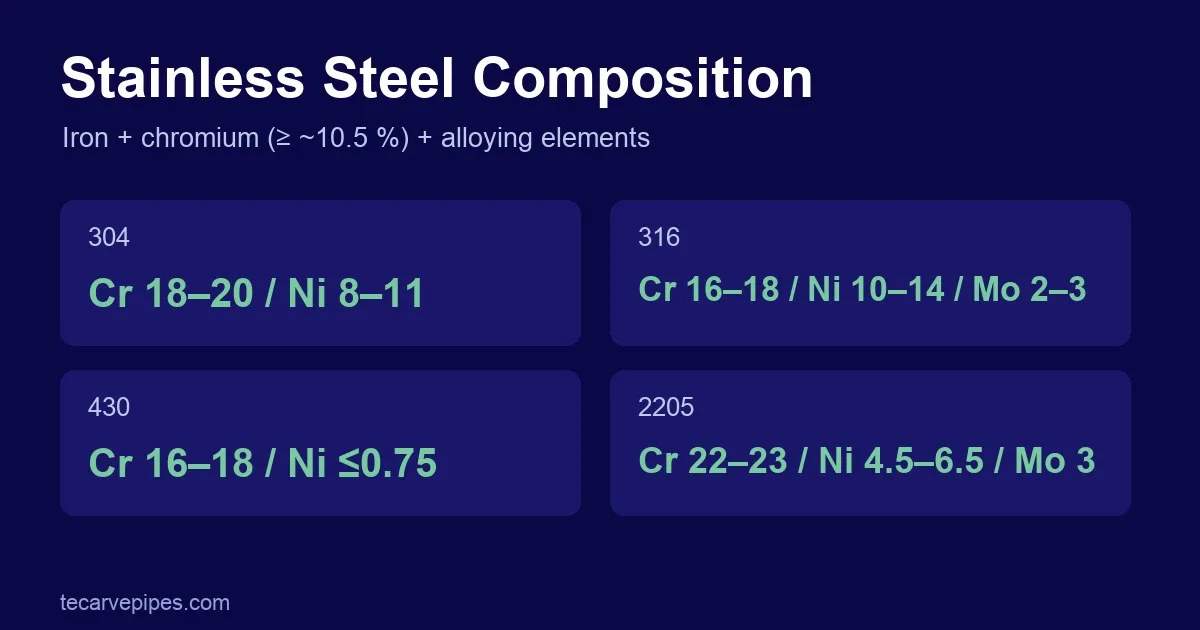

Stainless steel is made of iron alloyed with at least about 10.5 % chromium, plus, depending on the grade, nickel, molybdenum, manganese, nitrogen and small amounts of carbon and other elements. Chromium forms a thin, self-repairing chromium oxide film on the surface, which is what makes the steel “stainless”.
Grade composition limits below are from ASTM A554-26 Table 1 (welded stainless steel mechanical tubing), percent by mass. Pipe and tube specifications such as ASTM A312, A269 and A213 list the same grades with closely similar limits; always check the specification on your order.
What each element does
| Element | Role in stainless steel |
|---|---|
| Iron (Fe) | The base metal; the balance of the composition |
| Chromium (Cr) | Forms the passive oxide film; the defining element of stainless steel |
| Nickel (Ni) | Stabilises the austenitic structure (304, 316), improving ductility, toughness and corrosion resistance |
| Molybdenum (Mo) | Improves resistance to pitting and crevice corrosion in chlorides (316, 317L, 904L, duplex) |
| Manganese (Mn) | Partly replaces nickel as an austenite stabiliser in 200-series grades such as 201 |
| Nitrogen (N) | Strengthens the steel and improves pitting resistance; important in duplex and 201 |
| Carbon (C) | Kept low in “L” grades (0.030 % max) to reduce chromium carbide precipitation at welds |
| Titanium (Ti), niobium (Nb) | Bind carbon in stabilised grades such as 321 and 316Ti |
| Copper (Cu) | Improves resistance to some reducing acids, as in 904L |
Composition of common stainless steel grades
Percent by mass, maximum unless a range is shown. Phosphorus, sulfur and silicon limits are omitted here for readability; see the grade pages for the full table.
| Grade (UNS) | C max | Cr | Ni | Mo | Mn | Other |
|---|---|---|---|---|---|---|
| 201 (S20100) | 0.15 | 16.0–18.0 | 3.5–5.5 | — | 5.50–7.50 | N 0.25 max |
| 304 (S30400) | 0.08 | 18.0–20.0 | 8.0–11.0 | — | 2.00 max | N 0.10 max |
| 304L (S30403) | 0.030 | 18.0–20.0 | 8.0–12.0 | — | 2.00 max | N 0.10 max |
| 316 (S31600) | 0.08 | 16.0–18.0 | 10.0–14.0 | 2.00–3.00 | 2.00 max | N 0.10 max |
| 316L (S31603) | 0.030 | 16.0–18.0 | 10.0–14.0 | 2.00–3.00 | 2.00 max | N 0.10 max |
| 321 (S32100) | 0.08 | 17.0–19.0 | 9.0–12.0 | — | 2.00 max | Ti 5×(C+N) min, 0.70 max |
| 310S (S31008) | 0.08 | 24.0–26.0 | 19.0–22.0 | — | 2.00 max | Si 1.50 max |
| 904L (N08904) | 0.020 | 19.0–23.0 | 23.0–28.0 | 4.00–5.00 | 2.00 max | Cu 1.00–2.00 |
| 430 (S43000) | 0.12 | 16.0–18.0 | 0.75 max | — | 1.00 max | — |
| 2205 (S32205) | 0.030 | 22.0–23.0 | 4.5–6.5 | 3.0–3.5 | 2.00 max | N 0.14–0.20 |
Stainless steel families by composition
- Austenitic (chromium plus nickel, sometimes manganese): 304, 316, 321, 310S, 904L, 201. Non-magnetic when annealed.
- Ferritic (chromium, little or no nickel): 430. Magnetic.
- Martensitic (chromium with higher carbon, hardenable): 410, 420. Magnetic.
- Duplex (chromium, nickel, molybdenum, nitrogen; half austenite, half ferrite): 2205, 2507. Magnetic.
Related: is stainless steel magnetic, carbon steel vs stainless steel, 304 vs 316 vs 316L, and grade pages for 201, 430, 904L, duplex 2205/2507, 316Ti and 317L. All are listed in the technical resources index.
Frequently asked questions
What is stainless steel made of?
Iron alloyed with at least about 10.5 % chromium, usually with nickel, and in some grades molybdenum, manganese, nitrogen, titanium or copper, plus low carbon.
What is the composition of 304 stainless steel?
ASTM A554 lists 304 (S30400) with 18.0–20.0 % chromium, 8.0–11.0 % nickel, 0.08 % carbon max, 2.00 % manganese max and 0.10 % nitrogen max.
What is the composition of 316 stainless steel?
316 (S31600) has 16.0–18.0 % chromium, 10.0–14.0 % nickel and 2.00–3.00 % molybdenum, with 0.08 % carbon max (ASTM A554).
Why is chromium needed in stainless steel?
Chromium forms a thin chromium oxide film on the surface that protects the steel and repairs itself in air.