

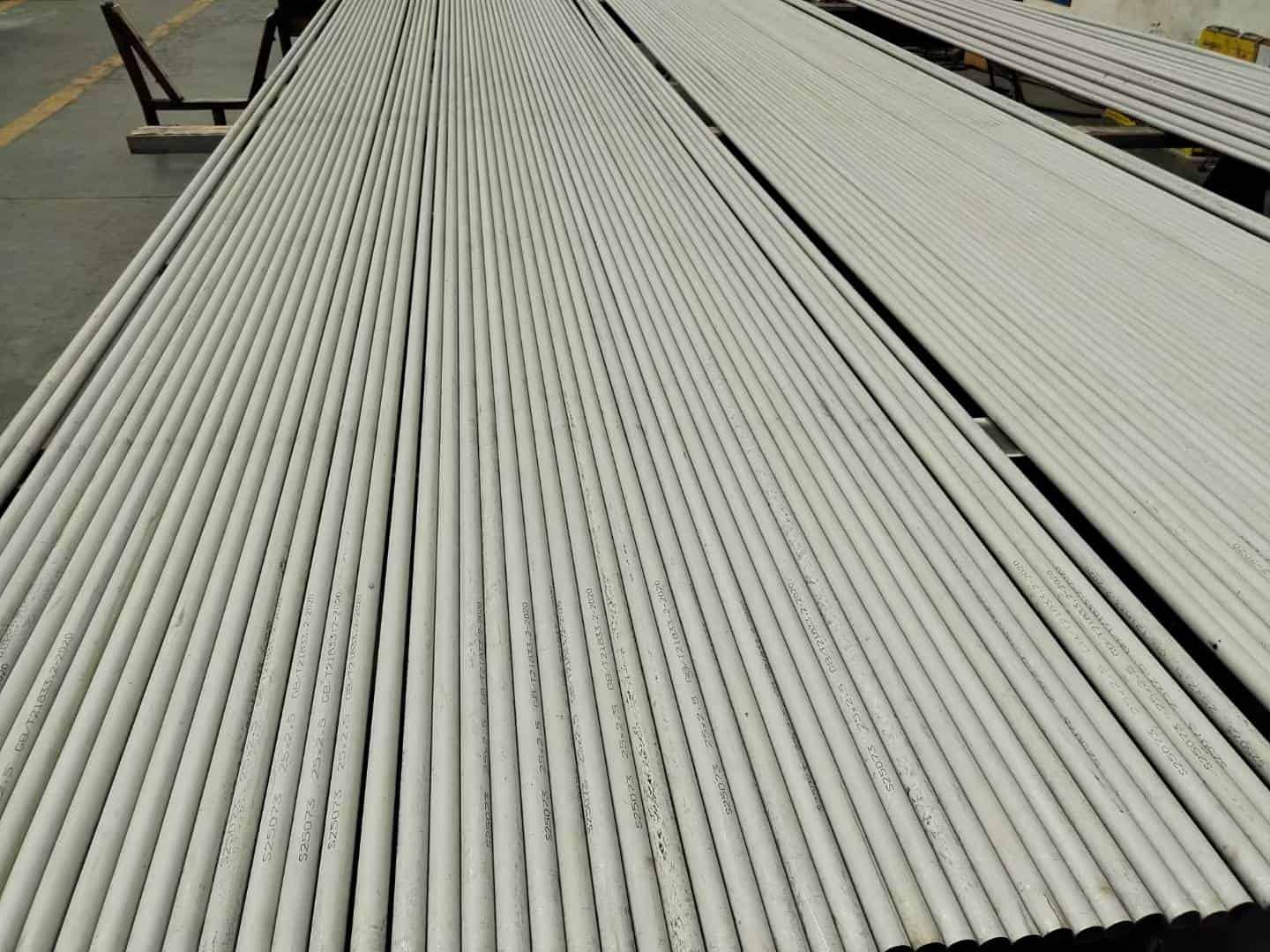

310S stainless steel pipe (designated ASTM A312 Grade TP310S, UNS S31008) is an austenitic chromium-nickel piping material engineered for high-temperature and general corrosive service. Containing 24.0–26.0% chromium and 19.0–22.0% nickel, TP310S provides significantly higher alloy content than standard 18-8 stainless steels like TP304, delivering structural stability in aggressive thermal environments.
Key Specification Summary: ASTM A312 TP310S
Under ASTM A312/A312M-24b, TP310S covers seamless, straight-seam welded, and heavily cold worked (HCW) pipe. Key requirements: minimum tensile strength 75 ksi [515 MPa], minimum yield strength 30 ksi [205 MPa], elongation 35% longitudinal (25% transverse), solution annealing at 1900 °F [1040 °C] minimum, and mandatory hydro or nondestructive electric testing per length.
1. Scope and Governing Standards
ASTM A312/A312M-24b is the standard specification for seamless, straight-seam welded, and heavily cold worked austenitic stainless steel pipes intended for high-temperature and general corrosive service. Grade TP310S (UNS S31008) represents the low-carbon modification of the 25Cr-20Ni alloy family.
Piping dimensions follow ASME B36.19 (Table X1.1) and ASME B36.10M. General delivery requirements, including marking and standard testing protocols, follow the ASTM A999 general requirements specification. For an overview across all austenitic grades, review our ASTM A312 stainless steel pipe guide.
2. Chemical Composition: TP310S vs. TP310H vs. TP304
Chemical composition limits are defined in Table 1 of ASTM A312/A312M-24b. The table below compares TP310S against high-carbon TP310H and baseline TP304:
| Element (% by weight) | ASTM A312 TP310S (UNS S31008) | ASTM A312 TP310H (UNS S31009) | ASTM A312 TP304 (UNS S30400) |
|---|---|---|---|
| Carbon (C) | 0.08 max | 0.04–0.10 | 0.08 max |
| Manganese (Mn) | 2.00 max | 2.00 max | 2.00 max |
| Phosphorus (P) | 0.045 max | 0.045 max | 0.045 max |
| Sulfur (S) | 0.030 max | 0.030 max | 0.030 max |
| Silicon (Si) | 1.00 max | 1.00 max | 1.00 max |
| Chromium (Cr) | 24.0–26.0 | 24.0–26.0 | 18.0–20.0 |
| Nickel (Ni) | 19.0–22.0 | 19.0–22.0 | 8.0–11.0 |
| Molybdenum (Mo) | 0.75 max | Not specified | Not specified |
The alloy profile of TP310S features elevated chromium (24.0–26.0%) and nickel (19.0–22.0%), which provide solid-solution stability. Table 1 also limits molybdenum to 0.75% maximum in TP310S, whereas TP310H has no specific molybdenum restriction.
3. Mechanical Properties and Elongation Requirements
Room-temperature mechanical requirements are specified in Table 4 of ASTM A312/A312M-24b:
| Mechanical Property | ASTM A312 TP310S | ASTM A312 TP310H | ASTM A312 TP304 |
|---|---|---|---|
| Tensile Strength, min | 75 ksi [515 MPa] | 75 ksi [515 MPa] | 75 ksi [515 MPa] |
| Yield Strength (0.2% offset), min | 30 ksi [205 MPa] | 30 ksi [205 MPa] | 30 ksi [205 MPa] |
| Elongation in 2 in [50 mm] (Longitudinal), min | 35% | 35% | 35% |
| Elongation in 2 in [50 mm] (Transverse), min | 25% | 25% | 25% |
TP310S and TP310H share identical baseline room-temperature mechanical property requirements with TP304: 75 ksi [515 MPa] minimum tensile strength and 30 ksi [205 MPa] minimum yield strength. Standard 2 in [50 mm] or 4D specimens must achieve at least 35% longitudinal and 25% transverse elongation.
4. Metallurgical Comparison: 310S vs. 310H
While sharing the 25Cr-20Ni base, ASTM A312 distinguishes TP310S and TP310H through carbon limits, grain size control, and designated heat treatment:
| Parameter | ASTM A312 TP310S (UNS S31008) | ASTM A312 TP310H (UNS S31009) | Standard Requirement |
|---|---|---|---|
| Carbon Range | 0.08% max | 0.04–0.10% | TP310S sets only a carbon maximum; TP310H requires a carbon range (0.04–0.10%). |
| ASTM Grain Size (Table 5) | No mandatory requirement | ASTM No. 6 or coarser | Grain size of TP310H determined per ASTM E112 on each heat treatment lot. |
| Solution Annealing (Table 2) | 1900 °F [1040 °C] min, rapid cool | 1900 °F [1040 °C] min, rapid cool | Quenched in water or rapidly cooled by other means. |
| Molybdenum Limit | 0.75% max | Not specified | Residual element restriction in TP310S chemistry per Table 1. |
The 0.08% carbon cap in TP310S improves weldability and reduces carbide sensitization during fabrication. In contrast, TP310H specifies a 0.04–0.10% carbon window alongside Table 5 grain size control (ASTM No. 6 or coarser) for specialized high-temperature applications.
5. Dimensions, Schedules, and Wall Thickness Tolerances
ASTM A312 TP310S pipe is produced to nominal dimensions per ASME B36.19 (Table X1.1) and ASME B36.10M across standard Schedules 5S, 10S, 40S, and 80S.
Permissible variations in nominal wall thickness are governed by Table 3 of ASTM A312/A312M-24b:
| Nominal Pipe Size (NPS) Range | Wall-to-Diameter Ratio (t/D) | Over-Tolerance (%) | Under-Tolerance (%) |
|---|---|---|---|
| NPS 1/8 to 2-1/2 [DN 6 to 65] | All t/D ratios (Seamless & Welded) | +20.0% | −12.5% |
| NPS 3 to 18 [DN 80 to 450] | t/D ≤ 5% | +22.5% | −12.5% |
| NPS 3 to 18 [DN 80 to 450] | t/D > 5% | +15.0% | −12.5% |
| NPS ≥ 20 [DN ≥ 500] (Welded) | All t/D ratios | +17.5% | −12.5% |
| NPS ≥ 20 [DN ≥ 500] (Seamless) | t/D ≤ 5% | +22.5% | −12.5% |
| NPS ≥ 20 [DN ≥ 500] (Seamless) | t/D > 5% | +15.0% | −12.5% |
Across all diameters and manufacturing processes, the permissible under-tolerance is fixed at −12.5% of nominal wall thickness. To check specific dimensions, schedules, and linear theoretical weights, see our stainless steel pipe sizes and schedule weight chart.
6. Mandatory Testing and Lot Inspection Protocols
ASTM A312 establishes mandatory testing on finished pipe and production lots:
- Pressure & NDT Testing (Clause 12.1): Each individual pipe length must undergo either a nondestructive electric test (eddy current or ultrasonic) or a hydrostatic test.
- Tensile Testing Frequency (Clause 11.2): For lots of 100 pipes or fewer, one tension test is conducted. For lots over 100 pipes, two tension tests are required.
- Flattening Test (Clause 11.3): For continuous furnace lots, flattening tests are performed on 5% of pipes (minimum two lengths). Welded pipe may substitute a transverse guided face bend test.
To evaluate joint quality factors and design pressures under ASME B31.3, consult our pipe pressure rating chart.
7. ASTM A312 TP310S Purchase Order Checklist
Purchase orders should define the following technical parameters:
- Quantity: Total footage, meters, or piece count.
- Standard Specification: ASTM A312/A312M-24b and ASTM A999.
- Material Grade: Grade TP310S (UNS S31008).
- Manufacturing Route: Seamless, straight-seam welded, or heavily cold worked (HCW).
- Size Designation: Nominal Pipe Size (NPS) and Schedule, or outside diameter and nominal wall.
- Lengths: Single random (approx. 6 m / 20 ft), double random, or custom cut lengths.
- End Finish: Plain end square cut or beveled for welding per ASME B16.25.
- Testing Preference: Hydrostatic test or nondestructive electric test per Clause 12.1.
- Inspection Documentation: EN 10204 Type 3.1 Mill Test Certificate with melt analysis and mechanical lot records per ASTM A999.
8. TeCarve Welded and Seamless Stainless Steel Supply Range
TeCarve is the exclusive factory-direct export channel for two dedicated manufacturing plants in Foshan (welded & decorative tubing) and Wenzhou (seamless & precision tubing). Plant certifications (ISO 9001, ISO 14001, ISO 45001, PED/AD 2000-Merkblatt W0, and marine classifications) are held by the dedicated manufacturing plants — see https://tecarvepipes.com/verify-our-factories/ for details.
Through the two dedicated plants, TeCarve supplies Grade 310S across primary product categories:
- Seamless Stainless Steel Pipe: Supplied to ASTM A312, ASTM A213, and EN 10216-5 in Grade 310S from NPS 1/8 in (OD 10.3 mm) to NPS 24 in (OD 610.0 mm) across full ASME B36.19M and B36.10M schedules (wall thicknesses from 0.89 mm to 59.54 mm), with larger diameters up to 1,600 mm OD available on request. See our stainless steel seamless pipe and tube catalog.
- Heavy-Wall Stainless Steel Pipe: Heavy-wall seamless and HCW pipe in Grade 310S covering Schedule 80S, Schedule 160, and XXS (wall thicknesses up to 59.54 mm), with customized forged/extruded pipes up to OD 1600 mm / WT 100 mm per our heavy-wall seamless stainless steel pipe specifications.
- Heat Exchanger & Boiler Tubing: Grade 310S supplied to ASTM A213 seamless and ASTM A249 welded specifications in straight lengths up to 24 meters or custom U-bent configurations, detailed in our stainless steel heat exchanger tubes overview.
- Quality Documentation: Every shipment includes an EN 10204 3.1 inspection certificate issued by the producing plant. For guidance on reviewing test certificates, see our EN 10204 3.1 mill test certificate guide.
9. Frequently Asked Questions (FAQ)
What is 310S stainless steel pipe according to ASTM A312?
ASTM A312 TP310S (UNS S31008) is an austenitic chromium-nickel stainless steel pipe containing 24.0–26.0% chromium, 19.0–22.0% nickel, and a maximum of 0.08% carbon. It covers seamless, straight-seam welded, and heavily cold worked pipe for high-temperature and general corrosive service.
What is the key difference between TP310S and TP310H under ASTM A312?
The primary differences are carbon content and grain size. TP310S limits carbon to 0.08% maximum with no mandatory grain size, while TP310H requires 0.04–0.10% carbon and an ASTM grain size of number 6 or coarser (per ASTM E112).
What testing is mandatory for each length of ASTM A312 TP310S pipe?
Under Clause 12.1 of ASTM A312/A312M-24b, each individual pipe length must undergo either a nondestructive electric test (eddy current or ultrasonic) or a hydrostatic test.
What wall thickness tolerances govern ASTM A312 TP310S pipe?
Under Table 3 of ASTM A312/A312M-24b, nominal wall thickness has a fixed under-tolerance of −12.5% across all sizes. Allowable over-tolerance is +15.0% to +22.5% depending on nominal pipe size, t/D ratio, and whether the pipe is seamless or welded.
What solution annealing temperature is required for TP310S pipe?
Under Table 2 of ASTM A312/A312M-24b, TP310S must be solution treated at 1900 °F [1040 °C] minimum, followed by water quenching or rapid cooling by other means.
Chemical and mechanical values per ASTM A312/A312M-24b; refer to the purchased standard for the full text.