

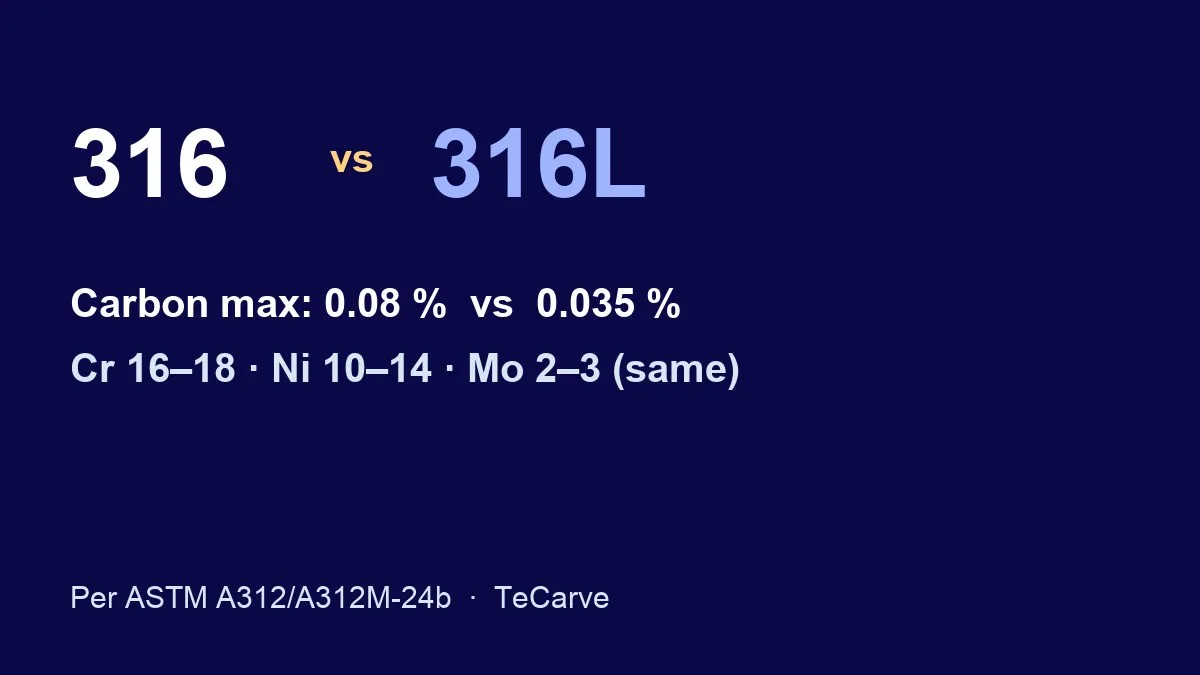

The difference between 316 and 316L stainless steel is carbon. In ASTM A312 pipe, TP316 allows up to 0.08 % carbon and TP316L up to 0.035 %; chromium (16–18 %), nickel (10–14 %) and molybdenum (2–3 %) ranges are the same. Lower carbon makes 316L the usual choice for welded pipe and tube, while 316 has the higher minimum strength: 75 ksi [515 MPa] tensile and 30 ksi [205 MPa] yield versus 70 ksi [485 MPa] and 25 ksi [170 MPa] for 316L.
316 vs 316L side by side
| 316 | 316L | |
|---|---|---|
| UNS (ASTM A959) | S31600 | S31603 |
| EN number / name (EN 10088-1 Table A.1) | 1.4401 / X5CrNiMo17-12-2 | 1.4404 / X2CrNiMo17-12-2 |
| JIS / GB/T 20878 | SUS316 / S31608 | SUS316L / S31603 |
| Carbon, max (ASTM A312 TP grades) | 0.08 % | 0.035 % (0.040 % for small or thin tube, footnote D) |
| Chromium | 16.0–18.0 % | 16.0–18.0 % |
| Nickel | 10.0–14.0 % | 10.0–14.0 % |
| Molybdenum | 2.00–3.00 % | 2.00–3.00 % |
| Tensile strength, min (A312) | 75 ksi [515 MPa] | 70 ksi [485 MPa] |
| Yield strength, min (A312) | 30 ksi [205 MPa] | 25 ksi [170 MPa] |
| Density (EN 10088-1 Annex E) | 8.0 g/cm³ | 8.0 g/cm³ |
| Melting range (ASM Alloy Digest) | 1,371–1,399 °C (SS-865) | 1,371–1,399 °C (SS-872) |
Chemical composition (ASTM A312)
Weight percent, maximum unless a range is shown, from ASTM A312/A312M-24b, Table 1.
| Grade | UNS | C max | Mn max | P max | S max | Si max | Cr | Ni | Mo |
|---|---|---|---|---|---|---|---|---|---|
| TP316 | S31600 | 0.08 | 2.00 | 0.045 | 0.030 | 1.00 | 16.0–18.0 | 10.0–14.0 | 2.00–3.00 |
| TP316L | S31603 | 0.035* | 2.00 | 0.045 | 0.030 | 1.00 | 16.0–18.0 | 10.0–14.0 | 2.00–3.00 |
| TP316H | S31609 | 0.04–0.10 | 2.00 | 0.045 | 0.030 | 1.00 | 16.0–18.0 | 10.0–14.0 | 2.00–3.00 |
* Footnote D: for small diameter or thin walls or both, where many drawing passes are required, a carbon maximum of 0.040 % is necessary in grades TP304L and TP316L.
Why the “L” matters in welded pipe and tube
When austenitic stainless steel is held for a time in its sensitisation temperature range, chromium carbides can form at grain boundaries and leave chromium-depleted zones that are prone to intergranular corrosion. The heat-affected zone of a weld passes through this range. Keeping carbon low, as in 316L, reduces the carbon available to form these carbides, which is why 316L is the common choice for pipe and tube that will be welded and not solution annealed afterwards. Intergranular corrosion susceptibility can be checked with the practices in ASTM A262 when the order requires it.
When to choose 316, 316L or 316H
- 316L: welded pipelines, process piping and sanitary or instrumentation tubing that is welded in fabrication.
- 316: where the higher A312 minimum strength is used in the design and welding is limited or followed by solution annealing.
- 316H: elevated-temperature service where the design code calls for controlled higher carbon.
- 316Ti (UNS S31635, EN 1.4571): titanium-stabilised alternative common in European specifications; see 316Ti stainless steel.
Compared with 304, both 316 grades add molybdenum for better resistance to pitting in chloride-bearing media; see 304 vs 316 vs 316L and 304 / 304L stainless steel pipe and tube.
Equivalent EN grades: 1.4401, 1.4404, 1.4432, 1.4435
EN 10088-1:2023 Table A.1 lists 1.4401 (X5CrNiMo17-12-2) against UNS S31600 and 1.4404 (X2CrNiMo17-12-2) against S31603, both as wider-match cross-references. 1.4432 (X2CrNiMo17-12-3) is also listed against S31603, while 1.4435 (X2CrNiMo18-14-3), often specified for pharmaceutical tubing, has no UNS cross-reference in the table. Check which EN grade a European specification names before ordering. Full list: stainless steel grades chart.
Related: does stainless steel rust, 316L stainless steel tube, stainless steel density, stainless steel melting point.