

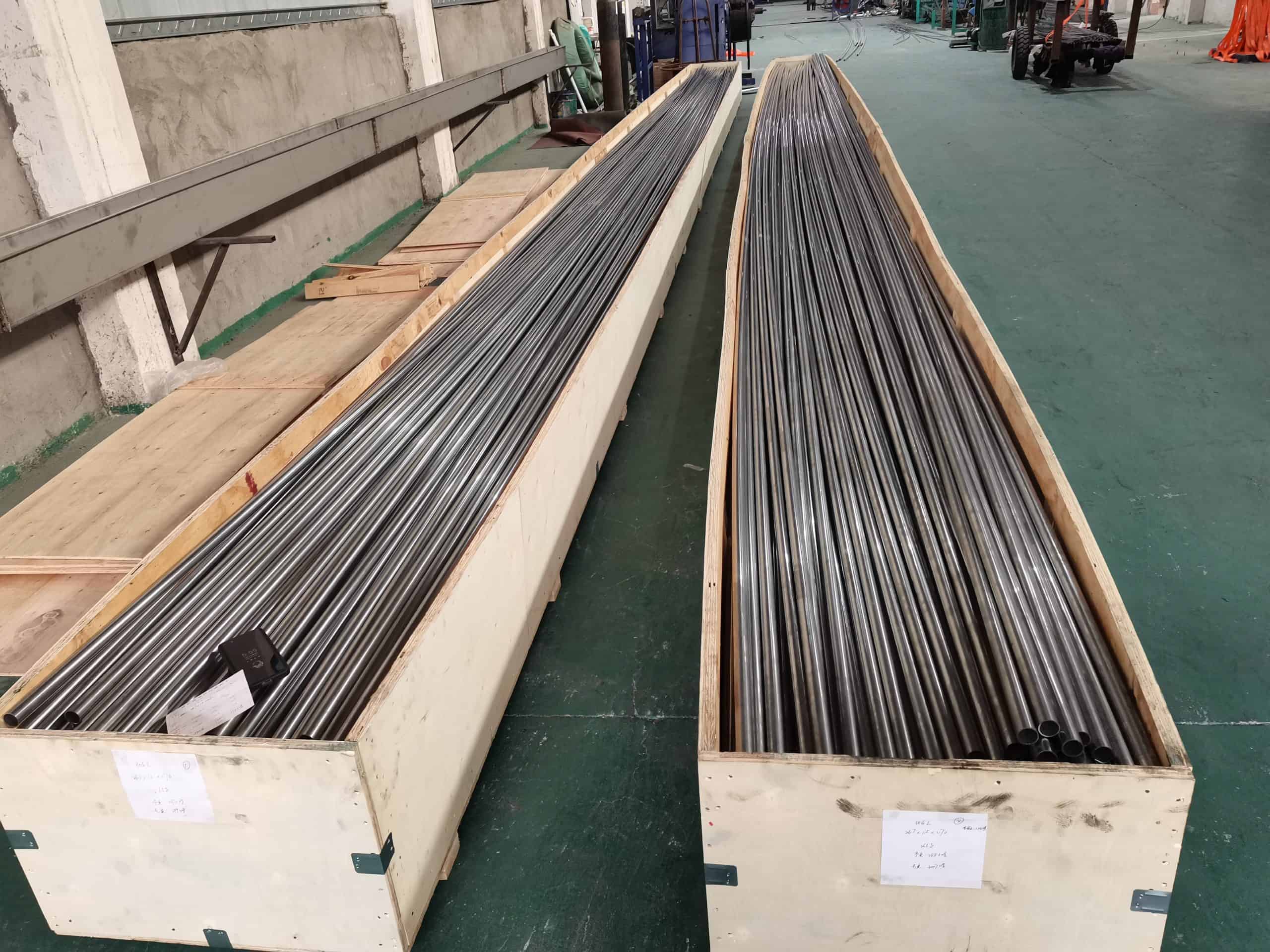

ASTM A249 / A249M-24a is the standard specification for nominal-wall welded tubes (WLD) and heavily cold-worked welded tubes (HCW) in austenitic stainless steels for boiler, superheater, heat exchanger, and condenser service. Approved May 1, 2024, by ASTM Subcommittee A01.10 and adopted as ASME Specification SA-249 (BPVC Section II, Part A), it governs pressure-tight tubes made without filler metal, mandating post-weld cold working, reverse-bend ductility testing, and weld-bead height limits.
Standard Scope: ASTM A249 covers sizes from 1/8 in [3.2 mm] inside diameter (ID) to 12 in [304.8 mm] outside diameter (OD), with nominal wall thicknesses from 0.015 to 0.320 in [0.4 to 8.1 mm].
1. Scope, Product Forms (WLD vs. HCW) and Size Limits
ASTM A249 covers two welded tube conditions:
- Standard Welded Tubes (WLD): Made from flat-rolled steel by automatic welding without filler metal. Prior to final heat treatment, tubes are cold worked in weld and base metal or in weld only (Section 5.1.1).
- Heavily Cold Worked Tubes (HCW): Cold worked to ≥35% reduction in both wall and weld before final anneal. Prior to cold work, the weld is 100% radiographically examined per ASME BPVC Section VIII, Div. 1, UW-51 (Section 5.1.2).
- High-Temperature “H” Grades (Section 1.2): Modified grades (TP304H, TP309H, TP309HCb, TP310H, TP310HCb, TP316H, TP321H, TP347H, TP348H) engineered for elevated creep strength in superheaters and reheaters.
- Size Range (Section 1.3): Usually furnished from 1/8 in [3.2 mm] ID to 12 in [304.8 mm] OD; wall 0.015 to 0.320 in [0.4 to 8.1 mm] inclusive. Other sizes are permitted if all requirements are met.
- Mechanical Exclusions (Section 1.4): Tensile/hardness rules do not apply to tubes <1/8 in [3.2 mm] ID or <0.015 in [0.4 mm] wall.
- Units (Section 1.6): Inch-pound units govern unless metric “M” designation (A249M) is ordered.
2. Engineering Comparison: ASTM A249 vs. ASTM A213 vs. ASTM A269
Engineers compare three common ASTM austenitic tube standards:
| Parameter | ASTM A249 / A249M | ASTM A213 / A213M | ASTM A269 / A269M |
|---|---|---|---|
| Manufacture | Welded only (WLD or HCW), automatic, no filler | Seamless only (hot/cold-finished) | Seamless and welded permitted |
| Application | Boilers, superheaters, heat exchangers, condensers | Boilers, superheaters, heat exchangers | General corrosion, instrumentation |
| Weld Cold Work | Required after welding (weld and base metal, or weld metal only) before final heat treatment | Not applicable (seamless) | See ASTM A269 |
| Weld Ductility | Reverse-bend test, 1 per 1,500 ft [450 m] (reverse flattening per A1016 where Note 1 applies) | Not applicable (seamless) | See ASTM A269 |
| Weld Bead (14.2) | Weld thickness ≤ wall at 90° + 6% of specified wall or 0.004 in [0.1 mm] | Not applicable (seamless) | See ASTM A269 |
| ASME VIII S9 | S9: 100% joint efficiency permissible in certain ASME applications with UT per E273 or E213 | Not applicable (no longitudinal weld) | See ASTM A269 |
| Reference | This standard specification guide | See heat exchanger tube catalog | Consult ASTM A269 tubing guide |
ASTM A249 offers closer wall concentricity (±10%) than seamless pipe. For piping headers, see the ASTM A312 pipe guide; for enhanced heat transfer, A249 plain tubes serve as raw stock for stainless steel low fin tube products.
3. Manufacture and Cold Working (Section 5)
Section 5 establishes processing controls to ensure seam integrity matches parent metal:
- No Filler Metal (Section 5.1): Tubes are made from flat-rolled steel by automatic welding without filler metal.
- WLD Cold Work (Section 5.1.1): After welding and before final heat treatment, tubes are cold worked in weld and base metal or in weld metal only. Purchasers may specify the cold-working method and minimum cold-drawn reduction.
- HCW Processing & Radiography (Section 5.1.2): Heavily cold worked tubes require ≥35% reduction in both wall and weld before final anneal. The weld seam must pass 100% radiography per ASME BPVC Section VIII, Div. 1, UW-51 before cold working.
- General Requirements (Section 4): ASTM A1016/A1016M governs testing, sampling, and definitions unless otherwise provided in A249.
4. Heat Treatment Parameters (Section 6 & Table 2)
Tubes must be furnished heat-treated per Section 6 and Table 2. Rapid cooling prevents chromium carbide precipitation:
- Standard Austenitic Grades: All grades not individually listed (TP304, TP304L, TP316, TP316L) require solution heat treatment at 1900 °F [1040 °C] minimum, followed by water quench or rapid cooling (demonstrable by A262 Practice E under S6).
- Grade TP316H: 1900 °F [1040 °C] minimum solution heat treatment.
- Stabilized Grades: TP321 and TP347 require 1900 °F [1040 °C] minimum; TP321H and TP347H require 2000 °F [1100 °C] minimum.
- High-Temperature Caution (Section 6.2): Solution temperatures >1950 °F [1065 °C] may impair subsequent intergranular corrosion resistance in stabilized grades (TP309HCb, TP310HCb, TP321, TP321H, TP347, TP347H, TP348, TP348H). A stabilizing or re-solution anneal may be specified on the order (Supplementary Requirement S4).
5. Chemical Composition Requirements (Table 1)
Table 1 specifies chemical limits (% max unless range). Product analysis is tested on one length of flat-rolled stock or one tube per heat (Section 8.1):
| Grade | UNS | C (max) | Mn | P | S | Si | Cr | Ni | Mo |
|---|---|---|---|---|---|---|---|---|---|
| TP304 | S30400 | 0.08 | 2.00 | 0.045 | 0.030 | 1.00 | 18.0–20.0 | 8.0–11.0 | — |
| TP304L | S30403 | 0.030D | 2.00 | 0.045 | 0.030 | 1.00 | 18.0–20.0 | 8.0–12.0 | — |
| TP316 | S31600 | 0.08 | 2.00 | 0.045 | 0.030 | 1.00 | 16.0–18.0 | 10.0–14.0 | 2.00–3.00 |
| TP316L | S31603 | 0.030D | 2.00 | 0.045 | 0.030 | 1.00 | 16.0–18.0 | 10.0–14.0 | 2.00–3.00 |
Footnote D: For small OD (<0.500 in [12.7 mm]) or light wall (<0.049 in [1.2 mm] min wall) where many drawing passes are required, carbon max is 0.040% for TP304L and TP316L.
Product Analysis Tolerances (Section 8.2): Conform to ASTM A480 Table A1.1 (not applicable to carbon when specified max carbon is ≤0.04%).
6. Mechanical Properties and Hardness Limits (Table 3)
Tubes must conform to the tensile and hardness criteria of Table 3:
| Grade | Tensile min, ksi [MPa] | Yield min, ksi [MPa] | Elongation min, % | Rockwell max | Vickers max |
|---|---|---|---|---|---|
| TP304 | 75 [515] | 30 [205] | 35 | 90 HRB | 200 HV |
| TP304L | 70 [485] | 25 [170] | 35 | 90 HRB | 200 HV |
| TP316 | 75 [515] | 30 [205] | 35 | 90 HRB | 200 HV |
| TP316L | 70 [485] | 25 [170] | 35 | 90 HRB | 200 HV |
| TP321 | 75 [515] | 30 [205] | 35 | 90 HRB | 200 HV |
- Exclusions (Table 3 Note A): Properties do not apply to tubes <1/8 in [3.2 mm] OD or wall <0.015 in [0.4 mm].
- Vickers Option (Section 10.2): Vickers testing (200 HV max) is permitted instead of Rockwell for ID <0.354 in [9.00 mm] or wall <0.065 in [1.65 mm].
7. Mechanical Testing, Reverse-Bend Test, and Lot Sampling
Mandatory test frequencies verify mechanical strength and weld seam ductility:
- Tension Test (Section 13.1): 1 tube per lot ≤50 tubes; 2 tubes per lot >50 tubes.
- Flattening and Flange Tests (Sections 13.2 & 13.3): 1 test from each end of one tube per lot.
- Reverse-Bend Test (Section 11): 1 test per 1,500 ft [450 m]. A 4 in [100 mm] section is split 90° each side of the weld, opened flat, and bent around a mandrel ≤4× wall thickness with the weld at maximum bend. No cracks or overlaps permitted.
Note 1 Exceptions: Does not apply when wall ≥10% OD, wall ≥0.134 in [3.4 mm], or OD <0.375 in [9.5 mm]; then reverse-flattening per A1016 applies. - Hardness (Section 13.5): 2 tubes per lot.
- Pressure Test / NDE (Section 13.6): Each tube receives either hydrostatic or nondestructive electric testing; the purchaser may specify which.
- Continuous-Furnace Lot Sizes (Table 4): OD ≥2 in [50.8 mm] and wall ≥0.200 in [5.1 mm]: ≤50 tubes; OD 1–2 in or >1 in with wall <0.200 in: ≤75 tubes; OD ≤1 in [25.4 mm]: ≤125 tubes.
- Grain Size (Section 12): ASTM No. 7 or coarser for TP304H, TP316H, TP321H, TP347H, TP348H; No. 6 or coarser for TP309H, TP309HCb, TP310H, TP310HCb.
8. Dimensions, Wall Tolerances, Weld Bead, and Straightness
Dimensional precision ensures proper fit into tube sheets:
- Wall Tolerance (Section 14.1): Strictly ±10% of nominal wall for all sizes.
- OD Tolerances: Per ASTM A1016/A1016M.
- Weld Bead Limit (Section 14.2): Outside weld thickness ≤ wall at 90° + 6% of nominal wall or 0.004 in [0.1 mm], whichever greater.
Exceptions: Does not apply if wall >12% OD, wall >0.165 in [4.2 mm], OD >3 in [76.2 mm], or yield ≥35 ksi [240 MPa]. - Straightness (Section 15): Maximum deviation ≤0.030 in [0.8 mm] in 3 ft [900 mm]; ends square and burr-free.
- Surface (Section 16): Chemically descaled or pickled free of scale; not required when bright annealed.
- Forming (Section 17): Tubes must stand expanding and beading without cracks or flaws.
9. Supplementary Requirements (S1 to S9)
Supplementary requirements apply only when specified on the purchase order:
| Req. | Title | Technical Scope & Criteria |
|---|---|---|
| S1 | Stress-Relieved Anneal | TP304L, TP316L, TP321, TP347, TP348; 1550–1650 °F [845–900 °C] after roll straightening. |
| S2 | Minimum Wall Thickness | Tubes ordered to minimum wall per A1016; marked “S2”. |
| S3 | Pneumatic Testing | Air underwater or pneumatic leak testing per A1016. |
| S4 | Stabilizing Heat Treatment | Stabilization anneal for titanium/niobium stabilized grades. |
| S5 | Unstraightened Tubes | Supplied without straightening; marked “U”; min yield reduced by 5 ksi [35 MPa]. |
| S6 | Intergranular Corrosion | Tested per ASTM A262 Practice E. |
| S7 | Weld Decay Testing | Boiling 50% HCl; ratio ≤1.25 or ≤1.00 (HCW 13.8 ratio 0.90–1.10). Not for Ni ≥19.0% or Mo ≥4.00%. |
| S8 | Special Applications (NB) | Controlled weld bead for hydraulic tube sheet expansion; marked “NB”. |
| S9 | ASME 100% Joint Efficiency | Permits 100% joint efficiency in certain ASME applications if each tube is UT tested per E273/E213; marked “S9” (Note S9.1: not mandatory for all ASME units). |
10. Purchasing and Ordering Checklist (Section 3)
Orders referencing ASTM A249 should specify:
- Quantity: Feet, meters, or number of lengths.
- Product Form: Standard welded (WLD) or heavily cold worked (HCW).
- Grade: Alloy designation (TP304, TP304L, TP316, TP316L, TP321).
- Size: Outside diameter (OD) and nominal wall thickness (or min wall if S2).
- Length: Specific cut lengths or random lengths.
- Testing Option (Section 13.6): Hydrostatic test or nondestructive electric test.
- Test Report: Certification per ASTM A1016 and EN 10204 3.1 mill test certificate.
- Specification: ASTM A249/A249M-24a (and ASME SA-249 if required).
- Supplementary Requirements: S1 to S9 (e.g., S7 weld decay or S8 NB).
- S7 Ratio: Acceptable weld decay ratio (≤1.25 or ≤1.00) if S7 is specified.
11. Factory Sourcing and Supply Capabilities
TeCarve is the exclusive factory-direct export channel for two dedicated manufacturing plants in Foshan (welded & decorative tubing) and Wenzhou (seamless & precision tubing):
- Supply Scope: Welded heat exchanger tubes and fabricated U-bends are produced at the Foshan facility with bright annealing. Seamless tubes under ASTM A213 are supplied from the Wenzhou plant. Sourcing details are in our stainless steel heat exchanger pipe and tube catalog.
- Dual Testing: Every heat exchanger tube undergoes both hydrostatic testing and eddy-current testing (test benches rated up to 20–30 MPa). Mechanical lots receive flattening, flaring, bending, and reverse flattening on the weld seam.
- Finned Tubing: A249 plain tubes serve as raw material for stainless steel low fin tube geometries.
- Commercial Terms: Minimum order quantity (MOQ) is 100–300 kg for trial orders; custom U-tubes evaluated per bending schedule. Stocked sizes ship in 7–10 days; custom runs in 10–25 days.
- Documentation & Approvals: EN 10204 3.1 certificates accompany each order (EN 10204 3.2 witnessed by SGS, BV, TÜV on request). Plant certifications (ISO 9001/14001/45001, PED/AD 2000-Merkblatt W0, and marine classification society type approvals) are held by the plants — see https://tecarvepipes.com/verify-our-factories/.
| OD (mm [in]) | BWG | Wall Thickness (WT) | OD Tolerance | WT Tolerance |
|---|---|---|---|---|
| 6.35 mm [0.250 in] | 20 | 0.89 mm [0.035 in] | ±0.10 mm | ±10% |
| 12.70 mm [0.500 in] | 16 | 1.65 mm [0.065 in] | ±0.10 mm | ±10% |
| 19.05 mm [0.750 in] | 16 | 1.65 mm [0.065 in] | ±0.10 mm | ±10% |
| 25.40 mm [1.000 in] | 14 | 2.11 mm [0.083 in] | ±0.15 mm | ±10% |
| 38.10 mm [1.500 in] | 12 | 2.77 mm [0.109 in] | ±0.15 mm | ±10% |
| 50.80 mm [2.000 in] | 10 | 3.40 mm [0.134 in] | ±0.25 mm | ±10% |
Frequently Asked Questions (FAQ)
What is the primary difference between ASTM A249 and ASTM A213?
ASTM A249 covers welded austenitic tubes made without filler metal, whereas ASTM A213 covers seamless tubes. A249 adds weld-specific requirements: a reverse-bend test across the weld seam and a limit on weld thickness relative to the adjacent wall (Section 14.2).
Can ASTM A249 welded tubes achieve 100% joint efficiency under ASME Section VIII?
Yes. Under Supplementary Requirement S9, a joint efficiency factor of 1.00 is allowed in certain ASME applications if each tube is ultrasonic tested per ASTM E273 or E213 and marked “S9”.
What is heavily cold worked (HCW) tubing under ASTM A249?
HCW tubing is cold worked to ≥35% reduction in both wall and weld before final solution anneal. The weld seam must pass 100% radiography per ASME Section VIII, Div. 1, UW-51 before cold reduction.
What are the permissible wall thickness tolerances for ASTM A249 tubes?
ASTM A249 specifies a nominal wall thickness tolerance of ±10% across all sizes. For minimum wall design, Supplementary Requirement S2 must be specified on the purchase order.
What does the “NB” marking signify on an ASTM A249 tube?
The “NB” marking denotes compliance with Supplementary Requirement S8, confirming specialized weld bead control suitable for hydraulic or roller expansion into heat exchanger tube sheets.
Is hydrostatic testing mandatory for all ASTM A249 tubes?
Under Section 13.6, each tube must receive either a hydrostatic test or a nondestructive electric test (eddy current or ultrasonic); the purchaser may specify which test is performed.