

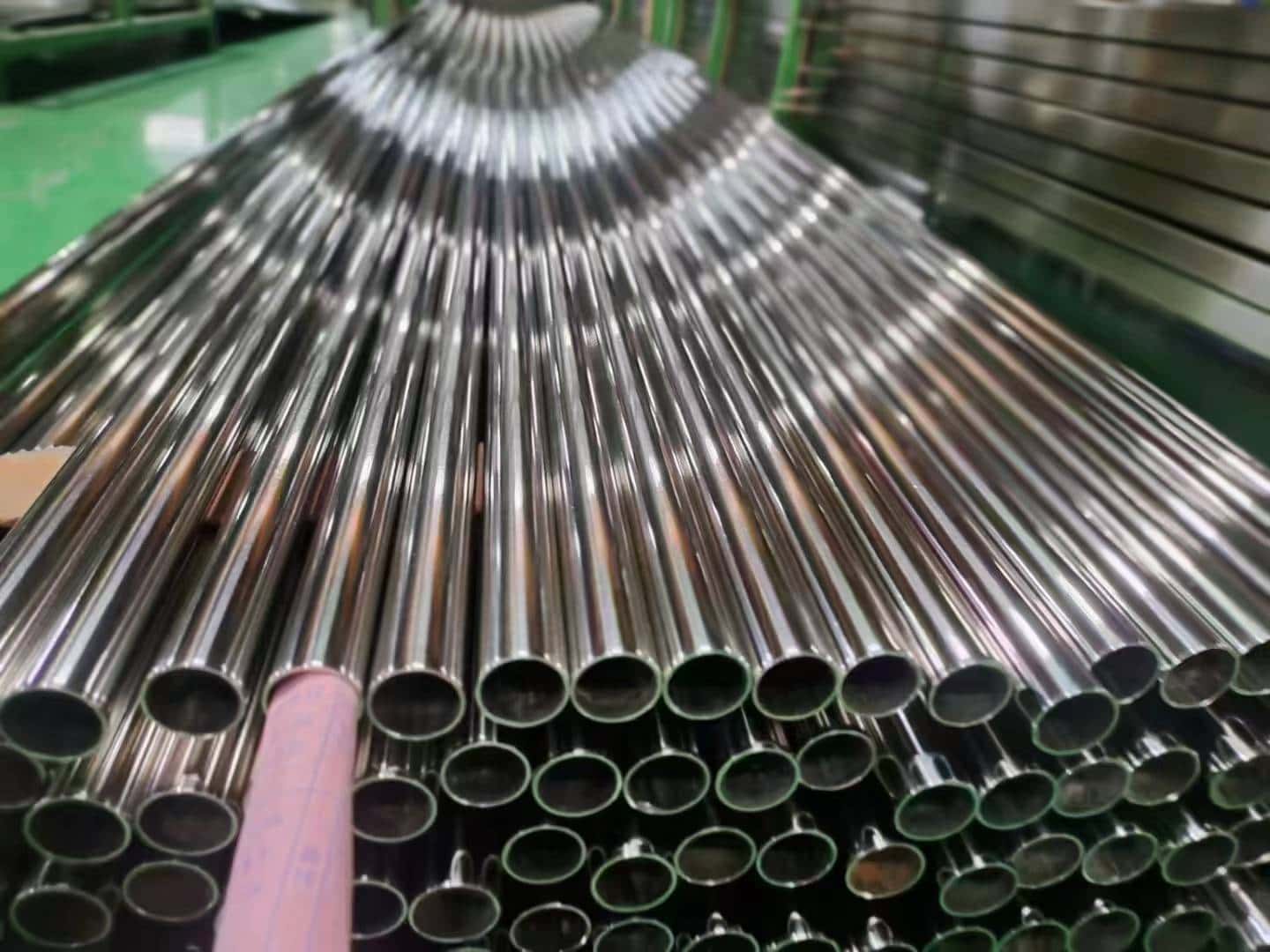

EN 10312:2002+A1:2005 is the European standard specifying technical delivery conditions for light-gauge welded stainless steel tubes intended for the conveyance of water and other aqueous liquids. Approved by CEN under committee ECISS/TC 29, the standard covers straight-length tubes from 6 mm to 267 mm outside diameter (OD) engineered for ambient-temperature plumbing, building service risers, and press-fit or compression jointing systems.
Crucial Regulatory Note on Drinking Water: Compliance with EN 10312 does not confer a presumption of fitness for water intended for human consumption under Directive 89/106/EEC. The standard states plainly that until a harmonized European Acceptance Scheme (EAS) is operational, products may only be used for drinking water if they comply with relevant national, regional, or local health regulations in the member state where installed.
1. Standard Scope, Applications, and Jointing Methods
EN 10312 establishes requirements for longitudinally welded stainless tubes:
- Application Scope: Light-gauge tubing primarily designed for building water systems and aqueous liquid conveyance at ambient temperatures. It is not intended for high-temperature pressure service (for industrial pressure piping, consult the EN 10217-7 welded tube guide).
- Size Coverage: Outside diameters from 6 mm to 267 mm in straight delivery lengths of 5 m or 6 m.
- Fittings and Jointing: Tube geometries are engineered for compression fittings, press fittings, adhesive bonding, silver brazing, or inert gas welding of capillary fittings.
- Allowed Materials: Stainless steel grades conforming to EN 10088-2, excluding martensitic and precipitation hardening grades. Annex A provides a preferred alloy list.
- Companion Standard: For non-alloy steel water pipes, the European companion standard is EN 10224.
2. Dimensional Series: Series 1 vs. Series 2
EN 10312 specifies two dimensional series:
- Series 1 (Table 1): Light-gauge tubes with outside diameters from 6 mm to 159 mm, wall thicknesses from 0.6 mm to 2.0 mm, and unilateral OD tolerances. Suitable for capillary, compression, and press fittings.
- Series 2 (Table 2): Heavier-gauge tubes with outside diameters from 12 mm to 267 mm and wall thicknesses from 1.0 mm to 3.0 mm. Suitable for compression and press fittings, but not capillary fittings.
Table 1: Dimensions and Tolerances for Series 1 Tubes
| Specified OD (mm) | Max OD (mm) | Min OD (mm) | Specified Wall T (mm) | Wall Thickness Tolerance |
|---|---|---|---|---|
| 6 | 6.04 | 5.94 | 0.6 | ±10% |
| 8 | 8.04 | 7.94 | 0.6 | ±10% |
| 10 | 10.04 | 9.94 | 0.6 | ±10% |
| 12 | 12.04 | 11.94 | 0.6 | ±10% |
| 15 | 15.04 | 14.94 | 0.6 | ±10% |
| 18 | 18.04 | 17.94 | 0.7 | ±10% |
| 22 | 22.05 | 21.95 | 0.7 | ±10% |
| 28 | 28.05 | 27.95 | 0.8 | ±10% |
| 35 | 35.07 | 34.97 | 1.0 | ±10% |
| 42 | 42.07 | 41.97 | 1.1 | ±10% |
| 54 | 54.07 | 53.84 | 1.2 | ±10% |
| 66.7 | 66.75 | 66.08 | 1.2 | ±10% |
| 76.1 | 76.30 | 75.54 | 1.5 | ±10% |
| (103)* | 103.8 | 102.2 | 1.5 | ±10% |
| 108 | 108.3 | 107.2 | 1.5 | ±10% |
| (128)* | 129.0 | 127.0 | 1.5 | ±10% |
| 133 | 133.5 | 132.2 | 1.5 | ±10% |
| (153)* | 154.5 | 151.5 | 1.5 | ±10% |
| 159 | 159.5 | 157.9 | 2.0 | ±10% |
*Parentheses denote non-preferred sizes. Out-of-roundness is included within outside diameter limits (Clause 8.8.4).
Table 2: Dimensions and Tolerances for Series 2 Tubes
| Specified OD (mm) | OD Tolerance (mm) | Specified Wall T (mm) | Wall Tolerance (mm) |
|---|---|---|---|
| 12.0 | ±0.10 | 1.0 | ±0.10 |
| 15.0 | ±0.10 | 1.0 | ±0.10 |
| 18.0 | ±0.10 | 1.0 | ±0.10 |
| 22.0 | ±0.11 | 1.2 | ±0.10 |
| 28.0 | ±0.14 | 1.2 | ±0.10 |
| 35.0 | ±0.18 | 1.5 | ±0.10 |
| 42.0 | ±0.21 | 1.5 | ±0.10 |
| 54.0 | ±0.27 | 1.5 | ±0.10 |
| 64.0 | ±0.32 | 2.0 | ±0.15 |
| 76.1 | ±0.38 | 2.0 | ±0.15 |
| 88.9 | ±0.44 | 2.0 | ±0.15 |
| 108.0 | ±0.54 | 2.0 | ±0.15 |
| 133.0 | ±1.00 | 3.0 | ±0.30 |
| 159.0 | ±1.00 | 3.0 | ±0.30 |
| 219.0 | ±1.50 | 3.0 | ±0.30 |
| 267.0 | ±1.50 | 3.0 | ±0.30 |
For standard metric tube tolerance classes across broader applications, see EN ISO 1127 stainless steel tube dimensions and tolerances.
3. Fitting Suitability and Jointing Guidelines (Annex B)
Annex B details fitting suitability for each series:
| Tube Series | Capillary Fittings | Compression Fittings | Press Fittings |
|---|---|---|---|
| Series 1 | Yes (Series 1 OD may also use Series 2 wall thickness) | Yes | Yes (care required to avoid wall damage during pressing) |
| Series 2 | No | Yes | Yes |
Press-fit systems crimp an external fitting with an elastomeric seal over the tube end. The lighter wall of Series 1 requires precision pressing tools to ensure leak tightness without bore distortion.
4. Manufacture and Delivery Condition (Clause 7)
EN 10312 mandates specific manufacturing rules:
- Welding Route (Clause 7.2): Formed from flat-rolled stainless strip, longitudinally welded without the addition of filler material. No transverse strip-joining welds are permitted.
- Delivery Condition (Clause 7.2): Tubes are supplied in the as-welded condition as standard. Under Option 1, tubes are supplied solution annealed (for austenitic/duplex grades) or annealed (for ferritic grades), with hardness criteria agreed upon ordering.
- Weld Seam Finish (Clause 8.8.6): The external weld bead shall be removed flush with the tube profile. The internal weld bead remains as-welded unless Option 5 is specified.
- Surface Quality (Clause 8.5.1): Tubes must feature a smooth, bright surface free from visually detectable defects. Heat discoloration in the weld area must be kept to a minimum.
- Fire Classification (Clause 8.9): Classified as Class A1 reaction to fire per Commission Decision 96/603/EEC without requiring testing.
5. Mechanical, Technological, and Leak-Tightness Testing (Clause 11)
Testing is conducted per test unit (≤400 tubes of identical grade and size, Clause 10):
- Tensile Test (Clause 11.2, EN 10002-1): Verifies Rm, Rp0.2 (and Rp1.0 for austenitic grades), and elongation A on gauge length 5.65√So.
- Drift Expanding Test (Clause 11.3.1, EN 10234): Austenitic and duplex tubes are flared over a 60° cone until outside diameter expands by +25% without cracking.
- Flattening Test (Clause 11.3.2, EN 10233): Austenitic and duplex tubes are flattened between parallel platens to 5T (5 × wall thickness) with the weld at 90° to load direction, showing no cracks.
- Leak-Tightness Testing (Clause 11.4): Each tube must be verified by one of three methods:
- Eddy Current Test (Clause 11.4.2): Per EN 10246-1 (ferromagnetic) or EN 10246-2 (austenitic/duplex).
- Hydrostatic Test (Clause 11.4.3): Minimum 50 bar for OD ≤ 76.1 mm; minimum 30 bar for OD > 76.1 mm (leak-tightness test, not a strength test; no leakage or visible deformation).
- Pneumatic Test (Clause 11.4.4): Air under water at minimum 6 bar with no bubble leakage.
- Full-Length Weld Seam NDT (Clause 8.5.2 & 11.5): The entire weld seam undergoes non-destructive testing per EN 10246-3 level E4(H) or EN 10246-8 level U4.
- Material Identification (Clause 11.9): Each tube is verified by positive alloy testing to confirm correct grade.
- Intergranular Corrosion (Clause 8.4): Performed per EN ISO 3651-1 or -2 only when Option 2 is ordered.
6. Straightness, Length, and End Tolerances
Dimensional controls ensure compatibility with plumbing fittings:
- Overall Straightness (Clause 8.6): Deviation across total length L must not exceed 0.0015 × L (0.15% of length).
- Local Straightness: Over any 1 m span, deviation is ≤ 3 mm for Series 1; for Series 2, ≤ 2 mm for 12 mm < D < 128 mm and ≤ 2.5 mm for D ≥ 128 mm.
- Delivery Lengths (Clause 8.8.3 & 8.8.7): Standard lengths are 5 m or 6 m with a tolerance of ±20 mm (Option 4 allows custom lengths).
- Tube Ends (Clause 8.7): Square cut and free from harmful burrs.
- Diameter Measurement (Clause 11.7): Outside diameter is measured ≥ 10 mm and ≤ 3D from the tube end.
7. Preferred Stainless Steel Grades (Annex A)
Annex A lists preferred European grades from EN 10088-2:
- Ferritic Grades: X3CrTi17 (1.4510), X3CrNb17 (1.4511), and molybdenum-alloyed X2CrMoTi18-2 (1.4521). Ferritics provide resistance to chloride stress corrosion cracking in hot water.
- Austenitic Standard Grades: X2CrNi18-9 (1.4307), X2CrNi19-11 (1.4306), and X5CrNi18-10 (1.4301).
- Austenitic Molybdenum Grades: X2CrNiMo17-12-2 (1.4404), X5CrNiMo17-12-2 (1.4401), stabilized X6CrNiMoTi17-12-2 (1.4571), X2CrNiMo17-12-3 (1.4432), X3CrNiMo17-13-3 (1.4436), and X2CrNiMo18-14-3 (1.4435).
- High-Alloy Austenitics: X2CrNiMoN17-13-5 (1.4439), X1NiCrMoCu25-20-5 (1.4539), X1CrNiMoCuN20-18-7 (1.4547), and X1NiCrMoCuN20-20-7 (1.4529).
- Duplex Grades: Lean duplex X2CrNiN23-4 (1.4362) and standard duplex X2CrNiMoN22-5-3 (1.4462).
For dairy and food processing lines, compare these with the DIN 11850 food and beverage tube standard.
8. Purchaser Options 1–9 and Ordering Specification
Clause 6.2 provides 9 standardized options:
| Option | Designation | Technical Delivery Requirement |
|---|---|---|
| Option 1 | Heat-Treated Condition | Tubes supplied annealed or solution annealed with agreed hardness. |
| Option 2 | IGC Testing | Intergranular corrosion test performed per EN ISO 3651-1 or -2. |
| Option 3 | Fitting Suitability | Special verification for capillary, compression, or press fittings. |
| Option 4 | Custom Lengths | Specified lengths other than standard 5 m or 6 m. |
| Option 5 | Internal Bead Removal | Internal weld seam bead removed flush with inner surface. |
| Option 6 | Specific Inspection | Specific inspection issuing an Inspection Certificate 3.1.B (EN 10204). |
| Option 7 | Leak-Tightness Method | Purchaser selects eddy current, hydrostatic, or pneumatic testing. |
| Option 8 | Label Marking | Marking placed on an attached bundle label rather than on each tube. |
| Option 9 | End Protection | Protective end caps or plugs fitted to preserve cleanliness. |
Example Order Line (Clause 6.3)
1000 m tube — series 1 76.1 × 1.5 — EN 10312 X5CrNi18-10 — 6 — option 8Specifies 1,000 meters of Series 1 tube, 76.1 mm OD × 1.5 mm wall, grade X5CrNi18-10 (1.4301), in 6 m lengths, with bundle label marking per Option 8.
9. Inspection Documents: Test Report 2.2 vs. Certificate 3.1.B
Clause 9 governs inspection documentation per EN 10204:
- Default Non-Specific Inspection: Deliveries are covered by a Test Report 2.2 per EN 10204, confirming compliance based on non-specific factory production control.
- Option 6 Specific Inspection: When Option 6 is specified, an Inspection Certificate 3.1.B (EN 10204:2004 3.1) is issued with verified chemical analysis, tensile, drift expansion, flattening, and NDT test records. For compliance details, see our EN 10204 3.1 mill test certificate guide.
10. TeCarve Supply Range
TeCarve is the exclusive factory-direct export channel for two dedicated manufacturing plants in Foshan (welded & decorative tubing) and Wenzhou (seamless & precision tubing):
- Production Scope: EN 10312 is among the standards listed on our welded stainless steel pipe and tube product page.
- Water Treatment Plant Sourcing: System guidance is detailed in our guide on stainless steel pipe for water treatment industry.
- Size Range: The welded product page lists TIG, plasma, laser and ERW welded pipe and tube with outer diameters from 6 mm to 4200 mm, wall thicknesses from 0.5 mm to 120 mm and lengths up to 12 m.
- Testing: Hydrostatic or nondestructive electric testing, with eddy-current or radiographic examination where required, as listed on the welded product page. For EN 10312 orders, the leak-tightness method and weld seam NDT follow Clauses 11.4 and 11.5.
- Quality Certification: EN 10204 3.1 inspection certificates are provided with shipments; EN 10204 3.2 witnessed inspections (SGS, BV, TÜV) are available upon request.
- Plant Accreditations: Quality management and pressure equipment approvals (ISO 9001/14001/45001, PED/AD 2000-Merkblatt W0, and marine classification society type approvals) are held by the plants — see https://tecarvepipes.com/verify-our-factories/.
- Regulatory Clarification: Generic tubing stock does not carry unilateral European potable certificates (e.g., WRAS, DVGW); local potable compliance must be verified per project regulations.
Frequently Asked Questions (FAQ)
Does EN 10312 compliance automatically certify a tube for drinking water?
No. Compliance does not confer a presumption of fitness for potable water under Directive 89/106/EEC. Relevant national or local regulations in the place of use govern drinking-water suitability.
What is the practical difference between Series 1 and Series 2 tubes?
Series 1 features lighter walls (0.6–2.0 mm) suited for capillary, compression, and press fittings. Series 2 has heavier walls (1.0–3.0 mm) suited for compression and press fittings, but not capillary fittings.
Is filler metal permitted during the welding of EN 10312 tubes?
No. Clause 7.2 requires longitudinal welding without the addition of filler material. Transverse strip-joining welds are prohibited.
How is the weld seam finished on EN 10312 tubes?
Clause 8.8.6 requires the external weld seam to be removed flush with the surface. The internal weld bead remains unless Option 5 is specified.
What leak-tightness test pressure is required for EN 10312?
Under Clause 11.4.3, hydrostatic testing requires minimum 50 bar for OD ≤ 76.1 mm and 30 bar for OD > 76.1 mm. Pneumatic air-under-water testing requires minimum 6 bar.
What inspection certificate is provided under EN 10312?
The default is a non-specific Test Report 2.2 per EN 10204. Under Option 6, a specific Inspection Certificate 3.1.B (EN 10204 3.1) is issued with verified test records.